




Where Will Oracle Be in 2 Years?
Key Points
Oracle is converting its massive backlog into revenue, which should accelerate growth in the next couple of years.
The company's earnings growth potential and valuation suggest it is likely to deliver healthy gains for investors.
- 10 stocks we like better than Oracle ›
Shares of Oracle (NYSE: ORCL) have retreated 48% in the past six months, driven by concerns that the company is spending way too much to build artificial intelligence (AI) infrastructure.
Oracle's decision to take on debt to fund the infrastructure buildout, along with its reliance on AI start-up OpenAI for a significant chunk of its backlog, has weighed on its shares in recent months. However, on March 10, Oracle stock received a nice shot in the arm after the company announced solid results for its fiscal 2026's third quarter (ended Feb. 28).
Will AI create the world's first trillionaire? Our team just released a report on the one little-known company, called an "Indispensable Monopoly" providing the critical technology Nvidia and Intel both need. Continue »
Let's see why that was the case, and if the stock could go on a bull run from here and make investors richer over the next couple of years.
Image source: Getty Images.
Oracle's smart infrastructure strategy is reaping rewards
Oracle's cloud infrastructure business is growing at a terrific pace. The company has been signing massive contracts with customers looking to run AI workloads in the cloud, and its backlog now stands at $553 billion. Oracle posted a 325% year-over-year increase in its remaining performance obligations (RPO) last quarter, which was much faster than the 22% year-over-year increase in its revenue to $17.2 billion.
Oracle now needs to convert its RPO, which is the total value of contracts yet to be fulfilled at the end of a quarter, into revenue by building more data centers. That's why the company intends to raise $50 billion in debt and equity funding this year. Importantly, Oracle has already raised $30 billion of its target by issuing convertible preferred stock and bonds.
Of course, the funding is going to negatively impact the cash flow, as it will have to cover the interest on the debt it is issuing. But Oracle has a big enough backlog to justify its financing moves. Additionally, Oracle now has a bring-your-own hardware model and is taking upfront payments from customers to build AI infrastructure.
This strategy has started bearing fruit for the company, as it signed $29 billion in contracts using this model last quarter. The model should allow Oracle to continue expanding its infrastructure while simultaneously reducing pressure on its cash flow. Additionally, Oracle's infrastructure expansion led to an 84% year-over-year increase in its cloud infrastructure revenue last quarter to $4.9 billion.
The company can therefore substantially accelerate its revenue and earnings growth over the next two years, driven by the massive demand for AI compute and its smart strategy of building more data centers through customer-funded hardware and advance payments.
How much upside can investors expect in the next two years?
Oracle has guided for $67 billion in revenue in fiscal 2026 (which will end in May this year). It has increased its fiscal 2027 revenue guidance to $90 billion, which points toward a 34% increase over the current year. Even better, the company's aggressive expansion is likely to lead to a bigger jump in fiscal 2028.
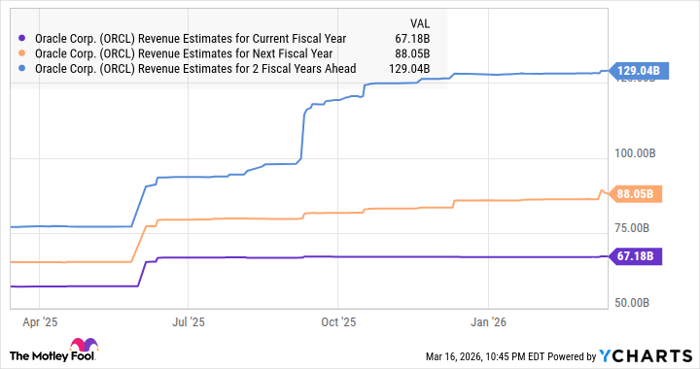
ORCL Revenue Estimates for Current Fiscal Year data by YCharts
Importantly, Oracle's bottom-line growth is also anticipated to accelerate.
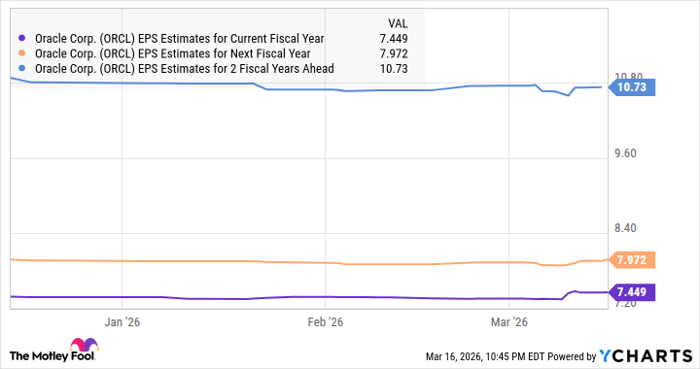
ORCL EPS Estimates for Current Fiscal Year data by YCharts
That won't be surprising, considering Oracle's smart infrastructure buildout strategy. Assuming Oracle's earnings reach $10.73 per share in fiscal 2028 and it trades at 24.5 times earnings at that time (in line with the tech-focused Nasdaq-100 index's forward earnings multiple), its stock price could jump nearly 68% from current levels to $263.
All this makes Oracle a top AI stock to buy right now, especially considering that it trades at just 19 times forward earnings.
Should you buy stock in Oracle right now?
Before you buy stock in Oracle, consider this:
The Motley Fool Stock Advisor analyst team just identified what they believe are the 10 best stocks for investors to buy now… and Oracle wasn’t one of them. The 10 stocks that made the cut could produce monster returns in the coming years.
Consider when Netflix made this list on December 17, 2004... if you invested $1,000 at the time of our recommendation, you’d have $494,747!* Or when Nvidia made this list on April 15, 2005... if you invested $1,000 at the time of our recommendation, you’d have $1,094,668!*
Now, it’s worth noting Stock Advisor’s total average return is 911% — a market-crushing outperformance compared to 186% for the S&P 500. Don't miss the latest top 10 list, available with Stock Advisor, and join an investing community built by individual investors for individual investors.
See the 10 stocks »
*Stock Advisor returns as of March 20, 2026.
Harsh Chauhan has no position in any of the stocks mentioned. The Motley Fool has positions in and recommends Oracle. The Motley Fool has a disclosure policy.
Recommended Articles


