




New CEO Greg Abel Just Gave Wall Street an Undeniable Signal About Berkshire Hathaway Stock. It Couldn't Be Any Clearer.
Key Points
New Berkshire Hathaway CEO Greg Abel did two things in March that should give shareholders confidence in Berkshire Hathaway stock.
The stock has been in transition since former Warren Buffett said he would step down from the CEO role last year.
- 10 stocks we like better than Berkshire Hathaway ›
When it comes to investing in the stock market, talk is often cheap. Forecasts from management teams are often viewed skeptically, and shareholders are typically not enthusiastic about buying a stock if they don't see a management team with skin in the game.
That said, when management or a chief executive officer does purchase a material amount of their company's stock, it can be viewed as a strong signal to shareholders that management is confident in what they are doing. Why else burn their own money?
Will AI create the world's first trillionaire? Our team just released a report on the one little-known company, called an "Indispensable Monopoly" providing the critical technology Nvidia and Intel both need. Continue »
Recently, new Berkshire Hathaway (NYSE: BRKA) (NYSE: BRKB) CEO Greg Abel sent Wall Street an undeniable signal about the company's stock. It couldn't be any clearer.
Double-dipping
Abel took the reins of Berkshire at the start of this year, stepping into the big shoes left by Warren Buffett, who ran the sprawling conglomerate for roughly six decades and is widely considered the best value investor of all time. During his tenure, Buffett turned Berkshire into one of the largest insurance companies in the U.S. and built huge businesses in energy and mortgages, among others.
Image source: The Motley Fool.
Buffett also increased Berkshire's stock portfolio to more than $300 billion in total value and built up a hoard of cash and short-term U.S. Treasury bonds, valued at close to $370 billion at the end of 2025.
Despite leaving the company in strong shape, Berkshire's stock has not been a great performer recently since Buffett announced his retirement. The stock has declined about 7% during the past year while the S&P 500 index rose almost 17%.
Although nobody expects Abel to be another Buffett, the Oracle of Omaha handpicked Abel to succeed him. Abel previously served as the chairman and CEO of Berkshire Hathaway Energy.
As the year kicked off, Abel became more visible, first with an 18-page letter to shareholders that outlined how he plans to run the company. Soon after that, Abel gave Wall Street an undeniable signal that couldn't have been clearer.
In early March, Abel plowed $15 million of his own money into Berkshire stock, an amount equivalent to his after-tax annual salary. Berkshire also said on the same day that it would resume share repurchases for the first time since 2024, and it bought back $225 million worth of stock on March 4. This is a clear sign to investors that Abel views Berkshire stock as undervalued.
Following in Buffett's footsteps
These moves aligns with Buffett's philosophy of putting your money where your mouth is. Buffett only received an annual salary of $100,000 from Berkshire, which also does not issue stock options to employees. Most of Buffett's wealth was made by owning Berkshire stock. As of mid-2025, Buffett owned more than 37% of Berkshire's Class A shares and held a total stake valued at roughly $149 billion, according to CNBC.
In his first annual letter to shareholders, Abel said the company's share repurchase policy remains unchanged; the company will conduct share repurchases when management believes the market value of Berkshire Hathaway trades for less than its perceived intrinsic value.
In fact, if you look at Berkshire's market price to its tangible book value (TBV), the stock currently trades at a lower valuation than its five-year historic average. TBV is essentially a measure of a company's equity after subtracting its intangible assets and goodwill and represents the value of a company in a theoretical liquidation scenario. Valuing companies based on their TBV is a frequent way investors value bank and insurance stocks.
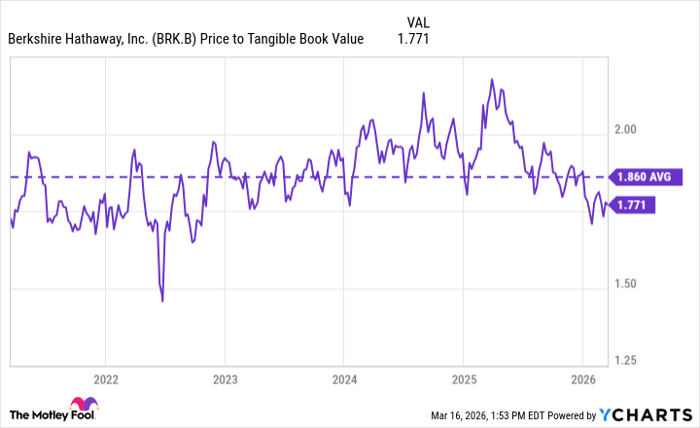
BRK.B Price to Tangible Book Value data by YCharts
A good sign for shareholders
When Buffett announced his retirement at Berkshire's annual meeting last year, it definitely caught the market off guard and caused some angst among investors. Buffett gave the stock a premium valuation because of his superb track record over six decades, during which Berkshire Hathaway's stock trounced the broader market's returns.
Once it became clear that Abel, while more than capable as a leader, would not be given that same premium and would have to show the market he could lead Berkshire into the future without Buffett.
Although change at Berkshire is likely in the future, I think it's a good sign that, so far, Abel is following many of the same principles that made Buffett into the legend he is today and Berkshire into one of the strongest companies in the world.
Should you buy stock in Berkshire Hathaway right now?
Before you buy stock in Berkshire Hathaway, consider this:
The Motley Fool Stock Advisor analyst team just identified what they believe are the 10 best stocks for investors to buy now… and Berkshire Hathaway wasn’t one of them. The 10 stocks that made the cut could produce monster returns in the coming years.
Consider when Netflix made this list on December 17, 2004... if you invested $1,000 at the time of our recommendation, you’d have $510,710!* Or when Nvidia made this list on April 15, 2005... if you invested $1,000 at the time of our recommendation, you’d have $1,105,949!*
Now, it’s worth noting Stock Advisor’s total average return is 927% — a market-crushing outperformance compared to 186% for the S&P 500. Don't miss the latest top 10 list, available with Stock Advisor, and join an investing community built by individual investors for individual investors.
See the 10 stocks »
*Stock Advisor returns as of March 20, 2026.
Bram Berkowitz has no position in any of the stocks mentioned. The Motley Fool has positions in and recommends Berkshire Hathaway. The Motley Fool has a disclosure policy.
Recommended Articles


