




Prediction: Nvidia Stock Will Be Worth This Much in 2 Years
Key Points
Nvidia's new Vera Rubin data center chips for AI workloads offer more performance and better cost efficiency than its industry-leading Blackwell chips.
The Vera Rubin platform is likely to drive an acceleration in the company's revenue and earnings growth during its current fiscal year.
Nvidia stock could double, and potentially even triple, over the next two years.
- 10 stocks we like better than Nvidia ›
Nvidia (NASDAQ: NVDA) supplies the world's best graphics processing units (GPUs) for the data center, which are the primary chips used in artificial intelligence (AI) development. The company has an incredible amount of pricing power right now because demand continues to outstrip supply, which is driving a surge in its revenue and earnings.
Nvidia will start shipping its next generation of AI chips in the second half of this year. They are based on its new Vera Rubin architecture, which offers substantial improvements in performance and cost relative to its industry-leading Blackwell architecture.
Will AI create the world's first trillionaire? Our team just released a report on the one little-known company, called an "Indispensable Monopoly" providing the critical technology Nvidia and Intel both need. Continue »
Vera Rubin chips are expected to fuel an acceleration in Nvidia's revenue and earnings, which could translate into significant returns for the company's shareholders. Here's where I predict Nvidia stock will be in two years.
Image source: Nvidia.
Vera Rubin could be Nvidia's most sought-after AI platform yet
Nvidia's GB300 GPU, which is based on its Blackwell Ultra architecture, is the most in-demand AI data center chip on the market right now. When configured in Nvidia's NVLink 72 data center rack, the GB300 offers up to 50 times more performance than the company's original AI data center chip, the H100, which was introduced in 2022. Greater performance can translate into more powerful AI models, and it can also lower costs by accelerating development timelines.
The Vera Rubin platform includes the Rubin GPU, the Vera CPU, the new NVLink 6 switches, and other networking hardware. Nvidia says it's so powerful that developers will be able to run the same AI training workloads with 75% fewer GPUs compared to Blackwell. Serving AI software to users will also be substantially cheaper, because Rubin reduces inference token costs by a staggering 90%.
Inference tokens are consumed when an AI model ingests an input from a user and generates an output in response. They can be words, images, or even videos, and they cost money to produce, which is why most AI companies charge their customers based on their usage rates.
Reducing inference token costs will achieve two things: First, it will make AI more affordable to use, thus boosting adoption, and second, it will improve profit margins for AI companies, giving them more money to fund additional infrastructure spending. This flywheel effect should, in theory, fuel more demand for Nvidia's chips over time.
Nvidia's growth is poised to accelerate
Nvidia delivered $215.9 billion in revenue during fiscal 2026 (ended Jan. 25), which was up 65% from the prior year. Its data center business alone brought in $193.7 billion, which was a 68% increase.
According to Wall Street's consensus estimate (provided by Yahoo! Finance), Nvidia could generate $367.7 billion in total revenue during fiscal 2027 (its current fiscal year), which would represent an accelerated growth rate of 70%. Most of that revenue is likely to come from the data center business yet again, given the incredible demand for AI chips.
At the bottom line, Wall Street analysts predict Nvidia's earnings will soar by 73% to $8.25 per share in fiscal 2027, accelerating from the company's fiscal 2026 earnings growth of 60%. Commercial quantities of Vera Rubin chips are expected to ship to customers in the second half of this calendar year, so they will play a central role in bringing analysts' forecasts to life.
Nvidia could be worth this much in two years
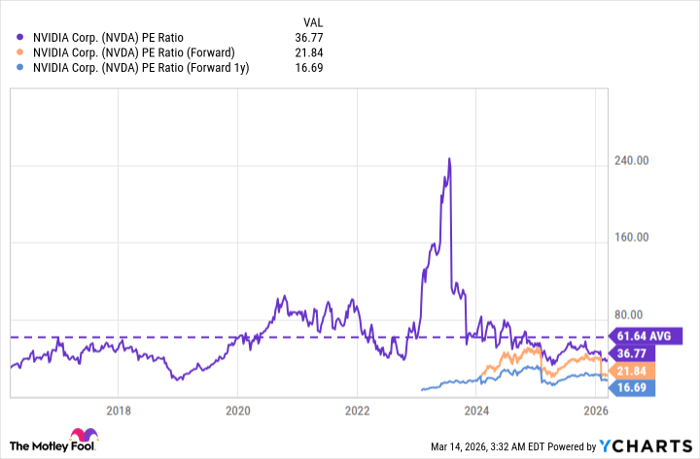
Based on Nvidia's fiscal 2026 earnings of $4.77 per share, its stock trades at a price-to-earnings (P/E) ratio of 37.2. That is a hefty discount to its 10-year average of 61.6, suggesting the stock might be undervalued right now.
The stock looks even cheaper on a forward basis. If we assume Nvidia will produce earnings of $8.25 per share during fiscal 2027 as Wall Street expects, then its forward P/E ratio is 21.8. Analysts believe the company will then deliver earnings of $10.80 per share in fiscal 2028, translating to a forward P/E ratio of 16.7.
NVDA PE Ratio data by YCharts.
Those forecasts suggest Nvidia stock will have to climb by 120% over the next two years just to maintain its current P/E ratio of 36.7, and by a whopping 269% if its stock were to trade in line with its 10-year average P/E of 61.6. Those potential gains imply a stock price of between $396 and $664 in two years from now, and an eye-popping market capitalization of between $9.6 trillion and $16.2 trillion.
Nvidia CEO Jensen Huang thinks AI infrastructure spending will reach $4 trillion per year by 2030, as data center operators race to meet demand for computing capacity from AI developers. Therefore, Nvidia stock could be poised for even more upside beyond the next two years.
Should you buy stock in Nvidia right now?
Before you buy stock in Nvidia, consider this:
The Motley Fool Stock Advisor analyst team just identified what they believe are the 10 best stocks for investors to buy now… and Nvidia wasn’t one of them. The 10 stocks that made the cut could produce monster returns in the coming years.
Consider when Netflix made this list on December 17, 2004... if you invested $1,000 at the time of our recommendation, you’d have $508,877!* Or when Nvidia made this list on April 15, 2005... if you invested $1,000 at the time of our recommendation, you’d have $1,115,328!*
Now, it’s worth noting Stock Advisor’s total average return is 936% — a market-crushing outperformance compared to 189% for the S&P 500. Don't miss the latest top 10 list, available with Stock Advisor, and join an investing community built by individual investors for individual investors.
See the 10 stocks »
*Stock Advisor returns as of March 19, 2026.
Anthony Di Pizio has no position in any of the stocks mentioned. The Motley Fool has positions in and recommends Nvidia. The Motley Fool has a disclosure policy.
Recommended Articles


