




Is the S&P 500 Headed for a Correction?
Key Points
The S&P 500 faces a potential triple whammy right now.
However, investors still have some reasons to be optimistic.
Even if the S&P 500 enters correction territory, it could present a great buying opportunity.
- 10 stocks we like better than S&P 500 Index ›
Uncertainty reigns over the stock market right now. The market's "fear gauge" -- the CBOE S&P 500 Volatility Index (VIX) -- has soared more than 50% year to date.
I wrote recently that it's starting to look like 1973 all over again. One of the worst stock market crashes ever occurred that year, after several Middle Eastern nations imposed an embargo on oil shipments to the U.S.
Will AI create the world's first trillionaire? Our team just released a report on the one little-known company, called an "Indispensable Monopoly" providing the critical technology Nvidia and Intel both need. Continue »
To be sure, I don't predict a stock market crash in 2026. But is the S&P 500 (SNPINDEX: ^GSPC) headed for a correction? That's another story altogether.

Image source: Getty Images.
A triple whammy
The S&P 500 only enters correction territory (usually defined as a decline of at least 10% from a previous peak) when investors are worried. And there's plenty for investors to worry about these days. I'd even say the market faces a potential triple whammy.
You can watch the news at pretty much any time of the day to be updated on the most imminent threat to the stock market. I'm referring, of course, to the ongoing conflict between the U.S. (along with Israel) and Iran. Oil prices have soared, raising fears about resurging inflation. The likelihood of further rate cuts by the Federal Reserve has declined as a result. Moody's Chief Economist Mark Zandi posted on X (formerly Twitter) that the risk of recession has jumped significantly.
Recession is once again a serious threat. Even before the recent disconcerting events in the Middle East, our machine learning based leading economic indicator model put the probability of a recession starting in the next 12 months at an uncomfortably high 49%. Behind the recent... pic.twitter.com/OUYhJClQyR
-- Mark Zandi (@Markzandi) March 16, 2026
Another legitimate concern is the stock market's valuation. The S&P 500 Shiller CAPE ratio, widely considered as one of the best market valuation metrics, is near its second-highest level since 2000 -- right before the dot-com bubble burst.
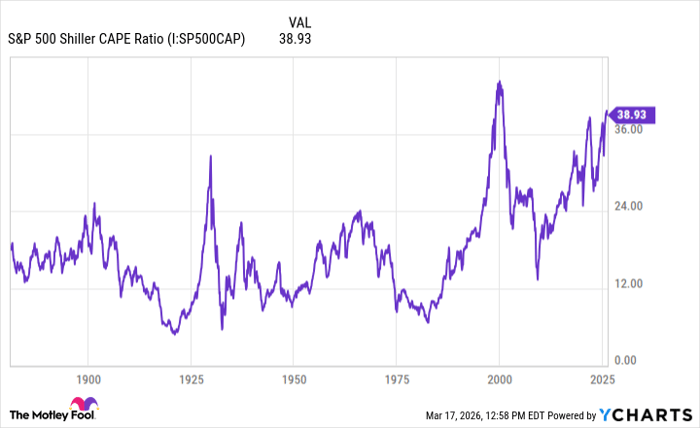
S&P 500 Shiller CAPE Ratio data by YCharts
What's the third component of the potential triple whammy? The market is highly concentrated in only a few stocks. Six of the so-called "Magnificent Seven" stocks make up roughly 31% of the S&P 500. If one of these artificial intelligence (AI) darlings has a misstep that investors view as troubling for the broader group, the index could easily enter a correction.
Reasons to be optimistic
So far, the S&P 500 is holding up quite well amid the uncertainty. The index has yet to fall more than 5% below its previous high.
Corporate earnings also remain strong. Most S&P 500 companies beat earnings estimates with their fourth-quarter results.
There are signs that AI investments could be paying off. Boston Consulting Group conducted a study last year that found AI leaders are achieving 1.7 times higher revenue growth and 3.6 times higher total shareholder return than AI laggards. Several major companies have announced staffing cuts in recent months linked to increased productivity from AI.
J.P. Morgan (NYSE: JPM) Global Research thinks we're in an "AI-driven supercycle." Dubravko Lakos-Bujas, head of the company's global markets strategy, believes that "this momentum is spreading geographically and across a diverse list of industries, from technology and utilities to banks, healthcare, and logistics."
Is a correction coming?
Despite the reasons for optimism, I suspect that we could see an S&P 500 correction in the not-too-distant future. Stock market corrections are much more common than crashes. The S&P 500 entered into correction territory as recently as 2025.
However, a correction could actually be good news for forward-looking investors. Last year's S&P 500 correction led to the index ultimately delivering a 16% annual gain. Could history repeat itself? It's a definite maybe.
Should you buy stock in S&P 500 Index right now?
Before you buy stock in S&P 500 Index, consider this:
The Motley Fool Stock Advisor analyst team just identified what they believe are the 10 best stocks for investors to buy now… and S&P 500 Index wasn’t one of them. The 10 stocks that made the cut could produce monster returns in the coming years.
Consider when Netflix made this list on December 17, 2004... if you invested $1,000 at the time of our recommendation, you’d have $508,877!* Or when Nvidia made this list on April 15, 2005... if you invested $1,000 at the time of our recommendation, you’d have $1,115,328!*
Now, it’s worth noting Stock Advisor’s total average return is 936% — a market-crushing outperformance compared to 189% for the S&P 500. Don't miss the latest top 10 list, available with Stock Advisor, and join an investing community built by individual investors for individual investors.
See the 10 stocks »
*Stock Advisor returns as of March 19, 2026.
JPMorgan Chase is an advertising partner of Motley Fool Money. Keith Speights has no position in any of the stocks mentioned. The Motley Fool has positions in and recommends JPMorgan Chase. The Motley Fool has a disclosure policy.
Recommended Articles


