




2 Energy Stocks That Could Be Bigger Winners Than Crude Oil
Key Points
Geopolitical risks in the Persian Gulf are impacting energy and fertilizer markets.
LNG and fertilizer supply chains are vulnerable to disruptions and also could see potentially long-term damage to the energy infrastructure that produces them.
- 10 stocks we like better than CF Industries ›
With the Strait of Hormuz currently closed and the threat of ongoing attacks on energy infrastructure in the Persian Gulf and the Gulf of Oman, and the price of oil almost $100 a barrel at the time of writing, investors have inevitably started looking at which energy-related stocks might help protect a portfolio from headline risk. I have two ideas.
Headline risk is rising
It's important to pause for a few seconds and consider the bigger picture. For example, the obvious way to invest in such an environment is to buy U.S. oil producers that will benefit from higher prices without facing supply issues. Moving beyond that, there's also the potential for structural damage to energy infrastructure in the Gulf and the instability's impact on the willingness or cost of investing in energy assets in the region.
Will AI create the world's first trillionaire? Our team just released a report on the one little-known company, called an "Indispensable Monopoly" providing the critical technology Nvidia and Intel both need. Continue »

Image source: Getty Images.
Oil captures the headlines, and understandably so, because according to the International Energy Agency (IEA), 34% of global crude oil trade went through the Strait in 2025. Still, according to the U.S. Energy Information Administration (EIA), 20% of global liquefied natural gas (LNG) flows through the Strait , and LNG flowing through the Strait accounts for 27% of Asia's LNG imports.
It gets worse. Natural gas is the primary raw material used to make fertilizers such as urea and ammonium nitrate, and fertilizer prices have soared this year. Countries like India, China, and Australia are highly reliant on fertilizers or materials (sulfur) used to make fertilizers that pass through the Strait.
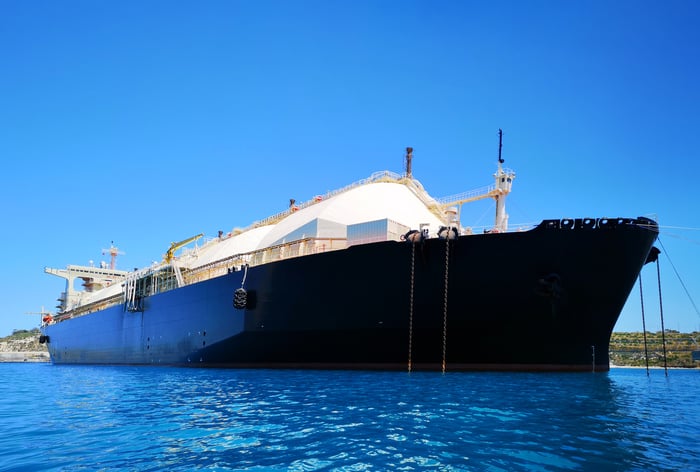
Image source: Getty Images.
Two stocks to buy
From these observations, it's clear that buying U.S.-focused producers of raw materials used to make fertilizers, such as CF Industries (NYSE: CF), makes sense. The company has six manufacturing facilities in the U.S., two in Canada, and one in the U.K. It's the world's largest producer of ammonia (used to make fertilizers) and a major producer of urea.
Its access to North American gas means it's not exposed to supply instability, and it's well placed to help fill the gap created by the lack of fertilizer coming through the Strait.
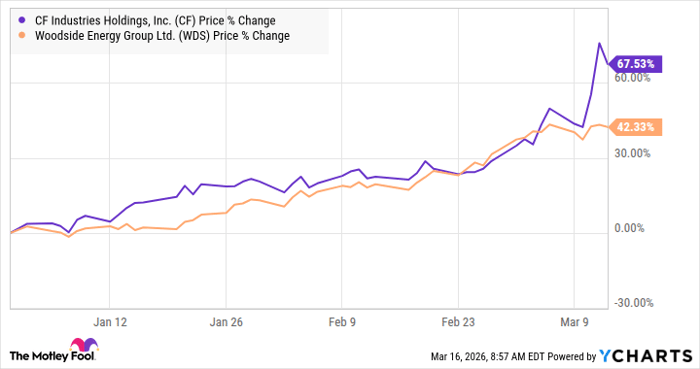
As you can see below, CF Industries' share price has surged (alongside Australia's Woodside Energy Group (NYSE: WDS)) amid mounting tensions, and investors might want to wait for a better entry point. Still, if the issues around tight fertilizer supply persist, CF Industries has significant upside potential. With the current market at $19.3 billion and $1.8 billion in free cash flow generated in 2025, CF Industries remains a decent value for investors concerned about persistent conflict in the Gulf.
CF data by YCharts
U.S. investors can buy shares in Woodside via a U.S. listing. The Australian company is a major LNG producer with assets in Western Australia that are ideally suited to supplying Asia with LNG. In fact, the company secured six new long-term supply agreements for its LNG in Asia and Europe in 2025 alone.
While other LNG producers can fill the current gap created by the closure of the Strait, Woodside is also ideally positioned to benefit in the long term from any structural shift in how Asia sources LNG.
Should you buy stock in CF Industries right now?
Before you buy stock in CF Industries, consider this:
The Motley Fool Stock Advisor analyst team just identified what they believe are the 10 best stocks for investors to buy now… and CF Industries wasn’t one of them. The 10 stocks that made the cut could produce monster returns in the coming years.
Consider when Netflix made this list on December 17, 2004... if you invested $1,000 at the time of our recommendation, you’d have $508,877!* Or when Nvidia made this list on April 15, 2005... if you invested $1,000 at the time of our recommendation, you’d have $1,115,328!*
Now, it’s worth noting Stock Advisor’s total average return is 936% — a market-crushing outperformance compared to 189% for the S&P 500. Don't miss the latest top 10 list, available with Stock Advisor, and join an investing community built by individual investors for individual investors.
See the 10 stocks »
*Stock Advisor returns as of March 18, 2026.
Lee Samaha has no position in any of the stocks mentioned. The Motley Fool has no position in any of the stocks mentioned. The Motley Fool has a disclosure policy.
Recommended Articles


