




Up 31% in 3 Months, Is This High-Yield Dividend King Stock Still a Buy in March?
Key Points
On March 3, Target reported fairly weak results and fiscal 2026 guidance.
Target is ramping up its spending even amid weak consumer spending.
Even though growth has slowed, Target is still a cash cow that can easily afford its high-yield dividend.
- 10 stocks we like better than Target ›
Target (NYSE: TGT) has rocketed 31% higher over the last three months, compared to a 1.9% decline in the S&P 500 (SNPINDEX: ^GSPC).
The retail giant is winning investor approval amid hopes that the worst of its sales slowdown is in the rearview mirror and optimism for newly appointed CEO Michael Fiddelke.
Will AI create the world's first trillionaire? Our team just released a report on the one little-known company, called an "Indispensable Monopoly" providing the critical technology Nvidia and Intel both need. Continue »
But even when factoring in Target's recent run-up, the dividend stock remains down more than 25% in the last three years and over 50% from its all-time high.
Here's how investors should approach the red-hot stock, and if it's a good buy in March.

Image source: Getty Images.
A prolonged slowdown for Target
Target had badly underperformed the broader market in recent years for good reasons. The company's sales have been declining, and its operating margins have yet to return to pre-pandemic levels.
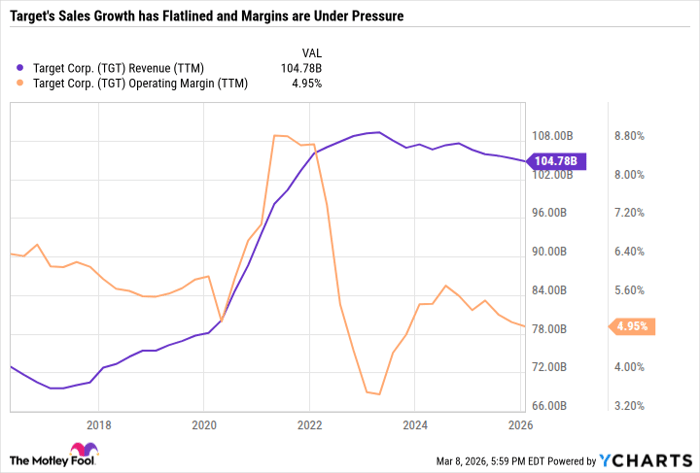
TGT Revenue (TTM) data by YCharts
Target badly overestimated consumer demand during the pandemic, poorly managed its supply chain, and struggled to adapt to pullbacks in consumer spending. Since Target can't compete with Walmart or Costco Wholesale on price and value, it relies on a more discretionary product mix and foot traffic.
When Target is at its best, it provides a relatively affordable and enjoyable in-store shopping experience -- such as grabbing an in-store Starbucks beverage and taking advantage of exclusive partnerships that shoppers can't find at value-first outlets. But when consumer budgets are strained, cheap thrills can lose their appeal.
Target's bold plans to return to growth
Before stepping down as CEO, Brian Cornell, who led the company for more than a decade, was focused on store improvements, boosting foot traffic, and leaning into the "Tarzhay" spirit, which makes shopping fun rather than routine.
New CEO Michael Fiddelke is following in Cornell's footsteps by implementing an aggressive strategy to get Target's mojo back, with plans to open more than 30 stores this fiscal year, complete more than 130 full-store remodels, and spend 25% more on capital expenditures than in fiscal 2025.
Although Target's stores drove 97.6% of order fulfillment in fiscal 2025, digitally originated sales made up 20.6% of total sales. That's more than even the pandemic years of fiscal 2020 and fiscal 2021 -- showing that Target is winning with in-store pickup and drive-up, especially through mobile orders.
Target is investing in brand marketing, technology, and artificial intelligence through ongoing investments rather than one-time costs. Target also realized $200 million in savings due to headcount reductions at its headquarters and field team changes. So the company is clearly prioritizing a push toward efficiency and productivity.
Fiddelke also recognizes the importance of the Target Circle loyalty program, as Target Circle members spent three times more on average than non-members, and Target Circle 360 members who get unlimited same-day delivery spend seven times more. In addition to higher spending, these loyal customers help Target determine which promotions and exclusive partnerships to pursue.
A reliable value stock with a high yield
Target's strategy may take some time to pay off. The company is guiding for just 2% year-over-year net sales growth and $7.50 to $8.50 in adjusted earnings per share compared to $7.57 in fiscal 2025, $8.86 in fiscal 2024, and $8.94 in fiscal 2023. So while fiscal 2025 could end up being the worst of Target's multiyear turnaround, the company is still a long way away from returning to its pre-pandemic growth rate.
With fairly weak guidance and a still unproven turnaround, investors may be wondering why Target is up so much in a few months. The answer likely has to do with expectations.
The market hates uncertainty. And with a new CEO and a clear game plan for returning to growth (albeit slowly), some investors may be willing to pay a higher price for Target.
Target is trading at 15.1 times the midpoint of its fiscal 2026 guidance -- which is right around its 10-year median P/E of 15.3. Whereas before its recent run-up, Target was extremely discounted.
Last June, Target announced its 54th consecutive annual dividend increase -- boosting the quarterly dividend to $1.14 per share or $4.56 per year. Target is one of just 57 companies that have increased their dividends for at least 50 consecutive years -- known as Dividend Kings. Based on earnings guidance for $7.50 to $8.50 per share, Target can easily support its dividend from its operations rather than relying on debt. And with a yield of 3.8%, Target has a considerably higher yield than many other Dividend Kings.
Target remains a reasonable buy
Heading into 2026, Target was so beaten down that mediocre results and guidance were enough to spark a rally. Target is still a decent buy, but it's more fairly valued now.
Lower interest rates tend to boost consumer spending and economic growth, but the labor market is showing signs of weakness. Throw in the inflationary effects of higher oil prices, and the economic backdrop isn't exactly great for retailers in 2026.
Still, the stock could be a good buy for long-term income investors, but only those who believe Target's in-store shopping experience is a significant differentiator compared to other retailers.
Should you buy stock in Target right now?
Before you buy stock in Target, consider this:
The Motley Fool Stock Advisor analyst team just identified what they believe are the 10 best stocks for investors to buy now… and Target wasn’t one of them. The 10 stocks that made the cut could produce monster returns in the coming years.
Consider when Netflix made this list on December 17, 2004... if you invested $1,000 at the time of our recommendation, you’d have $522,791!* Or when Nvidia made this list on April 15, 2005... if you invested $1,000 at the time of our recommendation, you’d have $1,132,678!*
Now, it’s worth noting Stock Advisor’s total average return is 952% — a market-crushing outperformance compared to 191% for the S&P 500. Don't miss the latest top 10 list, available with Stock Advisor, and join an investing community built by individual investors for individual investors.
See the 10 stocks »
*Stock Advisor returns as of March 12, 2026.
Daniel Foelber has positions in Starbucks and Target and has the following options: short March 2026 $120 calls on Target. The Motley Fool has positions in and recommends Costco Wholesale, Starbucks, Target, and Walmart. The Motley Fool has a disclosure policy.
Recommended Articles


