




Where Will Palantir Stock Be in 5 Years?
Key Points
The Palantir Artificial Intelligence Platform has been a game-changer for the company over the last few years.
Accelerating growth across both the private and public sectors should fuel meaningful growth into the next decade.
Palantir could become a $1 trillion company if it achieves management's long-term growth ambitions.
- 10 stocks we like better than Palantir Technologies ›
Over the last few years, Palantir Technologies (NASDAQ: PLTR) has evolved from a data analytics provider heavily utilized by the Department of Defense into one of the premier artificial intelligence (AI) operating systems purpose-built for the modern enterprise.
Last summer, CEO Alex Karp laid out a vision for the company that would see it 10x its revenue while simultaneously reducing its headcount. While this goal may seem like a moonshot, the accelerating deployments of Palantir's Artificial Intelligence Platform (AIP) underscore the software's value to clients across various industries.
Will AI create the world's first trillionaire? Our team just released a report on the one little-known company, called an "Indispensable Monopoly" providing the critical technology Nvidia and Intel both need. Continue »
If Palantir can achieve Karp's vision, I think it could grow to a $1 trillion valuation within the next five years.
Image source: Getty Images.
Palantir AIP is a prolific enterprise software tool
For much of its history, the largest share of Palantir's growth was driven by deals with the Pentagon and U.S. intelligence agencies. That dynamic continued to bolster the company's top line in 2025. Last year, Palantir won a 10-year deal with the U.S. Army worth up to $10 billion as well as a $795 million expansion of its deal with the U.S. military for its Maven Smart System.
While the fact that the company is still tightening its relationship with the U.S. government is encouraging, Palantir's most lucrative potential lies in its ability to improve corporate workflows.
In 2025, the company's U.S. commercial segment grew by 109% to $1.5 billion, and management's guidance is for it to grow by at least 115% in 2026.
A secret competitive advantage
Large organizations increasingly need secure access to artificial intelligence systems that can navigate messy, disparate datasets in real-world environments -- from hospitals to global supply chains across manufacturing and logistics facilities.
As corporations move beyond experimenting with chatbots and start implementing more agentic AI capabilities into their workflows, Palantir is positioned to benefit in a few ways.
First, the company's Foundry platform helps end users build ontologies -- granular visualizations that map data to its sources of truth in real time. Second, the company's various security clearances help make Palantir an out-of-the-box suite that can be seamlessly deployed across systems at the Pentagon as well as in corporate environments.
But perhaps its greatest strength is its lack of true competition. While companies such as Snowflake and Databricks are great for data storage and analytics, both companies' offerings lack the breadth of Palantir's AI intelligence layer.
For this reason, it's becoming harder for peers to compete with Palantir at scale. As the company accelerates its customer acquisition, its technological competitive advantage creates a network effect whereby Palantir's customers not only continue to renew their contracts, but tend to expand their relationships with it as their use cases for its technology evolve.
Palantir could 10x its top line by 2031
For 2026, Palantir's management is guiding for $7.2 billion in sales. Assuming an annualized growth rate of 45% from there -- which is well below the company's current trajectory -- it could reach roughly $46 billion in revenue by the early 2030s. That would be 10 times its 2025 revenue of $4.5 billion.
PLTR PS Ratio data by YCharts.
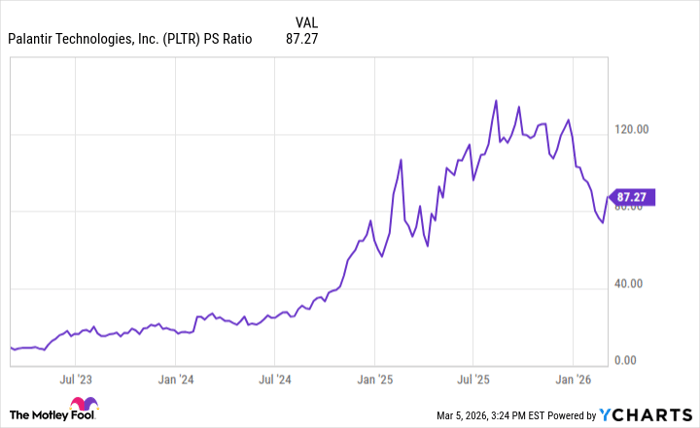
If the market were to apply a price-to-sales multiple of 30 to the company -- a steep discount to its current level, but still a premium for SaaS category leaders -- then Palantir could be worth $1.2 trillion by 2031.
Assuming no major hiccups in the macroeconomic environment and a steady AI-driven tailwind, there's a solid bull case for Palantir to be a $1 trillion company by early next decade.
Should you buy stock in Palantir Technologies right now?
Before you buy stock in Palantir Technologies, consider this:
The Motley Fool Stock Advisor analyst team just identified what they believe are the 10 best stocks for investors to buy now… and Palantir Technologies wasn’t one of them. The 10 stocks that made the cut could produce monster returns in the coming years.
Consider when Netflix made this list on December 17, 2004... if you invested $1,000 at the time of our recommendation, you’d have $530,233!* Or when Nvidia made this list on April 15, 2005... if you invested $1,000 at the time of our recommendation, you’d have $1,119,682!*
Now, it’s worth noting Stock Advisor’s total average return is 955% — a market-crushing outperformance compared to 191% for the S&P 500. Don't miss the latest top 10 list, available with Stock Advisor, and join an investing community built by individual investors for individual investors.
See the 10 stocks »
*Stock Advisor returns as of March 10, 2026.
Adam Spatacco has positions in Palantir Technologies. The Motley Fool has positions in and recommends Palantir Technologies and Snowflake. The Motley Fool has a disclosure policy.
Recommended Articles


