




Gold Just Did This For the 2nd Time in the Past 45 Years; Last Time It Preceded the Financial Crisis
Key Points
Gold prices just rose for the eighth consecutive month in February, something that's only happened one other time since 1970.
Unfortunately, that one time was just a couple of months before the financial crisis.
Given the uptick in volatility we've seen recently, along with labor market and geopolitical stresses, investors would be wise not to ignore this signal.
- 10 stocks we like better than S&P 500 Index ›
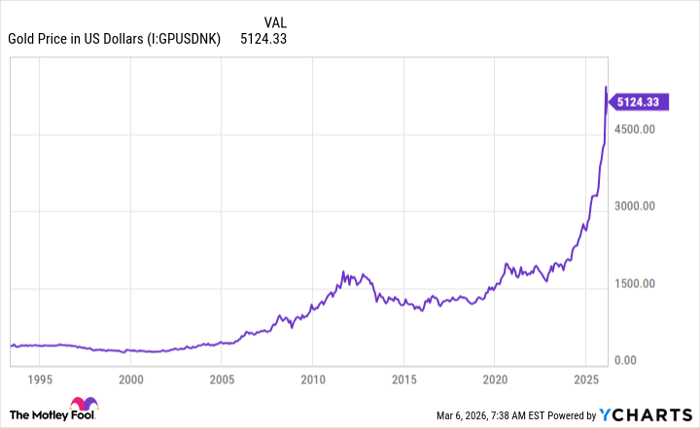
Most people are already well aware of gold's rally over the past couple of years. To say that it's historic would be an understatement. After hitting a ceiling around $2,000 per ounce multiple times in the early 2020s, gold finally broke through and has been rising virtually non-stop ever since. Gold pushed above the $5,000 mark in January and is still there now.
Will AI create the world's first trillionaire? Our team just released a report on the one little-known company, called an "Indispensable Monopoly" providing the critical technology Nvidia and Intel both need. Continue »
Gold Price in U.S. Dollars data by YCharts.
Gold's rally has been historic in another sense too -- but maybe not one that investors should be thrilled with.
February 2026 marked the eighth straight month that gold prices have risen. Most of the monthly gains haven't been small, either.
| Month | Return |
|---|---|
| July 2025 | 1% |
| August 2025 | 4% |
| September 2025 | 12% |
| October 2025 | 4% |
| November 2025 | 5% |
| December 2025 | 2% |
| January 2026 | 10% |
| February 2026 | 3% |
Data source: Investing.com.
Gold is traditionally considered a safe haven asset that can rise in value when stocks are falling. As I've pointed out in the past, gold's long-term correlation with the S&P 500 (SNPINDEX: ^GSPC) is almost zero. That means gold pretty much does whatever it wants, whenever it wants. It may help protect against stock market downside, but it also may not. In reality, gold prices can react to market events, geopolitics, monetary policy, debt, and other issues.
If we look at history, gold prices going up in eight straight months is almost unprecedented. In fact, since 1970, it has only happened one other time -- February 2008.
Image source: Getty Images.
Is gold signaling another major bear market?
It's difficult to ascribe a lengthy gold rally to one specific cause, but it was definitely sniffing something out back then. What's interesting is that Treasury yields were also falling steadily throughout 2007, so there's potentially a double risk-off signal brewing.
If we look at the S&P 500 chart during this time, the culmination of the gold rally wrapped up just before the index peaked. Once the financial crisis gripped the markets, the S&P 500 entered a deep bear market that cut the index's value in half.
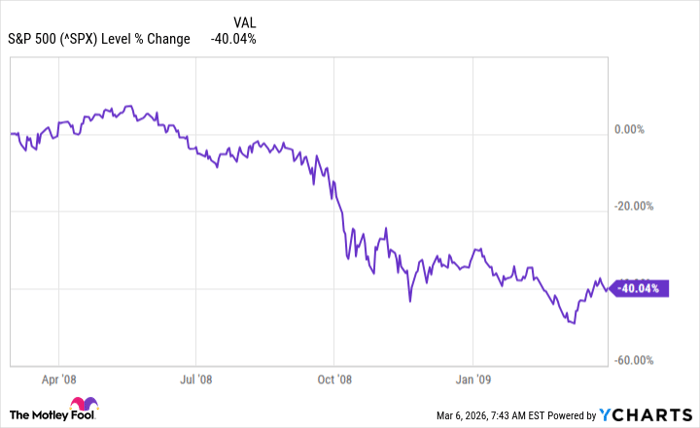
^SPX data by YCharts.
The big question now is whether the recent gold rally is signaling another precursor to a recession and/or bear market.
The weakness we're seeing in the labor market right now should signal that this isn't merely a coincidence. At its core, frequent negative monthly job growth, which we've seen throughout the past year, is a sure sign of labor market weakness. In this scenario, companies usually see a challenging environment ahead and don't want to commit to too much spending.
Employment is the foundation of almost everything the consumer does. If people feel less secure in their jobs, they tend to dial back spending and hang on to cash just in case. This is the kind of behavior that can lead to a recession.
However, the AI story is currently overshadowing a lot of potential weaknesses. Those weaknesses in the labor market have historically correlated highly with recessions and bear markets.
Right now, the S&P 500 still isn't that far below its all-time high. That may change quickly over the next several months.
Should you buy stock in S&P 500 Index right now?
Before you buy stock in S&P 500 Index, consider this:
The Motley Fool Stock Advisor analyst team just identified what they believe are the 10 best stocks for investors to buy now… and S&P 500 Index wasn’t one of them. The 10 stocks that made the cut could produce monster returns in the coming years.
Consider when Netflix made this list on December 17, 2004... if you invested $1,000 at the time of our recommendation, you’d have $534,008!* Or when Nvidia made this list on April 15, 2005... if you invested $1,000 at the time of our recommendation, you’d have $1,090,073!*
Now, it’s worth noting Stock Advisor’s total average return is 949% — a market-crushing outperformance compared to 190% for the S&P 500. Don't miss the latest top 10 list, available with Stock Advisor, and join an investing community built by individual investors for individual investors.
See the 10 stocks »
*Stock Advisor returns as of March 10, 2026.
David Dierking has no position in any of the stocks mentioned. The Motley Fool has no position in any of the stocks mentioned. The Motley Fool has a disclosure policy.
Recommended Articles


