




Prediction: The AI Capex War Will Create a Clear Winner by the End of 2026
Key Points
Big tech companies are spending hundreds of billions on AI infrastructure.
Alphabet has distinct advantages over the competition, namely its financial strength, its custom AI chips, and its diverse revenue streams.
Google Gemini has emerged as one of the biggest names in the large language model market.
- 10 stocks we like better than Alphabet ›
Several big tech companies surprised Wall Street with their fourth-quarter and full-year reports over the past few weeks. It wasn't because of missed earnings or anything like that. It was because of the incredible amounts of money they plan to spend on artificial intelligence (AI) data centers.
Meta (NASDAQ: META) announced a 73% boost to its capital expenditure guidance for 2026.
Will AI create the world's first trillionaire? Our team just released a report on the one little-known company, called an "Indispensable Monopoly" providing the critical technology Nvidia and Intel both need. Continue »
Microsoft (NASDAQ: MSFT) announced it had spent more than $200 billion on AI technology since the beginning of its fiscal 2024.
Amazon (NASDAQ: AMZN) announced $200 billion capex guidance for 2026, up 52% from the $131 billion it spent in 2025.
Finally, Alphabet (NASDAQ: GOOG), Google's parent company, announced plans for $175 billion to $185 billion in capex for this year.
The reason for all this spending is simple: Data centers aren't cheap. Industry news and analysis site Dgtl Infra notes that it costs $7 million to $12 million per megawatt of planned load to build a data center. CNBC has pointed out that the average modern hyperscale data center is between 150 and 300 megawatts. Say you want a 200 MW data center. That would cost between $1.4 billion and $2.4 billion.
The costs don't stop after construction, either. According to Stream Data Centers, a company that develops these projects, the average large data center costs $10 million to $25 million a year to operate.
In a spending war among all those giants, which one will emerge as the top dog?
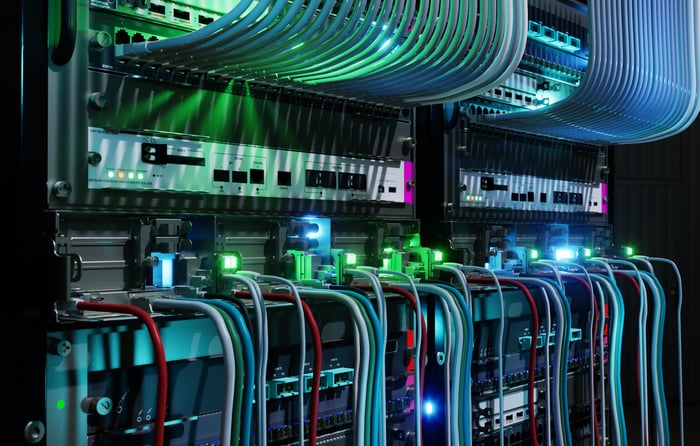
Image source: Getty Images.
Let me spell it out
I think the company with the best likelihood of sustaining the levels of capex AI demands is Alphabet, for three reasons. First, its financial strength relative to its peers (though none of these companies are strapped for cash). Second, its in-house hardware advantage. Third, its non-AI revenue streams.
Let's start with the money.
Alphabet generated $402.8 billion in revenue in 2025, up 15% over 2024, and it grew its net income by 32% to $132.2 billion. The company is also running a net profit margin of 32.8%, so if its costs of revenue do go up, it has quite a cushion of profitability.
Amazon is bigger than Alphabet in terms of its net sales, which increased 12% in 2025, with the biggest boost coming from Amazon Web Services (AWS). However, Amazon has a much thinner net profit margin of 10.8%. Amazon can eat increased costs, too, but not to the same degree that Alphabet can.
The net margins of Microsoft and Meta are 39% and 30%, respectively. But they face other problems with their AI programs.
As a report from tech sector venture capital firm Menlo Ventures highlights, Meta's AI has been losing its share in the enterprise large language model API (application programming interface) market rapidly. In 2023, it had a 16% market share. That figure has since fallen to 8%. Meanwhile, Alphabet's Google Gemini AI program has grown its market share from 7% to 21% over the same period.
While Meta can't be ruled out entirely, it has been increasing its AI capex only to lose market share. Microsoft is facing a similar problem.
Microsoft's Azure Cloud revenue is forecast by both analysts and the company to stagnate or even decline in its fiscal 2026 Q3, which will ned March 31. Meanwhile, Google Cloud and Amazon Web Services continue to grow quickly.
Microsoft also seems to be betting big on OpenAI, and that strategic partnership may be turning into a liability. OpenAI's market share is also plummeting: It controlled 50% of the enterprise large language model API market in 2023. Its share has since fallen to 27%.
Meanwhile, the two AI programs growing their market shares are Google Gemini and Anthropic's Claude, which overtook OpenAI's ChatGPT to become the dominant player in the enterprise large language model API market with 40% share.
That brings me to Alphabet's second advantage: its Tensor Processing Unit (TPUs).
A-to-Z AI
The TPU is one of the only real competitors to Nvidia's (NASDAQ: NVDA) graphics processing units (GPUs) in the AI processing realm. All the big AI players use Nvidia hardware, but only Alphabet now has its own in-house chips, which it can use to wean itself off Nvidia's hardware.
And Anthropic has announced it will begin using TPU chips, aiming to bring more than 1 gigawatt of computing capacity online this year using Alphabet's hardware. So even though Claude controls more of the market than Google Gemini, Alphabet can still make money off of it.
Meanwhile, everyone else must either pay Nvidia for the privilege of using its hardware or go to Alphabet, which is exactly what Apple (NASDAQ: AAPL) has done.
Finally, I want to talk about Alphabet's other revenue streams. Google, of course, is the legacy product, and has become synonymous with search engines on the whole.
Revenue from the Google search business grew 17% in 2025. Then there's YouTube, which generated $60 billion in revenue for Alphabet from ads and subscriptions in 2025. Google Cloud is smaller than AWS but still generated over $70 billion in annualized revenue run rate, up 48% year over year, in Q4 2025.
Put simply, Alphabet has so much money coming in already from a diverse set of assets that it has enough cash and high enough profit margins to spend as much as it needs to secure AI dominance without going into the red. Give it a look if you want to bet on what appears to be the fastest horse in the AI capex race.
Should you buy stock in Alphabet right now?
Before you buy stock in Alphabet, consider this:
The Motley Fool Stock Advisor analyst team just identified what they believe are the 10 best stocks for investors to buy now… and Alphabet wasn’t one of them. The 10 stocks that made the cut could produce monster returns in the coming years.
Consider when Netflix made this list on December 17, 2004... if you invested $1,000 at the time of our recommendation, you’d have $456,188!* Or when Nvidia made this list on April 15, 2005... if you invested $1,000 at the time of our recommendation, you’d have $1,133,413!*
Now, it’s worth noting Stock Advisor’s total average return is 916% — a market-crushing outperformance compared to 194% for the S&P 500. Don't miss the latest top 10 list, available with Stock Advisor, and join an investing community built by individual investors for individual investors.
See the 10 stocks »
*Stock Advisor returns as of February 28, 2026.
James Hires has positions in Alphabet. The Motley Fool has positions in and recommends Alphabet, Amazon, Apple, Meta Platforms, Microsoft, and Nvidia. The Motley Fool has a disclosure policy.
Recommended Articles


