




Worried About a Stock Market Crash? This Is the Single Best Investing Move You Can Make Right Now.
Key Points
The majority of Americans are at least somewhat worried about a recession.
Volatility could be looming, but it's simpler than you might think to protect your portfolio.
- 10 stocks we like better than S&P 500 Index ›
If you're nervous about the future of the market, you're not alone. Around 80% of Americans are at least slightly concerned about the possibility of a recession, according to a 2025 survey from financial association MDRT.
The bad news is that some stock market metrics suggest declines could be coming sooner rather than later. The S&P 500 Shiller CAPE Ratio, for example, implies that the index is overvalued -- with the metric reaching its highest point since the dot-com bubble burst of the early 2000s.
Will AI create the world's first trillionaire? Our team just released a report on the one little-known company, called an "Indispensable Monopoly" providing the critical technology Nvidia and Intel both need. Continue »
To be clear, past performance doesn't predict future returns, so there's no way to know for certain whether a recession is coming in 2026. But the good news is that there's an important move you can make that is all but guaranteed to prevent losses if the market crashes.
Image source: Getty Images.
A long-term strategy is key
Your portfolio will likely drop in value if stock prices take a turn for the worse this year. But staying invested for the long term is one of the most proven ways to build wealth despite short-term volatility.
Since 1929, the average S&P 500 (SNPINDEX: ^GSPC) bear market has lasted around 286 days, according to research from investing firm Bespoke. That's just under 9.5 months. Meanwhile, the average bull market has lasted over 1,000 days -- or nearly three years.
By staying patient and riding out the bear markets, , you're far more likely to make money in the market than you are to lose it. If you panic-sell your investments after prices have dropped, you risk selling your stocks for less than you paid for them and locking in steep losses.
History proves that patience pays off
No two bear markets or recessions are identical, but there's never been a downturn that the market hasn't recovered from -- with enough time.
The S&P 500 is up by nearly 45% since January 2022, which was the start of the most recent bear market. Since the dot-com bubble burst in 2000, it's up by nearly 400%.
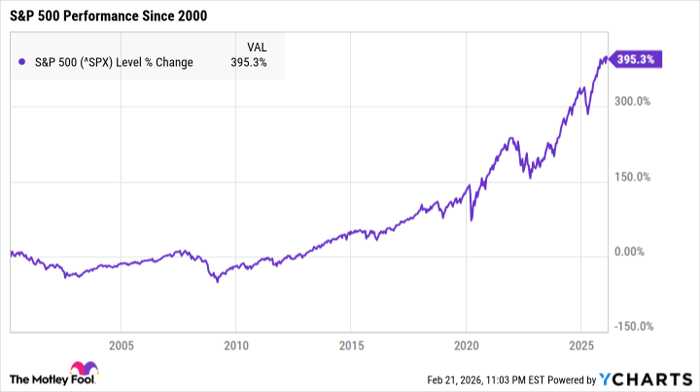
^SPX data by YCharts
Nothing is guaranteed in the stock market. That said, regardless of when the next recession begins, how long it lasts, or how severe it is, it's incredibly likely that the market will pull through with enough time.
If there's only one move you make to help protect your portfolio, it's staying invested even in the face of volatility. The longer you keep your money in the market, the better your chances of earning positive total returns.
Should you buy stock in S&P 500 Index right now?
Before you buy stock in S&P 500 Index, consider this:
The Motley Fool Stock Advisor analyst team just identified what they believe are the 10 best stocks for investors to buy now… and S&P 500 Index wasn’t one of them. The 10 stocks that made the cut could produce monster returns in the coming years.
Consider when Netflix made this list on December 17, 2004... if you invested $1,000 at the time of our recommendation, you’d have $424,262!* Or when Nvidia made this list on April 15, 2005... if you invested $1,000 at the time of our recommendation, you’d have $1,163,635!*
Now, it’s worth noting Stock Advisor’s total average return is 904% — a market-crushing outperformance compared to 194% for the S&P 500. Don't miss the latest top 10 list, available with Stock Advisor, and join an investing community built by individual investors for individual investors.
See the 10 stocks »
*Stock Advisor returns as of February 24, 2026.
Katie Brockman has no position in any of the stocks mentioned. The Motley Fool has no position in any of the stocks mentioned. The Motley Fool has a disclosure policy.
Recommended Articles


