




Where Will IonQ Stock Be in 1 Year?
Key Points
Growth investors once flocked to quantum computing pure plays such as IonQ stock.
IonQ has been issuing stock to fund various acquisitions over the last year.
Investors are beginning to rotate out of IonQ stock given the company's continued decision to dilute shareholders.
- 10 stocks we like better than IonQ ›
Throughout the artificial intelligence (AI) revolution, investors have primarily looked to semiconductors, data centers, and cloud service providers for growth. But over the last year, another concept started capturing the interest of AI investors: quantum computing.
One of the most popular quantum computing stocks is a company called IonQ (NYSE: IONQ). At one point, shares had skyrocketed over 90% last year. But today? IonQ stock is down nearly 60% from its high a year ago.
Where to invest $1,000 right now? Our analyst team just revealed what they believe are the 10 best stocks to buy right now, when you join Stock Advisor. See the stocks »
Is this the beginning of a falling knife, or are smart investors buying the dip in the quantum computing pure play?

Image source: Getty Images.
IonQ's growth looks explosive, but there's a catch
Just a few years ago, IonQ was barely generating any revenue. Per management's guidance below, the company is on pace for over $100 million in sales for 2025. This pace of growth isn't just impressive, it's unprecedented.
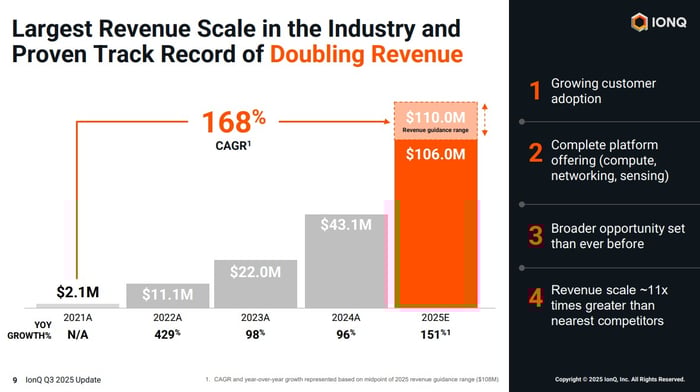
Image source: IonQ Investor Relations.
While the financial snapshot above might tempt investors to pour into IonQ stock, there's far more to the story. You see, quantum computing currently has little utility in the real world. Instead, the technology mostly remains a function of research and development (R&D) as companies assess how quantum AI can help their business.
This begs the question: What is fueling IonQ's growth?
In 2025, IonQ acquired five companies for an aggregate sum of roughly $2.4 billion. The company followed these transactions up with three more so far in 2026. In late January, IonQ announced its intent to acquire SkyWater Technology for $1.8 billion as well as software solutions provider Seed Innovations.
Of course, not all of IonQ's revenue growth stems from these acquisitions. However, the broader point I'm making is that the company is complementing the lumpy nature of its organic growth with these transactions in order to tell a story that IonQ is building a next-generation vertically integrated quantum enterprise.
While that sounds great in theory, investors are beginning to wake up to a glaring problem with this strategy.
Smart investors have seen this game before
Given the capital-intensive nature of building quantum AI systems in combination with the technology's limited applications today, it's not surprising to learn that IonQ is burning cash. Through the first nine months of 2025, IonQ reported net losses of $1.3 billion.
The culprit behind IonQ's transaction funding can be summed up below:
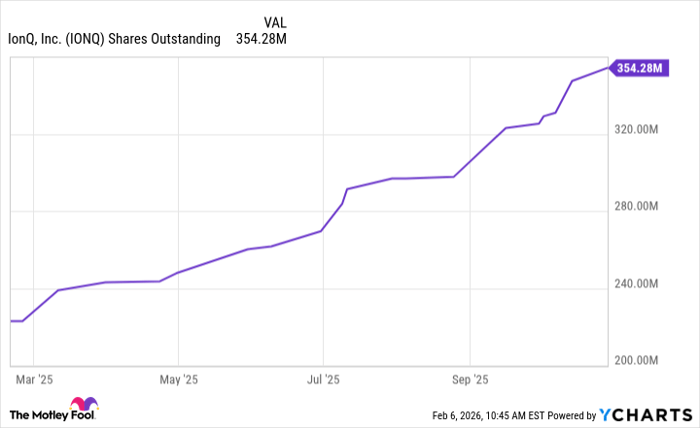
IONQ Shares Outstanding data by YCharts
IonQ has been issuing stock at a rapid pace over the last year. As its outstanding share count continues to balloon, existing investors suffer from dilution. Given the selling pressure IonQ has been facing lately, I think investor tolerance for the company's financial engineering game may finally be coming to an end.
Is IonQ a good stock to buy?
Even with its precipitous sell-off, IonQ still boasts a price-to-sales (P/S) ratio of 104. This is roughly double to triple the range of what investors witnessed in the most popular internet darlings during the peak of the dot-com boom.
Take Cisco as an example. During dot-com euphoria, Cisco boasted a P/S multiple of 33 and a market capitalization of $555 billion. About one year after the bubble burst, Cisco's market value had plummeted by 77%.
While history does not unfold in exactly the same ways, I think IonQ is on its way to following a Cisco-esque trajectory. Within one year, I think the stock could be trading closer to $10 -- representing over a 70% decline from where it is today.
Should you buy stock in IonQ right now?
Before you buy stock in IonQ, consider this:
The Motley Fool Stock Advisor analyst team just identified what they believe are the 10 best stocks for investors to buy now… and IonQ wasn’t one of them. The 10 stocks that made the cut could produce monster returns in the coming years.
Consider when Netflix made this list on December 17, 2004... if you invested $1,000 at the time of our recommendation, you’d have $439,362!* Or when Nvidia made this list on April 15, 2005... if you invested $1,000 at the time of our recommendation, you’d have $1,164,984!*
Now, it’s worth noting Stock Advisor’s total average return is 918% — a market-crushing outperformance compared to 196% for the S&P 500. Don't miss the latest top 10 list, available with Stock Advisor, and join an investing community built by individual investors for individual investors.
See the 10 stocks »
*Stock Advisor returns as of February 11, 2026.
Adam Spatacco has no position in any of the stocks mentioned. The Motley Fool has positions in and recommends Cisco Systems, IonQ, and SkyWater Technology. The Motley Fool has a disclosure policy.
Recommended Articles


