




Prediction: This Iconic Stock Will Slash Its Dividend in 2026
Key Points
Starbucks' dividend grew at a hefty average annual rate of 24.5% for a decade, but has slowed dramatically since 2021.
The company's 1.6% payout increase last year reflects some distressing fundamentals.
While turnaround efforts may well succeed, short-term pain for shares is likely to come first.
- 10 stocks we like better than Starbucks ›
For 15 years, Starbucks' (NASDAQ: SBUX) dividend growth couldn't be stopped. In 2010, in the shadow of the Great Recession, it issued its first dividend of $0.05 per share, which doubled less than three years later. Up through 2025, payouts grew by 1,140%, and anyone who had invested $1,000 on the eve of its first dividend in April 2010 would now be enjoying a yield on cost of 28% each year.
That's great income, but alas, this dividend growth is very likely in the past. As a shareholder, it pains me to say this, but I believe Starbucks' dividend growth will come to an abrupt halt later this year, as the company typically announces dividend hikes in October.
Will AI create the world's first trillionaire? Our team just released a report on the one little-known company, called an "Indispensable Monopoly" providing the critical technology Nvidia and Intel both need. Continue »
Here are the signs.

Image source: Getty Images.
Starbucks' dividend growth has sputtered big-time in recent years
From 2010 to 2020, the company hiked its dividend by an average of 24.5% a year. But since 2021, dividend growth has slowed dramatically, as you can see below.
| Year | Quarterly Payout | Annual Dividend Increase |
|---|---|---|
| 2021 | $0.49 per share | 8.9% |
| 2022 | $0.53 per share | 8.2% |
| 2023 | $0.57 per share | 7.5% |
| 2024 | $0.61 per share | 7% |
| 2025 | $0.62 per share | 1.6% |
Data source: Author calculations and Yahoo! Finance.
Slowing dividend growth may not tell us much by itself, not even a slowdown as sharp as this. After all, I argued recently that Coca-Cola's dividend growth will soon pick back up after a years-long slowdown. But Starbucks' token dividend growth in 2025 came alongside some worrying fundamentals.
2. Starbucks' payout ratio is soaring
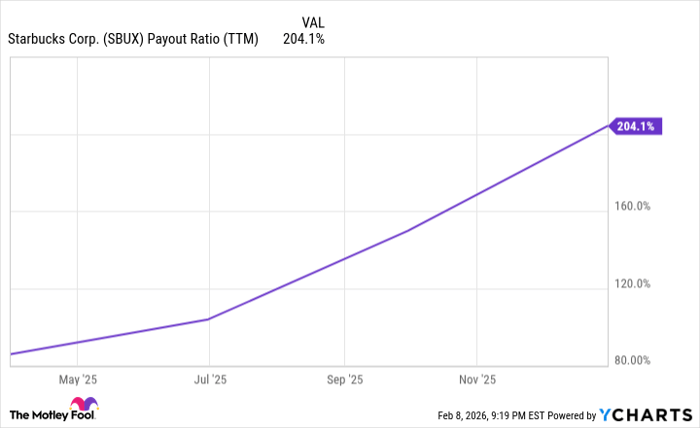
Over the last year, look what's happened to the payout ratio -- the percentage of net income that the company spends on its dividend.
Data by YCharts.
As you can see, it's now above 200%, meaning that it's spending over twice as much on its dividend as it takes in as net income.
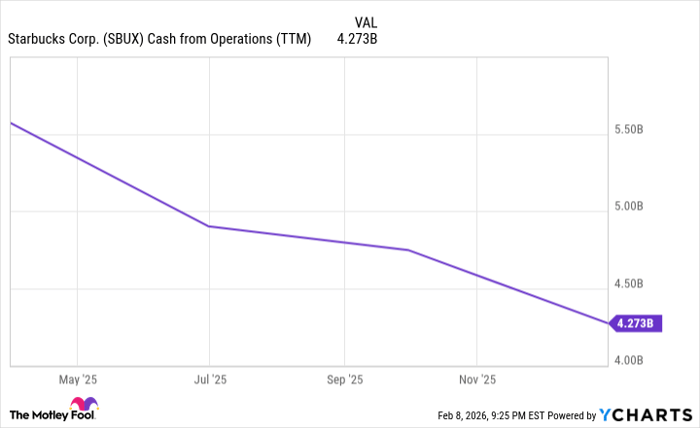
That's a big warning sign, though admittedly not definitive. Cash from operations can offer better insight into a dividend's sustainability, since that metric shows what a company has left over after paying salaries, keeping the lights on, and all other operating costs.
3. Cash flow from operations is plummeting
Starbucks' cash flow from operations has fallen from roughly $5.6 billion a year ago to just under $4.3 billion today.
Data by YCharts.
Ordinarily, I would look to share repurchase figures to see if the dividend might be more sustainable than it appears, thanks to a falling share count. But Starbucks hasn't repurchased shares since 2024, and its employee stock investment plan, which allows employees to buy stock at a 5% discount after 90 days of service, is actually expanding the number of shares outstanding and diluting the share price. The effect isn't massive, but it doesn't help a company that's holding onto its dividend by its fingernails.
And speaking of share buybacks, shares of Starbucks slid in 2022 when then-CEO Howard Schultz suspended the company's buyback program, saying that cash was needed for investment in operations. Because buybacks don't carry the same prestige that consistently rising dividends do -- there are no "Buyback Aristocrats" of "Repurchase Kings" -- a dividend cut would likely hit shares much harder.
While CEO Brian Niccol might succeed in his turnaround mission at Starbucks, shares are more likely to be in for some short-term pain before that day arrives. For investors who prioritize income, this is one stock to avoid.
Should you buy stock in Starbucks right now?
Before you buy stock in Starbucks, consider this:
The Motley Fool Stock Advisor analyst team just identified what they believe are the 10 best stocks for investors to buy now… and Starbucks wasn’t one of them. The 10 stocks that made the cut could produce monster returns in the coming years.
Consider when Netflix made this list on December 17, 2004... if you invested $1,000 at the time of our recommendation, you’d have $439,362!* Or when Nvidia made this list on April 15, 2005... if you invested $1,000 at the time of our recommendation, you’d have $1,164,984!*
Now, it’s worth noting Stock Advisor’s total average return is 918% — a market-crushing outperformance compared to 196% for the S&P 500. Don't miss the latest top 10 list, available with Stock Advisor, and join an investing community built by individual investors for individual investors.
See the 10 stocks »
*Stock Advisor returns as of February 10, 2026.
William Dahl has positions in Coca-Cola and Starbucks. The Motley Fool has positions in and recommends Starbucks. The Motley Fool has a disclosure policy.
Recommended Articles


