




A Once-in-a-Decade Investment Opportunity: 1 Artificial Intelligence (AI) Semiconductor Stock That Could Go Parabolic in 2026 (Hint: It's Not Nvidia)
Key Points
Nvidia has long dominated the GPU industry.
AMD's GPUs, CPUs, and software platform have helped the company become an integrated supplier for AI workloads.
Several hyperscalers are beginning to complement their Nvidia architectures with AMD's AI stack.
- 10 stocks we like better than Advanced Micro Devices ›
Throughout the artificial intelligence (AI) revolution, Nvidia (NASDAQ: NVDA) has been the 800-pound gorilla in the world of high-performance parallel processors. The company's pioneering role in designing graphics processing units (GPUs) gave it a massive first-mover advantage in the generative AI race that it has largely maintained.
That left Advanced Micro Devices (NASDAQ: AMD) as a far more minor player in the GPU landscape -- but one with ambitious goals. While it has taken some time for AMD to scale up its data center presence, the company is beginning to prove that its offerings can hold their own. Now, it's looking like 2026 could be a transformative year for the company, which could make AMD a lucrative investment opportunity.
Where to invest $1,000 right now? Our analyst team just revealed what they believe are the 10 best stocks to buy right now. Continue »
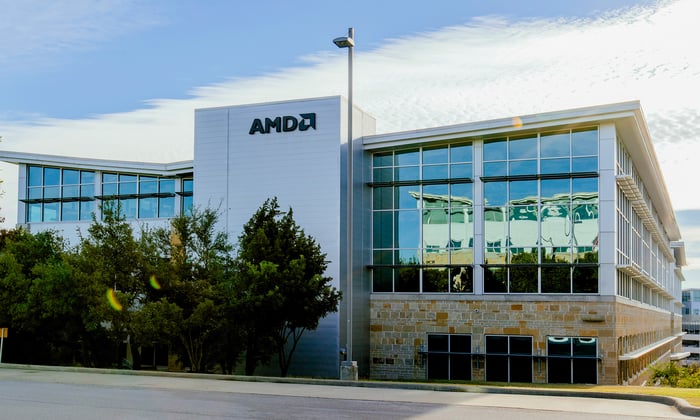
Image source: Advanced Micro Devices.
AMD is beginning to win over the hyperscalers
AMD's chips are handling a growing fraction of hyperscaler workloads. That's an important validation for the company's efforts to compete with the GPU leader. Microsoft, Meta Platforms, Oracle, and OpenAI are all complementing their existing Nvidia GPU stacks with AMD's Instinct accelerators.
This demonstrates that AI's largest developers view AMD's chips as credible alternatives to incumbent chip designs. It also shows that its wares are capable of handling large-scale AI applications and are not simply being deployed in testing or edge cases.
AMD's chips are being used for both training and inference workloads. In the long run, these dynamics may be able to yield better unit economics across memory and storage for big tech -- making AMD a lower-cost alternative to Nvidia, which currently commands enormous pricing power.
AMD looks poised for explosive revenue and earnings growth
While Nvidia's CUDA ecosystem remains the industry standard for powering hyperscaler workloads, AMD's competing ROCm software platform offers developers a new level of control, given its open-source approach. This is the opposite of Nvidia's lock-in strategy.
This flexibility is more than just a technological difference -- it could be a competitive advantage for big tech. By integrating AMD into a meaningful portion of their overall AI stacks, customers gain negotiating leverage over other suppliers. While it may not be obvious yet, AMD is starting to show some signs of disrupting Nvidia's structural moat.
Smart investors realize that AMD is not simply a cheaper alternative to Nvidia. The company's growing ability to win big contracts with hyperscalers could pave the way to further, sustained deal flow.
AMD's true value proposition lies in its ability to complement other architectures across various aspects of the AI value chain. AMD is more than just a GPU designer. The company is cross-selling CPUs and networking products to help developers build robust, end-to-end integrated systems.
Industry research suggests that the hyperscalers are going to spend over $500 billion on AI infrastructure this year. Given AMD's attractive cost profile and its comprehensive product suite, I would not be surprised to see big tech continue shifting its AI chip mix through further AMD deployments.
Even nominal market share gains for AMD could fuel meaningful revenue acceleration and profit margin expansion as the AI chip market continues to grow. AMD is slowly becoming a major beneficiary of AI diversification strategies.
This is what makes 2026 particularly interesting. AMD's evolving position in the data center market could result in the stock seeing significant valuation expansion throughout this year and beyond as the market continues to realize the company is not just a minor contender in the GPU arena but a core pillar supporting the AI infrastructure boom.
Should you buy stock in Advanced Micro Devices right now?
Before you buy stock in Advanced Micro Devices, consider this:
The Motley Fool Stock Advisor analyst team just identified what they believe are the 10 best stocks for investors to buy now… and Advanced Micro Devices wasn’t one of them. The 10 stocks that made the cut could produce monster returns in the coming years.
Consider when Netflix made this list on December 17, 2004... if you invested $1,000 at the time of our recommendation, you’d have $450,256!* Or when Nvidia made this list on April 15, 2005... if you invested $1,000 at the time of our recommendation, you’d have $1,171,666!*
Now, it’s worth noting Stock Advisor’s total average return is 942% — a market-crushing outperformance compared to 196% for the S&P 500. Don't miss the latest top 10 list, available with Stock Advisor, and join an investing community built by individual investors for individual investors.
See the 10 stocks »
*Stock Advisor returns as of February 1, 2026.
Adam Spatacco has positions in Meta Platforms, Microsoft, and Nvidia. The Motley Fool has positions in and recommends Advanced Micro Devices, Meta Platforms, Microsoft, Nvidia, and Oracle. The Motley Fool has a disclosure policy.
Recommended Articles


