




This Growth Stock Continues to Crush the Market
Key Points
High bandwidth memory chips sell for four times the price of standard DRAM, and Micron is going all-in on this AI-driven product category.
Micron plays a supporting role in Nvidia's AI dominance.
The memory market is cyclical, but this upswing looks different for real.
- 10 stocks we like better than Micron Technology ›
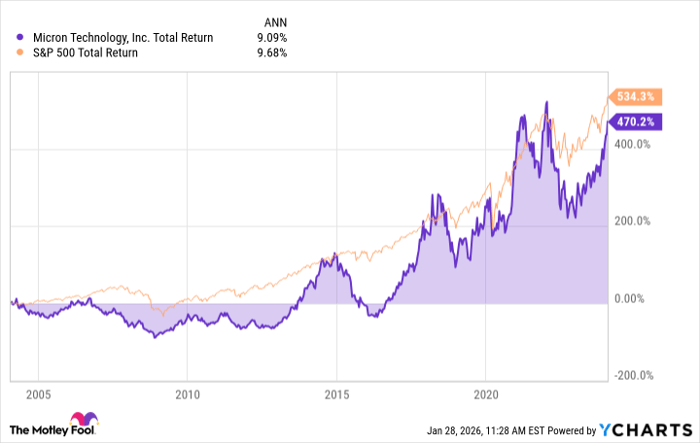
Two years ago, Micron Technology (NASDAQ: MU) looked like an overly volatile stock with fairly average long-term returns. Through a series of lofty peaks and deep valleys, the memory-chip maker's chart couldn't quite keep up with the S&P 500 (SNPINDEX: ^GSPC) market index from January 2004 to the same month of 2024.
Where to invest $1,000 right now? Our analyst team just revealed what they believe are the 10 best stocks to buy right now. Continue »
MU Total Return Level data by YCharts
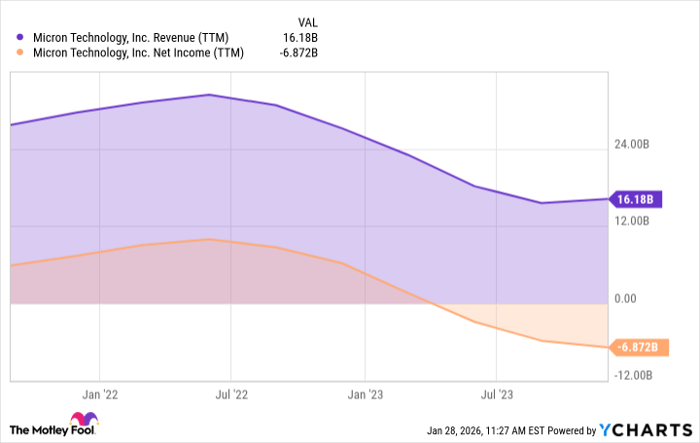
With an average annual return of 9.1% over this span, Micron trailed the S&P 500's 9.7%. The artificial intelligence (AI) boom had been going on for about a year but didn't really include memory chips yet. Chip supply was not a problem and unit prices were down more than 50% from the summer of 2021. As a result, Micron's revenues were down and the company used more cash than it earned.
MU Revenue (TTM) data by YCharts
AI data centers are gobbling up memory chips
Things have changed. The memory market tightened up in 2025, as hyperscale AI specialists started building massive data centers to power their large language models (LLMs), generative AI tools, and other memory-hungry services.
The price of last-generation DDR4 memory modules is up 37% over the last two years. More modern DDR5 modules roughly tripled in price over the same period. And that's not even the good stuff anymore -- the bleeding-edge chip type known as high bandwidth memory (HBM) is exactly what AI servers crave. These chips cost roughly 4 times as much as standard DRAM products, and Micron has stopped making consumer-grade chips to focus its production lines on this lucrative product category.

Image source: Micron Technology.
Every AI accelerator card Nvidia (NASDAQ: NVDA) ships carries lots of that pricey HBM memory. The recently announced Vera Rubin superchip, for example, comes with half a terabyte (TB) of HBM (and 1.5 TB of lower-cost DDR5 for the system processor). In other words, Micron plays a large supporting role in Nvidia's success story.
The memory market ain't what it used to be (in a good way)
This turn of the cyclical wheel may be different from the others, if the AI boom sticks around for a few more years. Micron's management projects chip shortages well into 2028. And the HBM market's explosive growth is reshaping the entire industry.
"We forecast an HBM TAM CAGR of approximately 40% through calendar 2028, from approximately $35 billion in 2025 to around $100 billion in 2028," Micron CEO Sanjay Mehrotra said in December's Q1 2026 earnings call. "Remarkably, this 2028 HBM TAM projection is larger than the size of the entire DRAM market in calendar 2024."
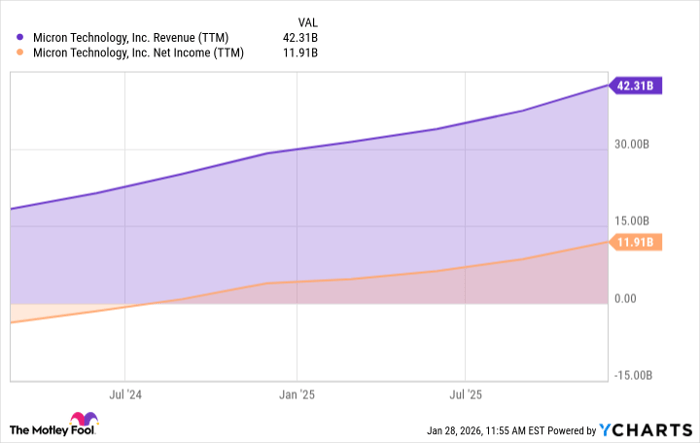
Thanks to this game-changing trend, Micron's revenues doubled in the last two years while profits swung to the positive side. And not by a little, either; the trailing net margin now stands at 28%.
MU Revenue (TTM) data by YCharts
The stock price finally soared
Wall Street caught wind of Micron's business growth and sent the stock skyrocketing in recent months. Whether you look at returns in the last month, last year, past 3 years, or the previous decade, Micron ranks among the top 10 performers in the S&P 500.
|
Price Performance Period |
Micron |
S&P 500 |
|---|---|---|
|
Month |
51% |
1% |
|
1 year |
371% |
16% |
|
3 years |
594% |
74% |
|
10 years |
4,171% |
275% |
Data source: collected from Finviz.com on Jan. 28, 2026.
Assuming that the AI boom has legs, Micron has established itself as a high-octane growth stock for the long term. And the stock isn't exactly cheap by classic metrics right now, but the story changes when you account for Micron's expected growth. Trading at 9.9 times forward earnings estimates, the PEG ratio is just 0.13 -- essentially tied for the lowest such ratio in the S&P 500. From this perspective, Micron's shares may be deeply undervalued.
So Micron is crushing the market right now, and the stock seems prepared to keep outperforming the S&P 500 for a while. As a longtime Micron investor, that's music to my ears. Like the best synth riffs of the 1980s, delivered over ultramodern memory channels.
Should you buy stock in Micron Technology right now?
Before you buy stock in Micron Technology, consider this:
The Motley Fool Stock Advisor analyst team just identified what they believe are the 10 best stocks for investors to buy now… and Micron Technology wasn’t one of them. The 10 stocks that made the cut could produce monster returns in the coming years.
Consider when Netflix made this list on December 17, 2004... if you invested $1,000 at the time of our recommendation, you’d have $448,476!* Or when Nvidia made this list on April 15, 2005... if you invested $1,000 at the time of our recommendation, you’d have $1,180,126!*
Now, it’s worth noting Stock Advisor’s total average return is 945% — a market-crushing outperformance compared to 197% for the S&P 500. Don't miss the latest top 10 list, available with Stock Advisor, and join an investing community built by individual investors for individual investors.
See the 10 stocks »
*Stock Advisor returns as of January 30, 2026.
Anders Bylund has positions in Micron Technology and Nvidia. The Motley Fool has positions in and recommends Micron Technology and Nvidia. The Motley Fool has a disclosure policy.
Recommended Articles


