




Ignore FMC Stock: This Agricultural Innovator Is Reaping Rewards From AI and Automation
Key Points
Deere is pioneering AI and automation in farming, from self-driving tractors to smart pesticide sprayers.
The company's smart sprayers have already seen a decline in cost and pollution in testing.
Deere had a poor 2025, but its most recent quarter showed the potential for upward momentum.
- 10 stocks we like better than Deere & Company ›
Spare a thought for the farmer. It's the millions of them across the world that allow our modern economy to exist. And there are fewer of them doing it today than ever. In the 1700s, roughly 80% of the American population was farmers. Today, they represent less than 2% of the population. Yet they feed a vastly larger population than their historical counterparts.
Modern technology allows farmers to produce enough food collectively to feed nearly all of the 8 billion people around the world. But the agricultural revolution is ongoing. And one of America's oldest companies is leading the way.
Where to invest $1,000 right now? Our analyst team just revealed what they believe are the 10 best stocks to buy right now. Continue »
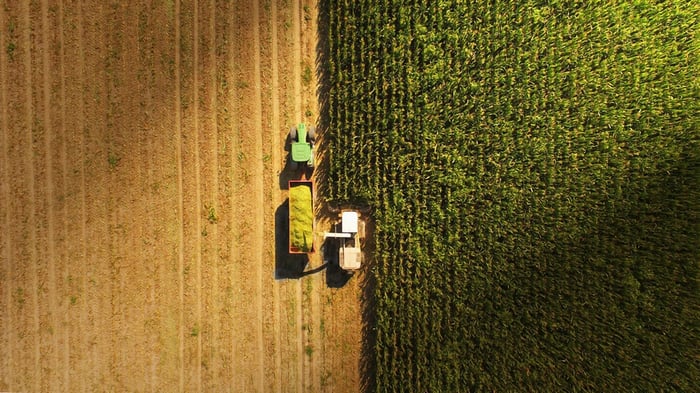
Image source: Getty Images.
Tomorrow's tractor, today's fields
Deere & Company (NYSE: DE), better known colloquially as John Deere, turns 189 this year, and it's still as much a leader in agriculture as it was back when it was founded in 1837. If there's a machine you need on a farm, from a riding lawn mower to a tractor to a combine harvester, odds are good you can find one branded with the company's iconic prancing stag logo.
More recent additions to the company's offerings include a whole suite of digital tools, including equipment management software and satellite imaging. But the company isn't stopping with the digitization of farming, it's introducing artificial intelligence (AI) and autonomous driving as well.
First, let's talk about pesticides and weed control. In the past, farmers had to spray down entire fields with pesticides to kill weeds. It was expensive and put a lot of chemicals into the food supply and the environment. But Deere's new smart sprayers use 36 cameras and machine learning to identify individual weeds and automatically spray them individually.
The result for the 1 million acres this technology was tested on in 2023 was a 50% reduction in water and chemical use, an 87% reduction in the airborne drift of those chemicals, and a 93% reduction in chemical runoff. The farmer saves money on water and pesticides, and there are fewer chemicals in the environment. It's a win-win.
Deere already has an autonomous tractor in field testing, too.
With its 360-degree cameras and sophisticated software, the tractor can recognize and avoid obstacles while being monitored remotely by the farmer, who is freed up to do other important work around the farm.
In the words of Deanna Kovar, Deere's president of Worldwide Ag & Turf for Europe, Asia, and Africa, "All farmers need to do is transport their tractor to the field, get it set, get out of the cab, and use their mobile phone to 'swipe to farm.'"
Deere has always been a juggernaut in the agricultural industry, and on the financial front, it's performing well despite a poor 2025. Over the year, net sales and revenue were down 12%, and net income was down 29%. The decline in income is likely due to the cost of Deere's research and development operations, which have skyrocketed to $2.29 billion or 5.1% of sales over the past four years.
Despite that, the company maintains a net income margin of 11%. It also regularly increases its dividend, which is up by 113% since 2020.
And for Q4 2025, the company saw a considerable uptick in net sales and revenue of 11%, indicating it's picking up some steam going into 2026. And it is still investing heavily in its technological edge. It needs to.
There are slated to be 10 billion people on the planet by 2050, and Deere projects that a 60%-70% increase in agricultural production will be needed to feed them all. This company's machines have been a farmer's best friend for almost 200 years, and I predict they will continue to be.
But more efficient farming is bad news for companies like FMC (NYSE: FMC) that make the chemicals Deere's tractors will ensure farmers use less of.
The farmer's chemist is looking sickly
FMC is also a straightforward business. It develops and produces pesticides, fungicides, and other farming chemicals used to protect crops. However, while Deere's latest results showed a potential increase in momentum, FMC's results were disastrous.
For Q3 2025, the company reported a revenue decline of 49% from just over $1 billion to $542 million. Net income went from $66 million in Q3 2024 to a $569 million loss in Q3 2025. Finally, the company's earnings per share fell from $0.52 in Q3 2024 to a loss of $4.52 per share in Q3 2025.
The company's cash-flow guidance is especially grim. At the end of 2024, its free cash flow (FCF) was $614 million. For 2025, it's projecting a FCF loss of $100 million. And this is coming at a time when Deere is just testing out the smart sprayers that can cut pesticide use in half.
Things aren't looking great for FMC, and I don't foresee the company's lot improving anytime soon. I would skip it and look at Deere instead.
Should you buy stock in Deere & Company right now?
Before you buy stock in Deere & Company, consider this:
The Motley Fool Stock Advisor analyst team just identified what they believe are the 10 best stocks for investors to buy now… and Deere & Company wasn’t one of them. The 10 stocks that made the cut could produce monster returns in the coming years.
Consider when Netflix made this list on December 17, 2004... if you invested $1,000 at the time of our recommendation, you’d have $474,578!* Or when Nvidia made this list on April 15, 2005... if you invested $1,000 at the time of our recommendation, you’d have $1,141,628!*
Now, it’s worth noting Stock Advisor’s total average return is 955% — a market-crushing outperformance compared to 196% for the S&P 500. Don't miss the latest top 10 list, available with Stock Advisor, and join an investing community built by individual investors for individual investors.
See the 10 stocks »
*Stock Advisor returns as of January 17, 2026.
James Hires has no position in any of the stocks mentioned. The Motley Fool has positions in and recommends Deere & Company. The Motley Fool has a disclosure policy.
Recommended Articles


