




The S&P 500 Just Did Something for the 5th Time in 97 Years. Here's What History Says May Happen in 2026.
Key Points
The S&P 500 finished 2025 up by 16% or more for the third consecutive year.
This has happened only five times in the S&P 500's history.
History suggests that the index could either soar again in 2026 -- or fall by a double-digit percentage.
- 10 stocks we like better than S&P 500 Index ›
Some things happen so infrequently that they grab your attention. Seeing a total solar eclipse is a good example. So is hitting a hole in one in a round of golf.
The S&P 500 (SNPINDEX: ^GSPC) just did something that should grab investors' attention. And it could provide a glimpse into what may happen with stocks in the new year.
Where to invest $1,000 right now? Our analyst team just revealed what they believe are the 10 best stocks to buy right now, when you join Stock Advisor. See the stocks »

Image source: Getty Images.
Sweet 16
The S&P 500 ended 2025 up 16.4%. This performance followed a gain of 23.3% in 2024 and 24.2% in 2023. The index has generated returns of over 16% for three consecutive years only five times in 97 years. (Note: I'm including nominal returns only and not total returns with dividends.)
Granted, the S&P 500 hasn't existed in its current form that long. The index didn't include 500 companies until 1957. However, a predecessor – the S&P 90 Stock Index – debuted in 1928.
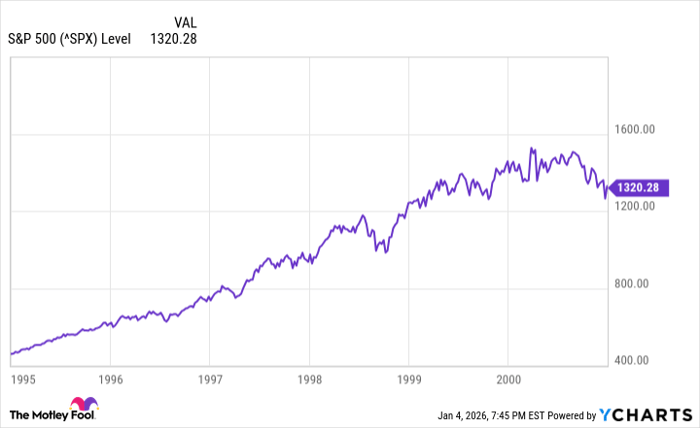
However, we don't have to go back that far to find the earliest instance of the index rising by 16% or more in three consecutive years. It first occurred from 1995 to 1997, during the dot-com boom. That boom produced two of the other notable streaks of 16%+ gains, from 1996 to 1998 and 1997 to 1999.
Two decades passed before the next three consecutive years of returns of 16% or more. The S&P 500 gained 28.9% in 2019, 16.3% in 2020, and 26.9% in 2021. The most recent streak, from 2023 to 2025, rounds out the list.
A mixed record
What typically happens next after three consecutive years of the S&P 500 delivering gains of 16% or more? History provides a mixed record.
Following the first streak from 1995 to 1997, the S&P 500 soared another 26.7% in 1998. After the next three years of gains of 16% or more between 1996 and 1998, the index jumped 19.5% in 1999.
However, the stock market bubble burst following the three consecutive years of 16% or more gains from 1997 to 1999. The S&P 500 declined 10.1% in 2000, marking the start of a prolonged decline that lasted several years.
^SPX data by YCharts
Anyone who has invested in recent years is aware of what happened following the three years of 16% or more returns between 2019 and 2021. The Federal Reserve began cranking up interest rates in 2022 in response to skyrocketing inflation. The S&P 500 plunged 19.4% as a result.
What's in store for 2026?
Historical precedents are murky at best for how the S&P 500 may perform in 2026. We could see continued momentum similar to the boom in the 1990s. On the other hand, the S&P 500 could decline in 2026 as it did in two of the four previous cases when the index delivered gains of 16% or more for three consecutive years.
In the 1990s, the rapid adoption of e-commerce fueled a significant surge in the stock market. Today, we're seeing a similar trend driven by artificial intelligence (AI), particularly generative AI. If companies report significant returns from their investments in AI this year, the S&P 500 could again deliver substantial gains in 2026.
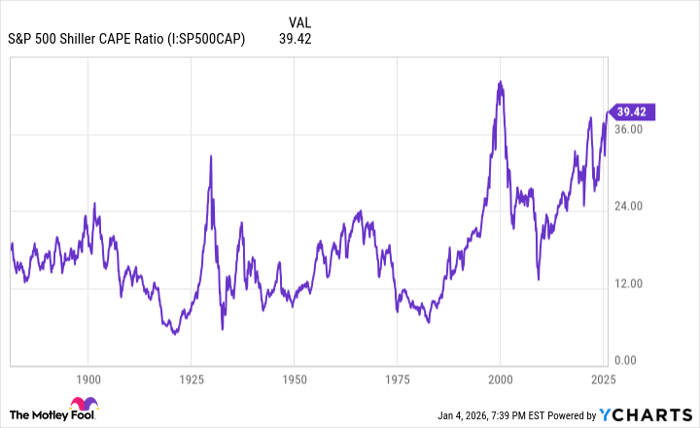
However, the good times for the S&P 500 came to an end in 2000, mainly due to the index's steep valuation. The S&P 500 Shiller CAPE ratio, a widely followed valuation metric, is currently at its highest level since then. It's possible that valuation could be the downfall for the S&P 500 this year, as it was in 2000.
S&P 500 Shiller CAPE Ratio data by YCharts
Perhaps the best strategy for investors is to focus on another S&P 500 streak, rather than its limited number of three consecutive years of 16% or more gains. What streak am I referring to? Over rolling 20-year periods, the S&P 500 has delivered positive total returns 100% of the time. This streak bodes well for long-term investors.
Should you buy stock in S&P 500 Index right now?
Before you buy stock in S&P 500 Index, consider this:
The Motley Fool Stock Advisor analyst team just identified what they believe are the 10 best stocks for investors to buy now… and S&P 500 Index wasn’t one of them. The 10 stocks that made the cut could produce monster returns in the coming years.
Consider when Netflix made this list on December 17, 2004... if you invested $1,000 at the time of our recommendation, you’d have $490,703!* Or when Nvidia made this list on April 15, 2005... if you invested $1,000 at the time of our recommendation, you’d have $1,157,689!*
Now, it’s worth noting Stock Advisor’s total average return is 966% — a market-crushing outperformance compared to 194% for the S&P 500. Don't miss the latest top 10 list, available with Stock Advisor, and join an investing community built by individual investors for individual investors.
See the 10 stocks »
*Stock Advisor returns as of January 6, 2026.
Keith Speights has no position in any of the stocks mentioned. The Motley Fool has no position in any of the stocks mentioned. The Motley Fool has a disclosure policy.
Recommended Articles


