




Dow Jones Industrial Average recovers from early losses despite software selloff
- Major indices recovered from morning declines to finish mixed as investors digested data-heavy week.
- Chinese regulators urged banks to curb US Treasury holdings, sending yields higher.
- Software stocks declined amid concerns about AI disruption to traditional business models.
- Gold and Bitcoin recovered from recent sharp selloffs while markets await jobs data.
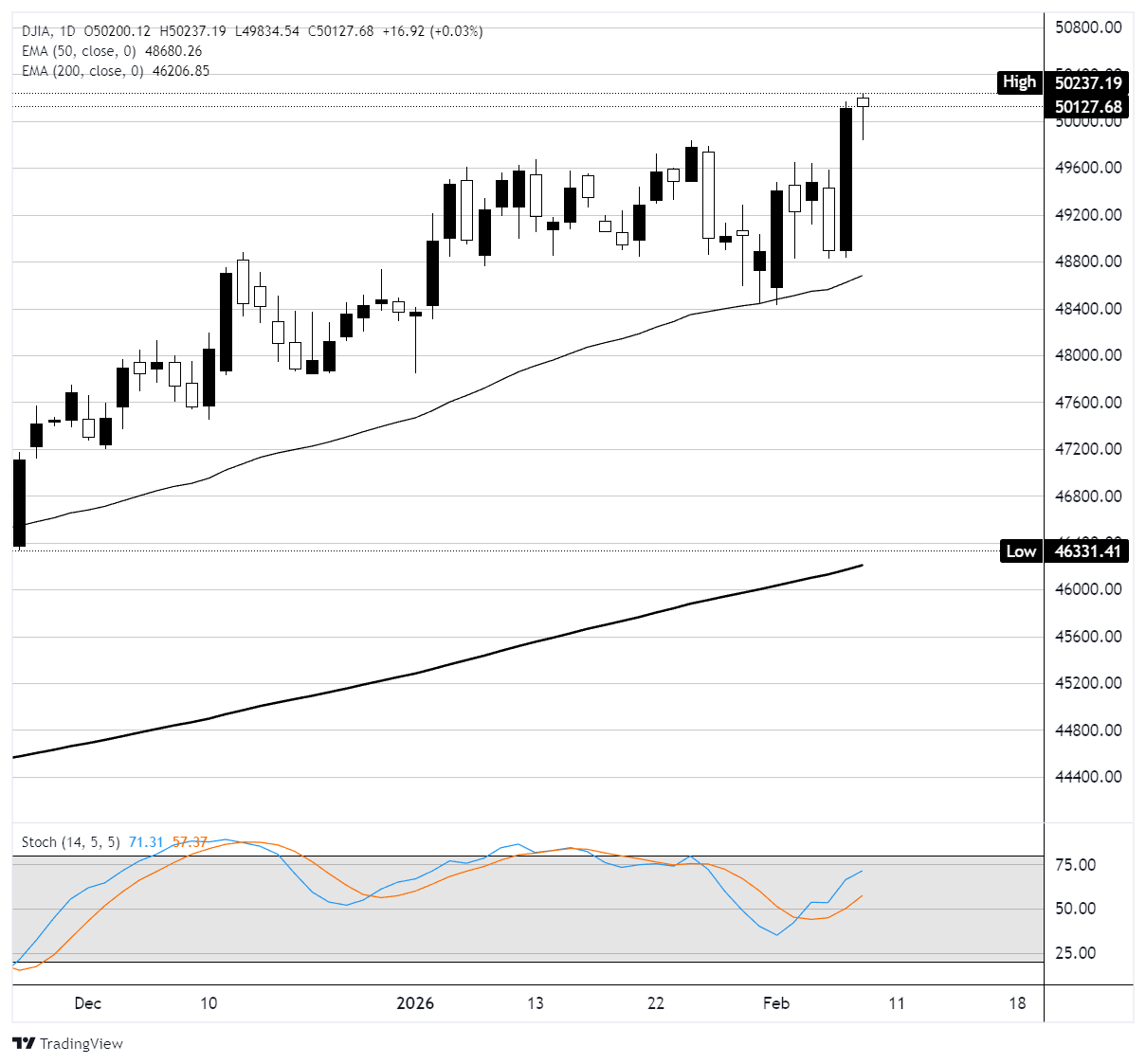
The Dow Jones Industrial Average (DJIA) recovered back to near-flat on Monday after declining as much as 160 points in morning trading. The S&P 500 gained 0.4% to touch 6,961, while the tech-heavy Nasdaq Composite managed modest gains after opening sharply lower. US equities shook off early pressure from news that Chinese regulators had advised domestic banks to reduce exposure to US government bonds, with investors ultimately focusing on an earnings-heavy week and upcoming employment data.
Treasury yields rise on China bond guidance
Chinese regulators advised financial institutions to rein in their holdings of US Treasuries, citing concerns over concentration risks and market volatility. The directive instructed banks to limit purchases of US government bonds, with those showing high exposure urged to pare positions. Yields on 10-year Treasuries climbed as much as four basis points to 4.25% before paring gains, while 30-year yields rose two to three basis points to 4.88%. China is the third-largest foreign holder of Treasuries after Japan and the United Kingdom, though its holdings have declined to $682.6 billion from a peak above $1.3 trillion in 2013. The move raised concerns about long-term borrowing costs for US corporations, though analysts noted that Chinese bank holdings represent only a small fraction of the overall Treasury market.
Software sector pressured by AI disruption fears
Software stocks faced selling pressure as concerns mounted about artificial intelligence disrupting traditional business models. Monday.com (MNDY) plunged roughly 14% despite reporting fourth-quarter results that beat expectations across the board, with adjusted earnings of $1.04 per share on revenue of $333.9 million. The Tel Aviv-based company issued fiscal 2026 revenue guidance of $1.452 billion to $1.462 billion, representing 18% to 19% growth and falling short of the 21% growth analysts had expected. The disappointing outlook sparked renewed worries about whether AI-powered automation tools could erode demand for traditional work management software. Intuit (INTU) and Salesforce (CRM) also declined more than 2% each as investors continued rotating away from software names vulnerable to AI-driven shifts.
Chip stocks gain on data center partnership
STMicroelectronics (STM) surged approximately 8% after announcing an expanded strategic collaboration with Amazon Web Services (AWS) through a multi-year, multi-billion US Dollar commercial engagement. The Franco-Italian chipmaker will supply advanced semiconductor technologies for AWS data centers, including chips supporting high-bandwidth connectivity and energy-efficient power management for hyperscale operations. As part of the agreement, STMicroelectronics issued warrants to AWS enabling the cloud giant to acquire up to 24.8 million ordinary shares exercisable at $28.38 over seven years. Amazon (AMZN) declined 2.6% despite the partnership announcement, extending losses from last week when the company's heavy AI spending plans rattled investors. Nvidia (NVDA) gained 3.3% as chip stocks found support, while Microsoft (MSFT) added 1.5%.
Hassett hints at weak jobs data ahead
National Economic Council Director Kevin Hassett suggested investors should brace for weaker-than-usual employment figures in coming months, attributing the slowdown to declining population growth rather than economic weakness. Speaking on CNBC, Hassett said markets should expect slightly smaller job numbers consistent with high Gross Domestic Product (GDP) growth, adding that population growth is declining while productivity growth is skyrocketing. The comments come ahead of the January Nonfarm Payrolls (NFP) report scheduled for release Wednesday, which was delayed from its original Friday date due to a partial government shutdown. December's report showed the economy added just 50K jobs, well below the historical average and marking one of the weakest years for hiring since the 2020 pandemic. Hassett's remarks appeared aimed at preemptively managing expectations for another soft print.
Gold and Bitcoin stabilize after selloff
Gold and Bitcoin stabilized on Monday following a turbulent week that saw both assets experience sharp declines. Spot Gold climbed more than 1.5% to trade above $5,000 per ounce after dropping to $4,423 earlier in the session, recovering from Friday's historic selloff that saw the precious metal plunge roughly 11% from record highs near $5,550. Silver also rebounded after plummeting 31% on Friday in its worst single-day performance since 1980. Bitcoin traded around $69,000, down approximately 3% on the day, after tumbling below $75,000 over the weekend from above $83,000 last week. The cryptocurrency has now fallen roughly 45% from its October record high above $126,000. Analysts attributed the precious metals recovery to dip-buying as a weaker US Dollar provided support, while ongoing geopolitical tensions and central bank demand kept safe-haven flows intact.
Dow Jones daily chart
Dow Jones FAQs
The Dow Jones Industrial Average, one of the oldest stock market indices in the world, is compiled of the 30 most traded stocks in the US. The index is price-weighted rather than weighted by capitalization. It is calculated by summing the prices of the constituent stocks and dividing them by a factor, currently 0.152. The index was founded by Charles Dow, who also founded the Wall Street Journal. In later years it has been criticized for not being broadly representative enough because it only tracks 30 conglomerates, unlike broader indices such as the S&P 500.
Many different factors drive the Dow Jones Industrial Average (DJIA). The aggregate performance of the component companies revealed in quarterly company earnings reports is the main one. US and global macroeconomic data also contributes as it impacts on investor sentiment. The level of interest rates, set by the Federal Reserve (Fed), also influences the DJIA as it affects the cost of credit, on which many corporations are heavily reliant. Therefore, inflation can be a major driver as well as other metrics which impact the Fed decisions.
Dow Theory is a method for identifying the primary trend of the stock market developed by Charles Dow. A key step is to compare the direction of the Dow Jones Industrial Average (DJIA) and the Dow Jones Transportation Average (DJTA) and only follow trends where both are moving in the same direction. Volume is a confirmatory criteria. The theory uses elements of peak and trough analysis. Dow’s theory posits three trend phases: accumulation, when smart money starts buying or selling; public participation, when the wider public joins in; and distribution, when the smart money exits.
There are a number of ways to trade the DJIA. One is to use ETFs which allow investors to trade the DJIA as a single security, rather than having to buy shares in all 30 constituent companies. A leading example is the SPDR Dow Jones Industrial Average ETF (DIA). DJIA futures contracts enable traders to speculate on the future value of the index and Options provide the right, but not the obligation, to buy or sell the index at a predetermined price in the future. Mutual funds enable investors to buy a share of a diversified portfolio of DJIA stocks thus providing exposure to the overall index.
Recommended Articles


