




Dow Jones Industrial Average misses out on tech gains as healthcare backslides
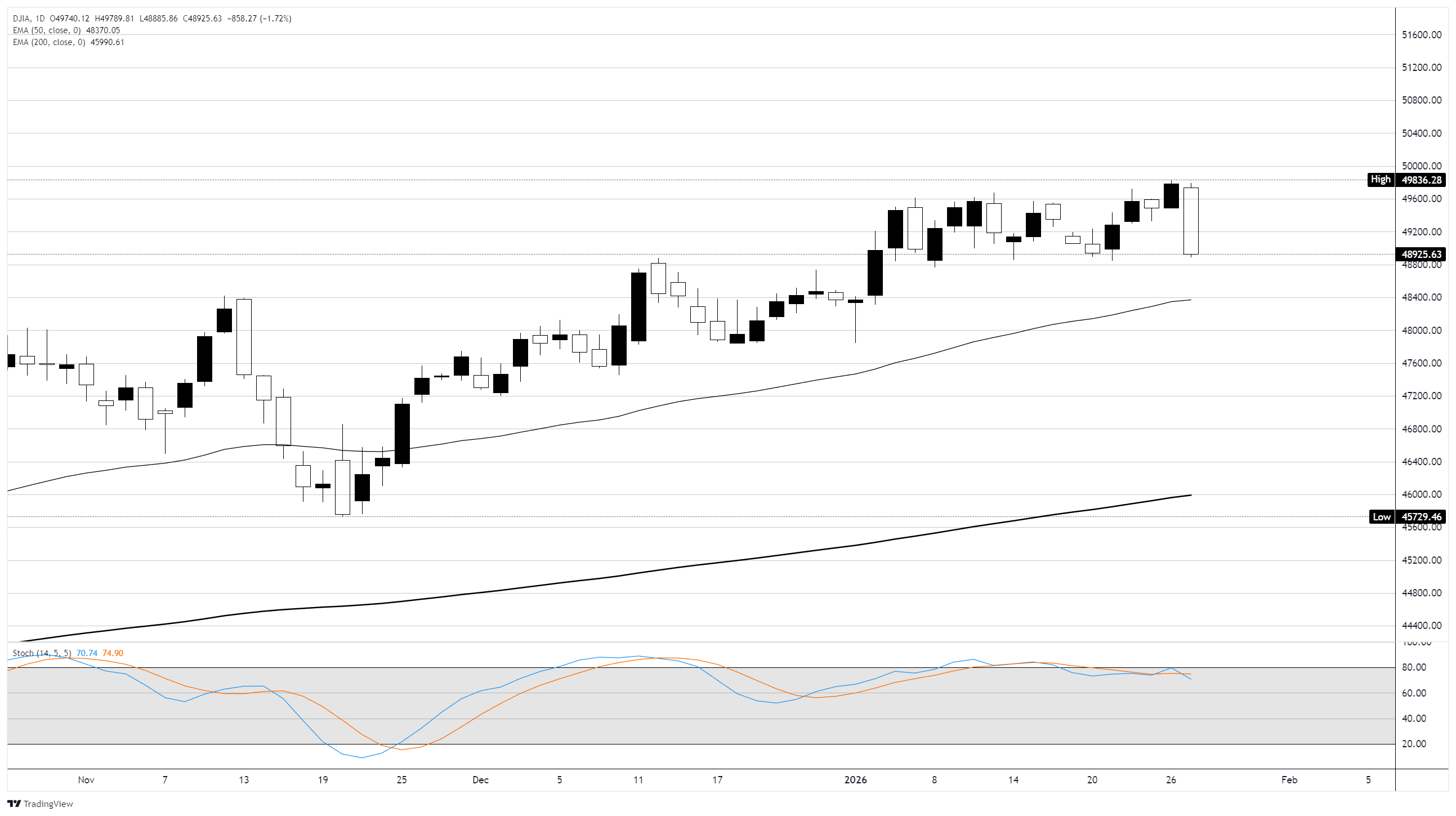
- The Dow Jones Industrial Average sank 500 points on Tuesday, led lower by insurance stocks.
- Big Tech rallied the S&P 500 into a record high, bucking the healthcare decline.
- Investors continue to see sunny economic skies in earnings reports despite a steep decline in consumer confidence.
The Dow Jones Industrial Average (DJIA) took a header on Tuesday, peeling away from the tech-bolstered pack of major indexes and falling around 500 points, or one percent, on an otherwise quiet trading day. The Standard and Poor’s 500 major equity index gained around one-half of one percent, and the tech-heavy Nasdaq index climbed one full percentage point.
The Federal Reserve (Fed) is set to announce its first rate decision of the year on Wednesday, with no change expected. Investor focus will be on forward guidance, particularly signals around the timing of potential rate cuts. Futures markets currently price in two quarter-point cuts by the end of 2026.
Tech stocks climb ahead of revenue reports
Many 'Big Tech' stocks, including several of the 'Magnificent Seven', will be reporting their latest quarterly earnings this week, and investors are positioning for a healthy clip of positive revenue headlines. Facebook parent Meta (META) and EV posterchild Tesla (TSLA) will be reporting their latest financial updates on Wednesday, with iPhone printer Apple (AAPL) posting earnings on Thursday.
A swirling cloud of unanswerable questions regarding capex, long-term capitalization capabilities, and revenue potential continues to surround the AI tech segment. However, lacking any real numbers, investors continue to bank on hopes that the LLM craze will eventually roll over into a profitable operating environment. Many AI investors have been quick to bank on comparisons to current-day internet giants such as Google (GOOGL) and Amazon (AMZN), who not only survived the dot-com bust but are thriving monoliths today. Major names historically involved with industry-level circular financing schemes, such as Enron and the former bond-market glutton Bear Stearns, tend not to come up.
Insurance providers wither following new CMS guidance
Shares of major health insurers declined sharply on Tuesday after the Trump administration’s healthcare policies leaked down into the operational levels of government. The Centers for Medicare & Medicaid Services (CMS) revealed an average healthcare payment increase of just 0.09% in 2027, drastically undercutting the profit-growth potential facing the Medicare-dependent insurance sector. Trump-appointed CMS head Dr. Mehmet Oz stated, “By strengthening payment accuracy and modernizing risk adjustment, CMS is helping ensure beneficiaries continue to have affordable plan choices and reliable benefits.”
Humana (HUM) tumbled 20% on the day, with CVS Health (CVS) backsliding 15%.
Dow Jones daily chart
Dow Jones FAQs
The Dow Jones Industrial Average, one of the oldest stock market indices in the world, is compiled of the 30 most traded stocks in the US. The index is price-weighted rather than weighted by capitalization. It is calculated by summing the prices of the constituent stocks and dividing them by a factor, currently 0.152. The index was founded by Charles Dow, who also founded the Wall Street Journal. In later years it has been criticized for not being broadly representative enough because it only tracks 30 conglomerates, unlike broader indices such as the S&P 500.
Many different factors drive the Dow Jones Industrial Average (DJIA). The aggregate performance of the component companies revealed in quarterly company earnings reports is the main one. US and global macroeconomic data also contributes as it impacts on investor sentiment. The level of interest rates, set by the Federal Reserve (Fed), also influences the DJIA as it affects the cost of credit, on which many corporations are heavily reliant. Therefore, inflation can be a major driver as well as other metrics which impact the Fed decisions.
Dow Theory is a method for identifying the primary trend of the stock market developed by Charles Dow. A key step is to compare the direction of the Dow Jones Industrial Average (DJIA) and the Dow Jones Transportation Average (DJTA) and only follow trends where both are moving in the same direction. Volume is a confirmatory criteria. The theory uses elements of peak and trough analysis. Dow’s theory posits three trend phases: accumulation, when smart money starts buying or selling; public participation, when the wider public joins in; and distribution, when the smart money exits.
There are a number of ways to trade the DJIA. One is to use ETFs which allow investors to trade the DJIA as a single security, rather than having to buy shares in all 30 constituent companies. A leading example is the SPDR Dow Jones Industrial Average ETF (DIA). DJIA futures contracts enable traders to speculate on the future value of the index and Options provide the right, but not the obligation, to buy or sell the index at a predetermined price in the future. Mutual funds enable investors to buy a share of a diversified portfolio of DJIA stocks thus providing exposure to the overall index.
Recommended Articles


