




Bitcoin Drop Wipes Billions From Recent Buyers: New Whale Cost Basis Falls Toward $90K
Bitcoin is attempting to reclaim the $70,000 level after weeks of volatility. Yet repeated failures to hold that threshold with confirmation suggest that demand remains fragile. Each push above this psychological barrier has been met with renewed selling pressure. Reinforcing the view that the market is still navigating a corrective phase rather than establishing a sustained recovery. Sentiment remains cautious as liquidity conditions tighten and traders look for clearer signs of stabilization.
Recent data shared by top on-chain analyst Maartunn highlights a notable shift among large holders. According to the analysis, many whales who entered the market near the $96,000 region are now sitting on significant unrealized losses following the subsequent price decline. After briefly testing those higher levels, Bitcoin reversed sharply, leaving late-cycle entrants exposed to downside pressure.
This dynamic suggests that some large investors may be reassessing risk, either reducing exposure or repositioning portfolios amid uncertain macro and crypto-specific conditions. Such behavior often contributes to heightened volatility, particularly when leveraged positions unwind.
Whale Capitulation Signals Market Redistribution Phase
Recent data shared by on-chain analyst Maartunn highlights a sharp wave of realized losses among large Bitcoin holders, pointing to an evolving market structure rather than a static downturn. According to the figures, realized losses reached approximately $944 million on Feb. 3, $431 million on Feb. 4, $1.46 billion on Feb. 5, and $915 million on Feb. 6. These numbers reflect significant selling activity from investors who accumulated BTC near higher price levels and are now exiting positions under pressure.

Such realized losses typically indicate capitulation among late-cycle entrants. When whales sell at a loss, it often means that conviction has weakened or that risk management considerations are taking priority. However, this process also implies redistribution. Coins do not disappear; they transfer from weaker hands to buyers willing to absorb supply at lower prices.
Maartunn notes that the estimated cost basis for the newest cohort of large holders is now around $90,000. This suggests that a substantial portion of recent accumulation occurred near that level, creating a potential overhead resistance zone if the price attempts to recover.
Markets often evolve through these phases of redistribution. While short-term sentiment may remain fragile, shifts in cost basis and ownership structure can eventually lay the groundwork for stabilization and future trend development.
Bitcoin Price Structure Signals Continued Distribution Phase
Bitcoin’s recent price structure reflects a market still dominated by distribution pressure rather than sustained demand recovery. After failing multiple times to consolidate above the $90K–$100K region, BTC entered a persistent downtrend characterized by lower highs and increasingly aggressive selloffs. The latest decline toward the $60K–$70K zone came with a sharp expansion in volume, typically associated with forced liquidations, panic exits, or large portfolio reallocations.
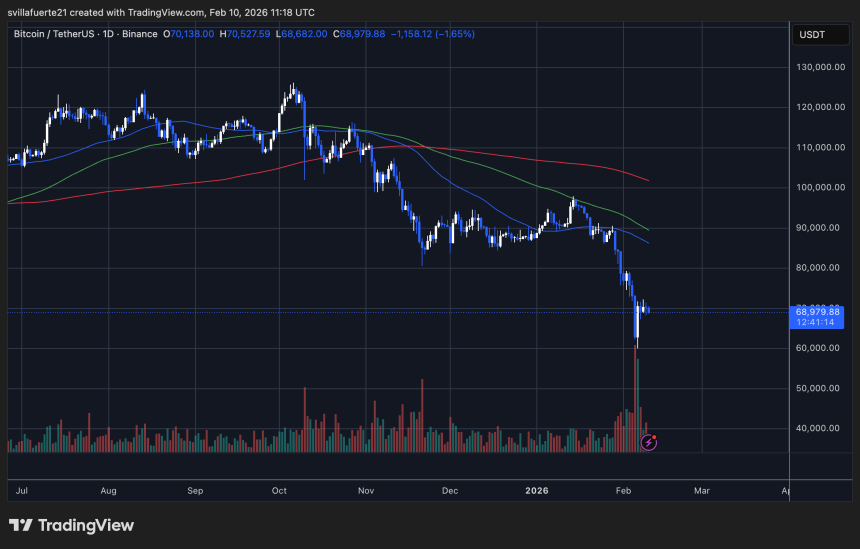
From a technical perspective, price now trades clearly below the major moving averages shown on the chart, all of which are trending downward. This configuration usually signals a mature corrective phase rather than a temporary pullback. The inability to reclaim those averages quickly suggests weak spot demand and continued caution among institutional participants.
The $60K–$65K region is emerging as a critical support cluster. A sustained hold above this range could stabilize sentiment and allow consolidation. However, failure to maintain this zone would likely expose deeper liquidity pockets below, potentially accelerating volatility.
Short term, price action appears reactive rather than directional. Until volume stabilizes and BTC reclaims key trend indicators, rallies may remain corrective. Market structure currently reflects redistribution rather than confirmed accumulation, keeping downside risks structurally elevated.
Featured image from ChatGPT, chart from TradingView.com
Recommended Articles


