




Gold Price Forecast: Can Gold Keep Rising as Stronger-Than-Expected Nonfarm Payrolls Boost Fed Rate Hike Expectations?
TradingKey - As of the Asian session on September 7, gold prices (XAUUSD) continued their downward trend following last Friday's US non-farm payrolls data, last trading lower around $4,390. The US August non-farm payrolls report released last Friday significantly exceeded market expectations, shifting previous market views of a rapid cooling in US employment and further raising expectations for a Fed rate hike in September. Driven by this, the US dollar and US Treasury yields rose, putting renewed pressure on gold from the interest rate side.
Why Gold Prices Are Falling
From a fundamental perspective, the core reason for the drop in gold prices lies in the U.S. August nonfarm payrolls performance far exceeding expectations.
According to data from the U.S. Bureau of Labor Statistics, nonfarm payrolls increased by 162,000 in August, nearly triple the market expectation of approximately 56,000, while the unemployment rate remained unchanged at 4.1%. Meanwhile, the labor force participation rate rose slightly from the previous level to 61.6%, indicating that the U.S. labor market as a whole maintains a degree of resilience.
Even more noteworthy is the significant upward revision to previous employment data. U.S. nonfarm payrolls for June were revised up from an increase of 20,000 to 31,000, while July was sharply revised from a decrease of 23,000 to an increase of 21,000, combining for a total of 55,000 higher than previously reported over the two months. This implies that market concerns over a rapid deterioration in the U.S. labor market have eased somewhat.
Previously, initial July nonfarm payrolls showed a decrease of 23,000 jobs, prompting market concerns that the U.S. economy was cooling rapidly and leading investors to lower expectations for further Federal Reserve rate hikes. However, August's addition of 162,000 jobs, along with the upward revision of July's figure into positive territory, prompted the market to reassess this judgment. Following the data release, U.S. Treasury yields and the U.S. dollar climbed in tandem. The 10-year Treasury yield rose to around 4.77% last Friday, and the market further increased the probability of a Federal Reserve rate hike in September.
As for gold, which yields no interest itself, when the market expects the Fed might raise interest rates further, Treasury yields typically rise accordingly, thereby increasing the opportunity cost of holding gold. Meanwhile, higher U.S. interest rate expectations usually support the U.S. dollar, placing further downward pressure on dollar-denominated gold.
Gold Price Technical Analysis: $4,300 Becomes Key Support Level for Bulls
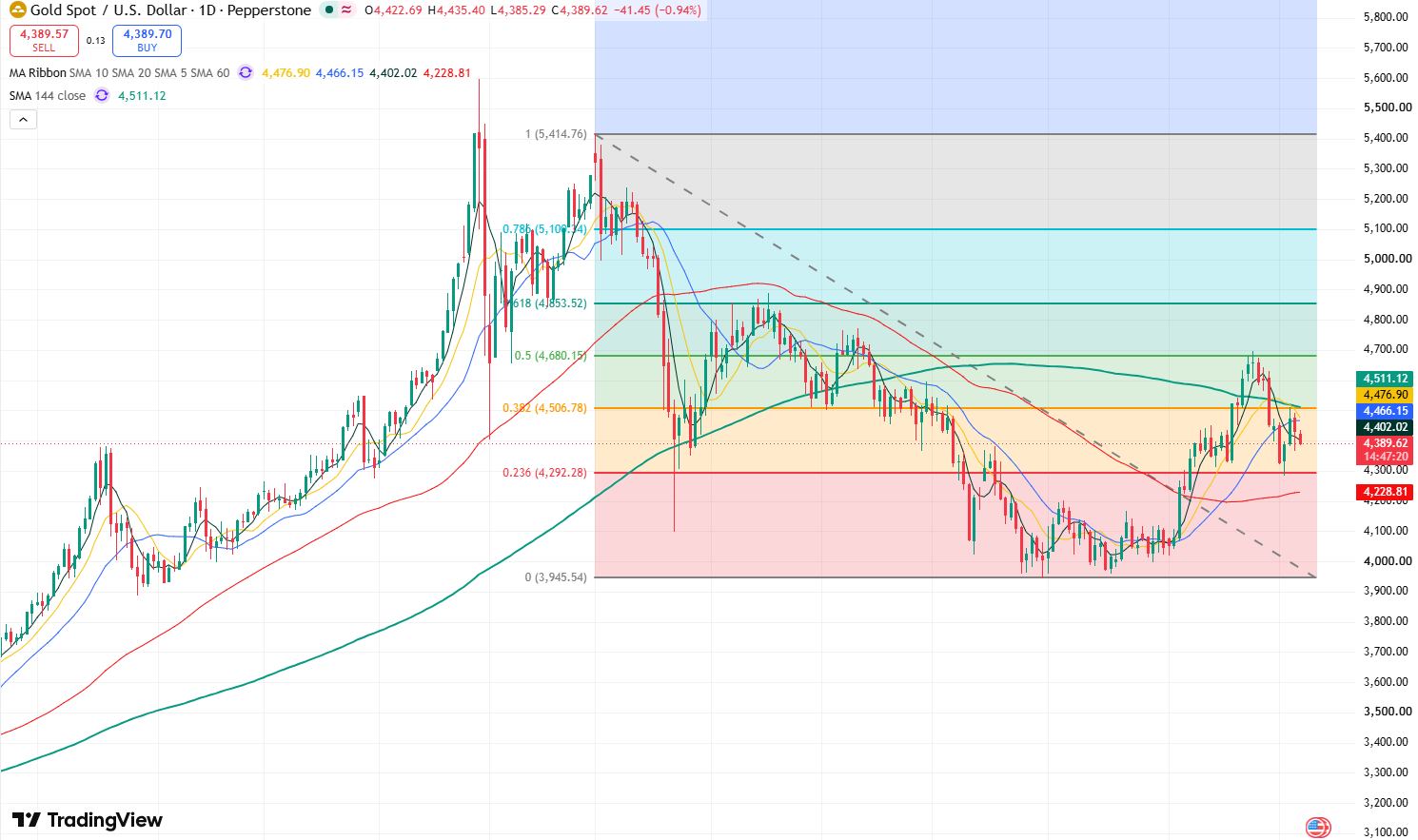
Gold Price Daily Chart, Source: TradingView
According to the gold price daily chart, gold had previously approached $4,700 before pulling back sharply under the impact of hawkish remarks by Fed Chair Warsh at Jackson Hole, rising international oil prices, and higher US Treasury yields, accumulating a decline of nearly 9% over the past two weeks. Although gold posted a notable rebound last week, strong non-farm payrolls data once again capped the scope for a price recovery.
At present, gold is in a consolidation phase after surging to just below $4,700 in August. Key support to watch on the downside is at $4,300. If this level fails to hold, gold's bullish momentum will be significantly weakened, potentially leading to a further test of the $4,200 mark on the downside.
Conversely, if gold holds above the $4,300 level, its short-term bullish trend will remain intact. The primary resistance to watch on the upside is $4,500–$4,510. If gold stabilizes above $4,510, it will challenge the resistance level of $4,700 once again.
Recommended Articles


