




Gold rebounds above $5,180 as Oil plunge pressures US Dollar
- Gold rises 0.50% to $5,187 as WTI Oil tumbles 14% on de-escalation hopes.
- DXY steadies near 98.86 while markets price around 40 bps of Fed easing.
- Traders await US CPI data, expected at 2.4% headline and 2.5% core YoY.
Gold price (XAU/USD) rallies on Tuesday as the US Dollar (USD) retreats after Oil prices edge lower, reflecting the Greenback's close correlation with crude. At the time of writing, XAU/USD trades at $5,187, up more than 0.50%.
XAU/USD gains as crude drops sharply on hopes the Iran conflict may ease
Geopolitics continues to drive price action. On Tuesday, US President Donald Trump hinted that the US incursion in Iran could end soon. Despite Trump’s comments, the Pentagon revealed that Tuesday is the “most intense day of strikes inside Iran,” according to the Secretary of Defense Pete Hegseth.
US Crude Oil, also known as West Texas Intermediate (WTI), tumbles some 14% in the day amid speculation that the Iran conflict could end soon, according to the White House.
The US Dollar Index (DXY), which measures the performance of the buck’s value against six peers, regained its composure, rising 0.14% to 98.86.
G7 energy ministers met on Tuesday and agreed to delay the release of strategic Oil reserves and asked the International Energy Agency (IEA) to assess the situation before taking their decisions.
Back to macroeconomics, investors expect a less dovish Federal Reserve, given high energy prices fueled by the Iran conflict. At the time of writing, the swaps market estimates 40 basis points of easing towards the year’s end, according to Prime Market Terminal data.
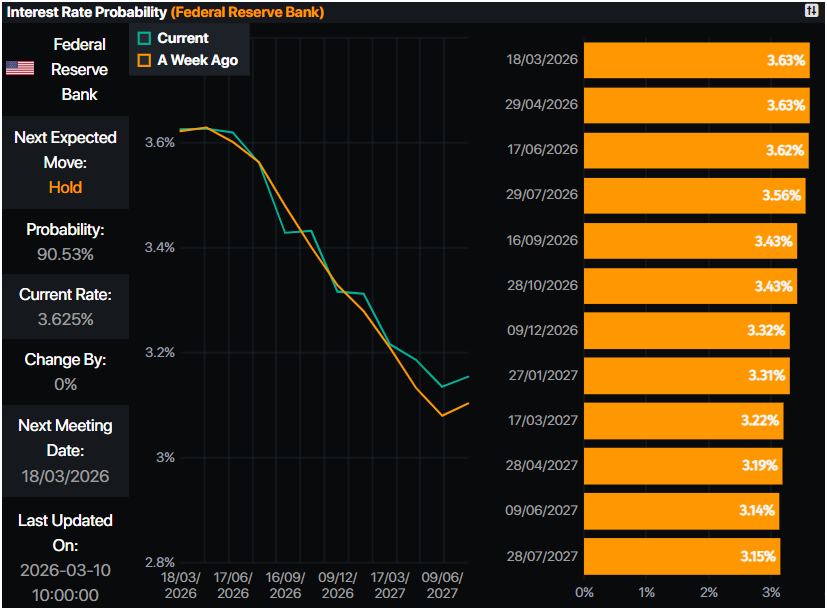
Earlier, US Existing Home Sales rose in February, improving following January’s -5.9% contraction, jumping by 1.7%. Jobs data, namely the US ADP Employment Change 4-week average, improved to 15.5K, up from the previous week's 12.8K reading.
US inflation data in focus
On Wednesday, the release of the US Consumer Price Index (CPI) for February would shed some light on the Fed’s stance on monetary policy. Headline CPI is projected to come at 2.4% YoY, unchanged from January’s reading, while Core CPI is projected to stay firm at 2.5% YoY, as in the previous month's reading.
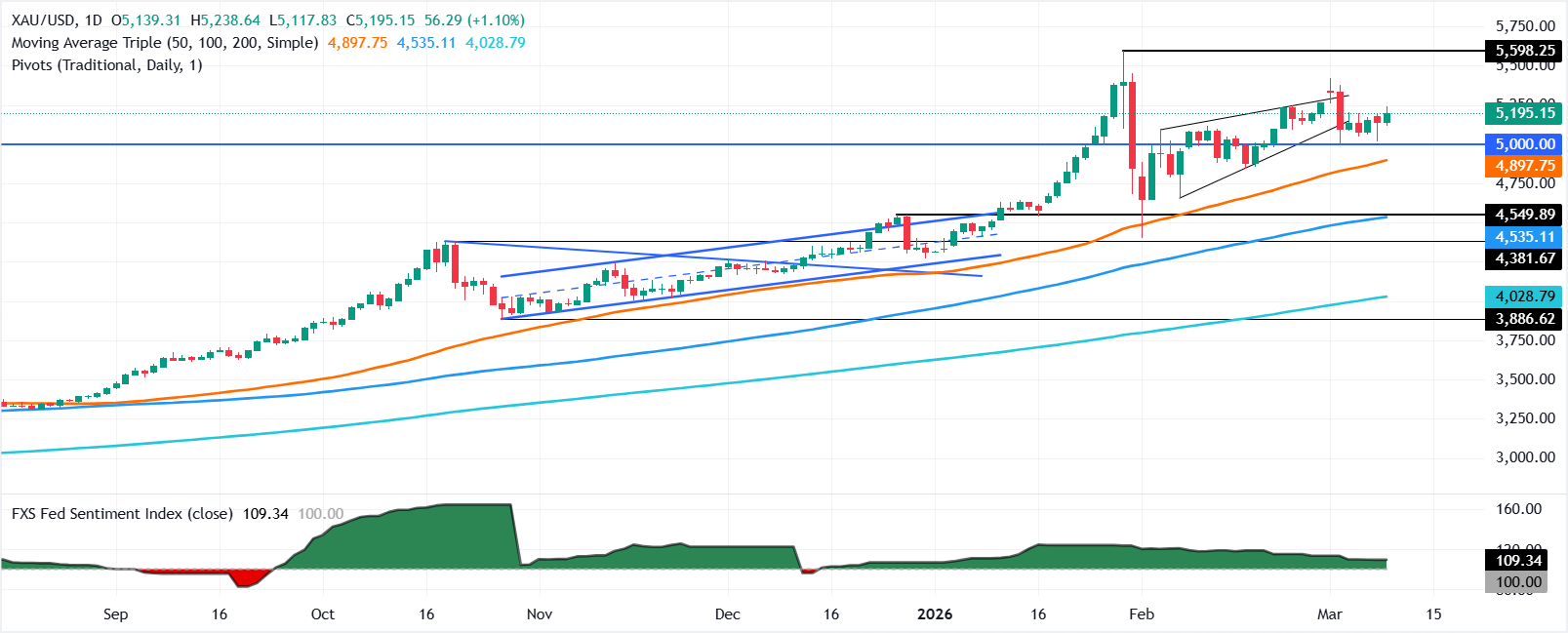
XAU/USD Technical outlook: Bullish upside remains, above $5,100
Gold prices continued to seesaw, unable to get a definitive direction, sponsored by geopolitical uncertainty, and despite the yellow metal’s inflation hedge appeal.
The technical picture shows XAU/USD consolidating within $5,100-$5,250, while momentum favors bulls, as depicted by the Relative Strength Index (RSI). Although momentum is bullish, buyers must clear key resistance levels, which could pave the way for further upside.
If Gold clears the March 2 swing high of $5,419, expect a test of the $5,500 figure. On further strength, the next stop is around the record high near $5,600.
Conversely, if XAU/USD tumbles below $5,150, the first support will be $5,100. A breach of the latter will expose the March 9 daily low of $5,014 ahead of the 50-day Simple Moving Average (SMA) at $4,884.
Gold FAQs
Gold has played a key role in human’s history as it has been widely used as a store of value and medium of exchange. Currently, apart from its shine and usage for jewelry, the precious metal is widely seen as a safe-haven asset, meaning that it is considered a good investment during turbulent times. Gold is also widely seen as a hedge against inflation and against depreciating currencies as it doesn’t rely on any specific issuer or government.
Central banks are the biggest Gold holders. In their aim to support their currencies in turbulent times, central banks tend to diversify their reserves and buy Gold to improve the perceived strength of the economy and the currency. High Gold reserves can be a source of trust for a country’s solvency. Central banks added 1,136 tonnes of Gold worth around $70 billion to their reserves in 2022, according to data from the World Gold Council. This is the highest yearly purchase since records began. Central banks from emerging economies such as China, India and Turkey are quickly increasing their Gold reserves.
Gold has an inverse correlation with the US Dollar and US Treasuries, which are both major reserve and safe-haven assets. When the Dollar depreciates, Gold tends to rise, enabling investors and central banks to diversify their assets in turbulent times. Gold is also inversely correlated with risk assets. A rally in the stock market tends to weaken Gold price, while sell-offs in riskier markets tend to favor the precious metal.
The price can move due to a wide range of factors. Geopolitical instability or fears of a deep recession can quickly make Gold price escalate due to its safe-haven status. As a yield-less asset, Gold tends to rise with lower interest rates, while higher cost of money usually weighs down on the yellow metal. Still, most moves depend on how the US Dollar (USD) behaves as the asset is priced in dollars (XAU/USD). A strong Dollar tends to keep the price of Gold controlled, whereas a weaker Dollar is likely to push Gold prices up.
Recommended Articles


