




Gold holds strong at $4,200 as Fed-cut anticipation builds
- Gold consolidates in the $4,200-$4,250 range ahead of the key Fed meeting.
- Federal Reserve likely to announce a rate cut next week, boosting Gold’s outlook.
- US Inflation gauge remains near 3%, yet money markets expect a Fed’s dovish policy stance.
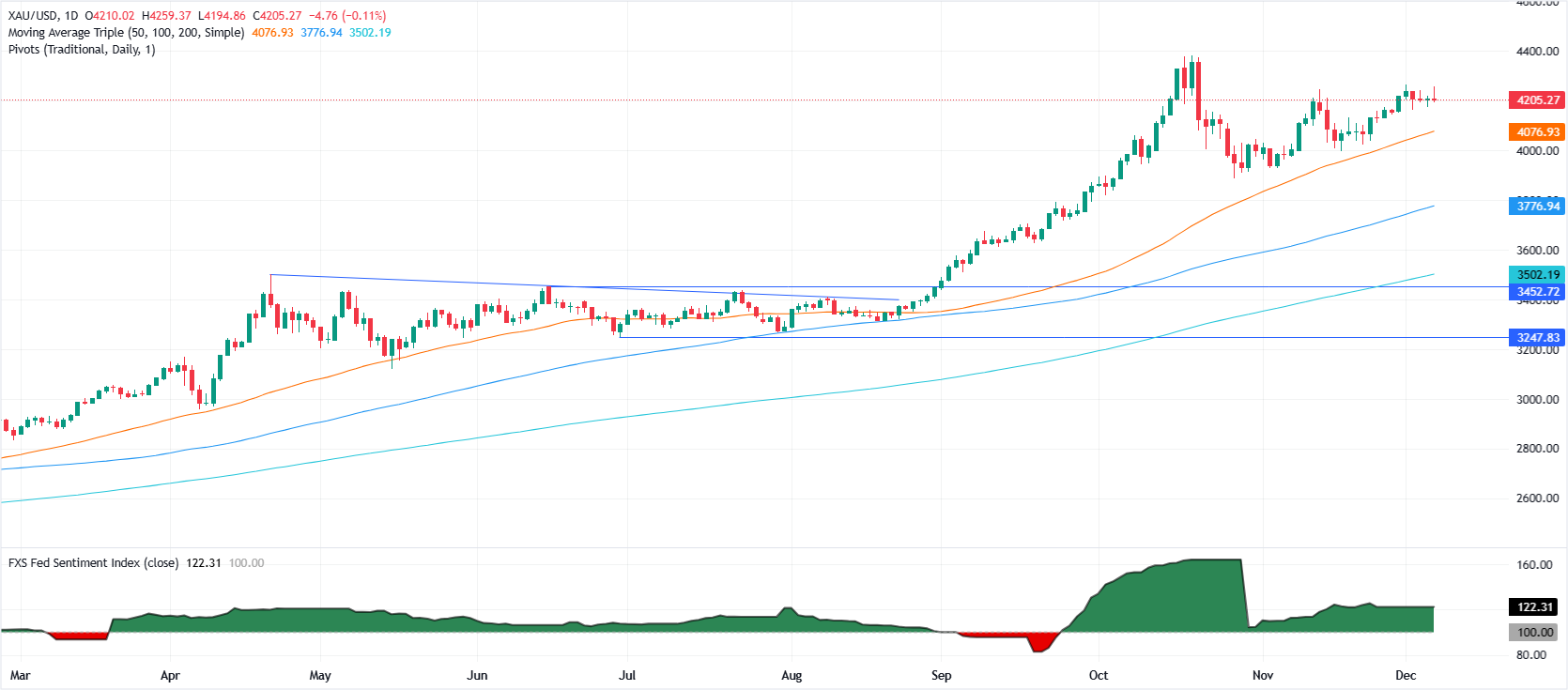
Gold (XAU/USD) advances during the North American session on Friday, poised to finish the week almost flat above the $4,200 figure as market participants brace for the Federal Reserve (Fed) monetary policy meeting next week. At the time of writing, XAU/USD trades at $4,216 after bouncing off daily highs of $4,259.
XAU/USD trades flat; markets eye Federal Reserve’s expected rate cut
The week ends with the release of the Fed’s preferred inflation gauge, the Core Personal Consumption Expenditures (PCE) Price Index for September, which remained virtually unchanged, slightly closer to the 3% threshold than the Fed’s 2% goal. Although the print would justify a Fed hold, jobs data showing a cooling labor market and dovish comments by Federal Reserve officials suggest that a rate cut is most likely.
Recently, the University of Michigan revealed that American consumers grew slightly optimistic regarding the outlook of the economy. Worth noting that inflation expectations dipped, even though there is growing speculation that the impact of tariffs is yet to be felt.
On Thursday, a Reuters poll revealed that economists had priced in the December rate cut, a green light for Gold price to extend its rally.
As of writing, the CME's FedWatch tool indicates an 87.2% probability of a 0.25% reduction next week.
Daily market movers: Gold firms as US Treasury yields climb
- The US Dollar Index (DXY), which tracks the American’s currency performance against other six, is virtually unchanged at 98.93.
- The US 10-year Treasury note yield is up nearly four basis points, up to 4.141%. US real yields, which correlate inversely with Gold prices, are also rising two bps to 1.881%, a headwind for Bullion.
- The Core Personal Consumption Expenditures (PCE) Price Index — the Federal Reserve’s preferred inflation measure excluding food and energy — rose 0.2% MoM in September, matching August’s pace and market estimates. On a yearly basis, core PCE eased from 2.9% to 2.8%, reinforcing the view that underlying inflation continues to cool gradually.
- The University of Michigan Consumer Sentiment index for December improved to 53.3, topping expectations of 52 and rising from November’s final reading of 51. Survey Director Joanne Hsu noted that “consumers see modest improvements from November on a few dimensions, but the overall tenor of views is broadly somber.”
- Inflation expectations moderated, with one-year expectations falling from 4.5% to 4.1%, while five-year expectations slipped from 3.4% to 3.2%, signaling a further easing in longer-term price concerns among households.
Technical Analysis: Gold price remains subdued post US Core PCE
Gold’s uptrend remains intact, but price action on Friday suggests that XAU/USD might consolidate within the $4,200-$4,250 range, ahead of the Fed’s meeting. Bullish momentum faded as depicted by the Relative Strength Index (RSI), which favors buyers, but it has turned flattish around the 61.00 level.
A break of the range to the upside clears the path to challenge $4,300 and the all-time high of $4,381. Conversely, a drop below $4,200 would expose initial support at the 20-day Simple Moving Average (SMA) at $4,124, followed by $4,100, and then the 50-day SMA at $4,059.
Gold FAQs
Gold has played a key role in human’s history as it has been widely used as a store of value and medium of exchange. Currently, apart from its shine and usage for jewelry, the precious metal is widely seen as a safe-haven asset, meaning that it is considered a good investment during turbulent times. Gold is also widely seen as a hedge against inflation and against depreciating currencies as it doesn’t rely on any specific issuer or government.
Central banks are the biggest Gold holders. In their aim to support their currencies in turbulent times, central banks tend to diversify their reserves and buy Gold to improve the perceived strength of the economy and the currency. High Gold reserves can be a source of trust for a country’s solvency. Central banks added 1,136 tonnes of Gold worth around $70 billion to their reserves in 2022, according to data from the World Gold Council. This is the highest yearly purchase since records began. Central banks from emerging economies such as China, India and Turkey are quickly increasing their Gold reserves.
Gold has an inverse correlation with the US Dollar and US Treasuries, which are both major reserve and safe-haven assets. When the Dollar depreciates, Gold tends to rise, enabling investors and central banks to diversify their assets in turbulent times. Gold is also inversely correlated with risk assets. A rally in the stock market tends to weaken Gold price, while sell-offs in riskier markets tend to favor the precious metal.
The price can move due to a wide range of factors. Geopolitical instability or fears of a deep recession can quickly make Gold price escalate due to its safe-haven status. As a yield-less asset, Gold tends to rise with lower interest rates, while higher cost of money usually weighs down on the yellow metal. Still, most moves depend on how the US Dollar (USD) behaves as the asset is priced in dollars (XAU/USD). A strong Dollar tends to keep the price of Gold controlled, whereas a weaker Dollar is likely to push Gold prices up.
Recommended Articles


