




EUR/USD remains bearish as ECB Lagarde plays down rate hike hopes
- EUR/USD drifts closer to 1.1700 on track to a mild weekly decline.
- The ECB kept its monetary policy unchanged and left all options open.
- In the US, November's CPI showed an unexpected decline in inflation.
EUR/USD extends losses for the fourth consecutive day on Friday, trading at 1.1715 at the time of writing, and on track to close the week slightly lower after having rallied nearly 2% over the previous three weeks.
The Euro (EUR) extended losses on Thursday after the European Central Bank (ECB) left interest rates unchanged, as widely expected, and ECB President Christine Lagarde refused to commit to any particular rate path. Lagarde affirmed that the decision was taken unanimously and there was no discussion to change interest rates, suggesting that market speculation about a rate hike is unfounded.
In the US, November's Consumer Price Index (CPI) revealed an unexpected decline in inflation, with the year-on-year rate easing to 2.7% from 3.0% in September, as October's reading was cancelled due to the US Government shutdown. The market has taken these figures with caution, and rightly so, as the Commerce Department affirmed that it only collected data from the second half of the month, with the Black Friday sales already in progress.
In the economic calendar on Friday, some ECB officials will take the stage during the European morning. In the US session, the US Michigan Consumer Sentiment Index and the European Commission's Consumer Confidence preliminary survey for December will be the main focus.
Euro Price Today
The table below shows the percentage change of Euro (EUR) against listed major currencies today. Euro was the strongest against the Japanese Yen.
| USD | EUR | GBP | JPY | CAD | AUD | NZD | CHF | |
|---|---|---|---|---|---|---|---|---|
| USD | 0.08% | 0.03% | 0.45% | 0.06% | 0.08% | 0.30% | 0.13% | |
| EUR | -0.08% | -0.05% | 0.38% | -0.01% | 0.00% | 0.22% | 0.05% | |
| GBP | -0.03% | 0.05% | 0.44% | 0.04% | 0.05% | 0.27% | 0.10% | |
| JPY | -0.45% | -0.38% | -0.44% | -0.39% | -0.39% | -0.18% | -0.34% | |
| CAD | -0.06% | 0.01% | -0.04% | 0.39% | 0.01% | 0.21% | 0.06% | |
| AUD | -0.08% | -0.01% | -0.05% | 0.39% | -0.01% | 0.21% | 0.04% | |
| NZD | -0.30% | -0.22% | -0.27% | 0.18% | -0.21% | -0.21% | -0.17% | |
| CHF | -0.13% | -0.05% | -0.10% | 0.34% | -0.06% | -0.04% | 0.17% |
The heat map shows percentage changes of major currencies against each other. The base currency is picked from the left column, while the quote currency is picked from the top row. For example, if you pick the Euro from the left column and move along the horizontal line to the US Dollar, the percentage change displayed in the box will represent EUR (base)/USD (quote).
Daily Digest Market Movers: Euro eases as the ECB maintains its "wait-and-see" stance
- The Euro is pulling back from recent highs, as investors come to terms with the fact that it is still too early to bet on an ECB rate hike. Downside attempts, however, are likely to remain limited, as the US Federal Reserve (Fed) is seen cutting rates at least two times in 2026.
- The ECB left its Rate on the Deposit Facility unchanged at 2%, as expected, and revised up its economic growth outlook to 1.4% in 2025 and 1.2% in 2026. President Lagarde, however, said that all options are open and that there is no date for any monetary policy move.
- In the US, CPI figures showed that inflation eased to a 2.7% yearly rate in November, from 3.0% in September, against expectations of a slight increase to 3.1%. Likewise, core inflation moderated to a 2.6% yearly rate from 3% in September.
- The German GfK Confidence Survey, released on Friday, has shown further deterioration, with January's reading dropping to -26.9 from -23.4 in the previous month, and undershooting market expectations of a -23.2 reading.
- German Producer Prices Index, also released on Friday, revealed that factory inflation stalled in November, down from a 0.1% rise in October, and contracted at a 2.3% pace in the last 12 months, below the 1.8% decline seen in October and also below the 2.2% contraction forecast by the market consensus.
- Later in the day, the preliminary Eurozone Consumer Confidence is expected to show a slight improvement to -14.0 in December from -14.2 in November.
- At the same time, December's US Michigan Consumer Sentiment Index is expected to be revised up to 53.4 from the 53.3 preliminary reading.
Technical Analysis: EUR/USD is expected to find support at 1.1700
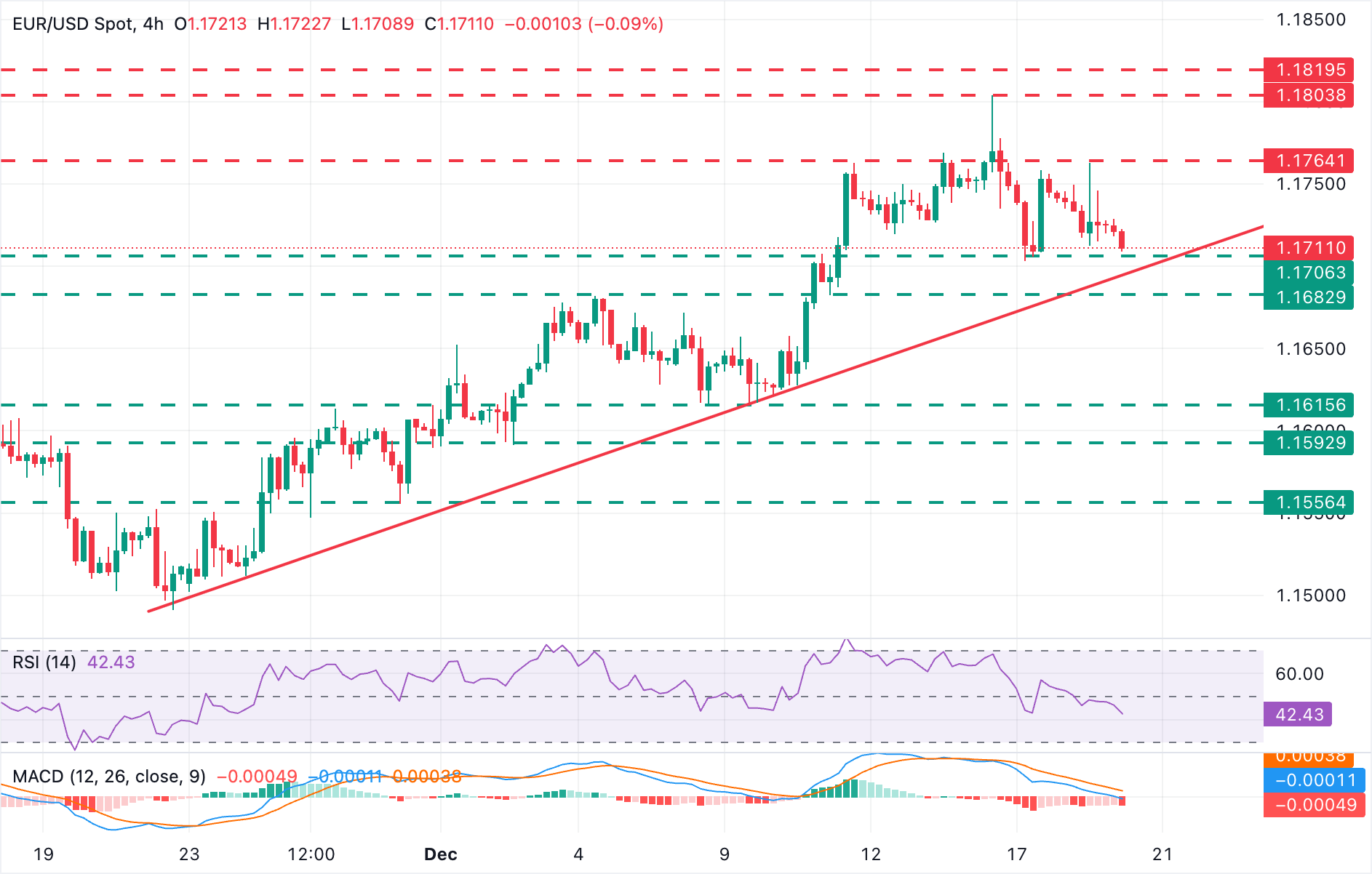
The EUR/USD remains under moderate bearish pressure, with bears focusing on the 1.1700 support area. The 4-hour Relative Strength Index (RSI) trends lower below the 50 mid-line, and the Moving Average Convergence Divergence (MACD) indicator remains below zero, printing red bars, which points to a growing negative momentum.
The December 17 low, at 1.1703, and the trendline support, now around 1.1695, are likely to challenge bears ahead of the 1.1685 level (December 11 low, December 4 high). A confirmation below this level would cancel the bullish view and bring the December 9 low, at 1.1615, into focus.
To the upside, immediate resistance is at Thursday's high, near 1.1760, ahead of Tuesday's high, at 1.1804, and the September 23 and 24 highs, near 1.1820.
ECB FAQs
The European Central Bank (ECB) in Frankfurt, Germany, is the reserve bank for the Eurozone. The ECB sets interest rates and manages monetary policy for the region. The ECB primary mandate is to maintain price stability, which means keeping inflation at around 2%. Its primary tool for achieving this is by raising or lowering interest rates. Relatively high interest rates will usually result in a stronger Euro and vice versa. The ECB Governing Council makes monetary policy decisions at meetings held eight times a year. Decisions are made by heads of the Eurozone national banks and six permanent members, including the President of the ECB, Christine Lagarde.
In extreme situations, the European Central Bank can enact a policy tool called Quantitative Easing. QE is the process by which the ECB prints Euros and uses them to buy assets – usually government or corporate bonds – from banks and other financial institutions. QE usually results in a weaker Euro. QE is a last resort when simply lowering interest rates is unlikely to achieve the objective of price stability. The ECB used it during the Great Financial Crisis in 2009-11, in 2015 when inflation remained stubbornly low, as well as during the covid pandemic.
Quantitative tightening (QT) is the reverse of QE. It is undertaken after QE when an economic recovery is underway and inflation starts rising. Whilst in QE the European Central Bank (ECB) purchases government and corporate bonds from financial institutions to provide them with liquidity, in QT the ECB stops buying more bonds, and stops reinvesting the principal maturing on the bonds it already holds. It is usually positive (or bullish) for the Euro.
Recommended Articles


