




Japanese Yen falters on fiscal concerns and BoJ rate-hike doubts
- The Japanese Yen kicks off the new week on a weaker note amid fiscal concerns, BoJ uncertainty.
- The risk-on impulse also undermines the safe-haven JPY and supports USD/JPY amid a bullish USD.
- Intervention fears might hold back the JPY bears from placing fresh bets and cap the currency pair.
The Japanese Yen (JPY) attracts fresh sellers at the start of a new week and erodes a part of Friday's modest recovery gains amid concerns about Japan's ailing fiscal position on the back of Prime Minister Sanae Takaichi’s pro-stimulus stance. Furthermore, the growing acceptance that the Bank of Japan (BoJ) would delay raising interest rates, along with a generally positive risk tone, is seen undermining the safe-haven JPY. The US Dollar (USD), on the other hand, sits near its highest level since late May in the wake of less dovish Federal Reserve (Fed) expectations and lifts the USD/JPY pair to the 156.80 region during the Asian session.
Meanwhile, comments from Japan's Finance Minister Satsuki Katayama on Friday fueled speculations that authorities could step in to stem further JPY weakness. Moreover, a member of a key government panel said on Sunday that Japan can actively intervene in the market to mitigate the negative economic impact of a weak JPY. This might hold back the JPY bears from placing aggressive bets. Nevertheless, the fundamental backdrop suggests that the path of least resistance for the JPY remains to the downside and backs the case for an extension of the USD/JPY pair's recent uptrend to the highest level since January, touched last Thursday.
Japanese Yen is pressured by concerns about Japan’s ailing fiscal position and BoJ rate hike uncertainty
- On Friday, Japan's cabinet approved a ¥21.3 trillion economic stimulus plan, marking the first significant policy initiative under Prime Minister Sanae Takaichi. The package contains ¥17.7 trillion in general account outlays, which exceeds the previous year's ¥13.9 trillion and represents the largest stimulus since the COVID pandemic. It will also include tax cuts totaling ¥2.7 trillion.
- This amplifies concerns about Japan's ailing fiscal position and fuels worries about the supply of new government debt, which keeps Japan’s borrowing costs close to the highest level in decades. Moreover, data released last week showed that Japan's economy contracted in Q3 for the first time in six quarters, putting additional pressure on the Bank of Japan (BoJ) to delay raising interest rates.
- Apart from this, the upbeat market mood prompts fresh selling around the safe-haven Japanese Yen during the Asian session on Monday amid relatively thin liquidity on the back of a holiday in Japan. The US Dollar, on the other hand, stands firm near its highest level since late May as traders have been scaling back their bets for another interest rate cut by the US Federal Reserve in December.
- In fact, minutes from the October FOMC meeting, released last Wednesday, showed that policymakers cautioned that cutting interest rates further could risk entrenched inflation. Moreover, the better-than-expected release of the delayed US Nonfarm Payrolls report for September eases concerns about the softening labor market conditions and validates less dovish Federal Reserve (Fed) expectations.
- Meanwhile, BoJ Governor Kazuo Ueda told the parliament on Friday that a weak JPY could push up import costs and broader prices. Moreover, Japan's Statistics Bureau reported that inflation remains sticky above the BoJ's 2% target, keeping alive hopes for a near-term interest rate hike. A Reuters poll showed that a slim majority of economists expect the BoJ to raise rates to 0.75% in December.
- Japan's Finance Minister Satsuki Katayama, in the strongest warning to date, said on Friday that we will take appropriate action as needed against excess volatility and disorderly market moves, and also signaled chances of intervention. Adding to this, an adviser to PM Takaichi said on Sunday that Japan has excessive foreign reserves, so it can become active in tapping them to conduct JPY intervention.
USD/JPY seems poised to appreciate further while above the 156.00 round figure
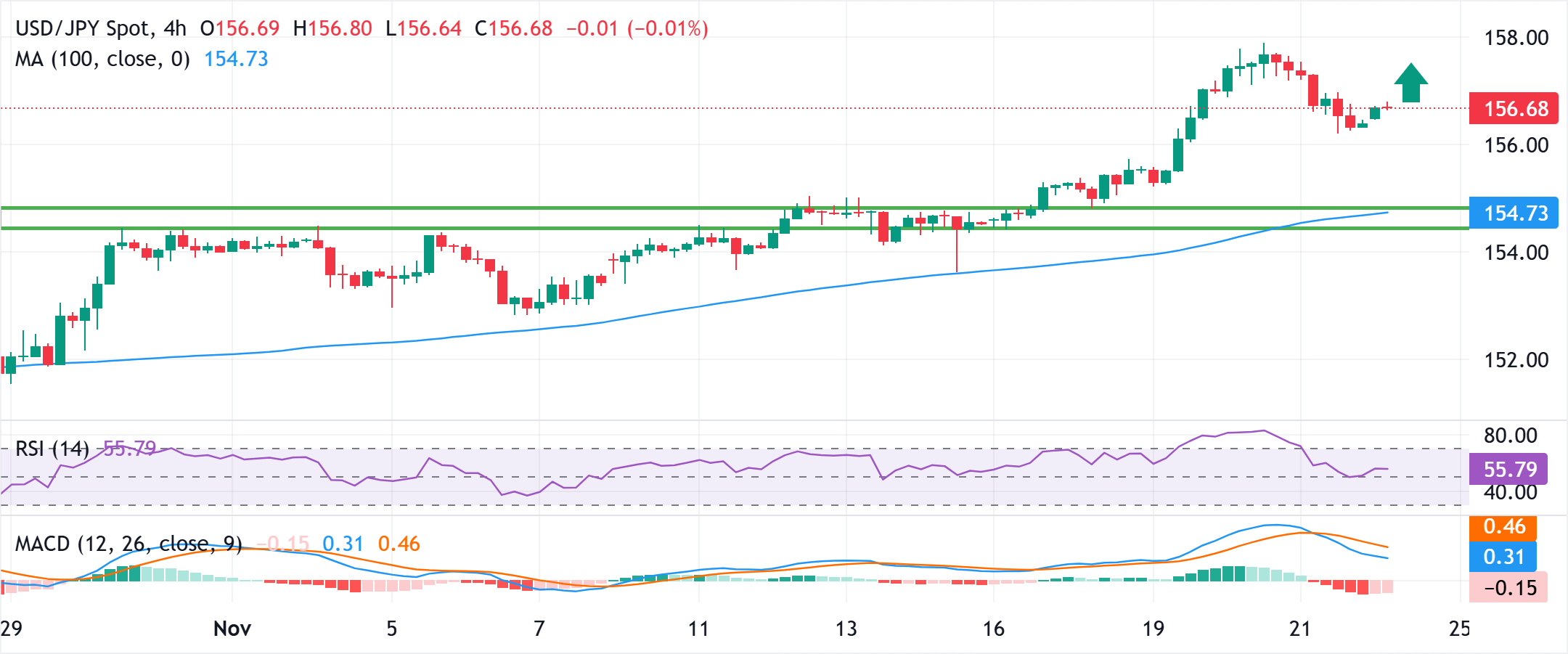
A subsequent strength beyond the 157.00 mark could lift the USD/JPY pair further towards the 157.45-157.50 intermediate hurdle en route to the 157.85-157.90 region, or an over ten-month peak touched last week. Some follow-through buying beyond the 158.00 round figure will be seen as a fresh trigger for bullish traders and pave the way for a further near-term appreciating move.
On the flip side, the 156.25-156.20 zone now seems to have emerged as an immediate support. This is followed by the 156.00 mark, which, if broken decisively, might prompt some technical selling and drag the USD/JPY pair to the 155.45-155.40 intermediate support en route to the 155.00 psychological mark. Any further decline is more likely to find decent support and attract fresh buyers near the 154.50-154.45 horizontal resistance breakpoint. The latter should act as a key pivotal point and as a strong near-term base for spot prices.
Japanese Yen FAQs
The Japanese Yen (JPY) is one of the world’s most traded currencies. Its value is broadly determined by the performance of the Japanese economy, but more specifically by the Bank of Japan’s policy, the differential between Japanese and US bond yields, or risk sentiment among traders, among other factors.
One of the Bank of Japan’s mandates is currency control, so its moves are key for the Yen. The BoJ has directly intervened in currency markets sometimes, generally to lower the value of the Yen, although it refrains from doing it often due to political concerns of its main trading partners. The BoJ ultra-loose monetary policy between 2013 and 2024 caused the Yen to depreciate against its main currency peers due to an increasing policy divergence between the Bank of Japan and other main central banks. More recently, the gradually unwinding of this ultra-loose policy has given some support to the Yen.
Over the last decade, the BoJ’s stance of sticking to ultra-loose monetary policy has led to a widening policy divergence with other central banks, particularly with the US Federal Reserve. This supported a widening of the differential between the 10-year US and Japanese bonds, which favored the US Dollar against the Japanese Yen. The BoJ decision in 2024 to gradually abandon the ultra-loose policy, coupled with interest-rate cuts in other major central banks, is narrowing this differential.
The Japanese Yen is often seen as a safe-haven investment. This means that in times of market stress, investors are more likely to put their money in the Japanese currency due to its supposed reliability and stability. Turbulent times are likely to strengthen the Yen’s value against other currencies seen as more risky to invest in.
Recommended Articles


