


Here Are 5 AI-Related Stocks to Buy and Hold for the Next 5 Years
Key Points
Copper and electricity demand by data centers is soaring.
These facilities also require several types of memory products.
Other electronic components are also critical for the AI expansion.
- 10 stocks we like better than Global X Funds - Global X Copper Miners ETF ›
The major driver of the stock market right now, and a huge contributor to economic growth, is the massive investment in artificial intelligence (AI) infrastructure -- primarily AI data centers -- by the so-called hyperscalers.
Hyperscalers are enormous technology companies that are borrowing and spending hundreds of billions of dollars a year to build AI data centers, including the big four: Meta Platforms, Microsoft, Amazon, and Alphabet. There are others, of course, but those four have more than tripled their capital expenditures (capex) on AI infrastructure over the last five years.
Will AI create the world's first trillionaire? Our team just released a report on the one little-known company, called an "Indispensable Monopoly" providing the critical technology Nvidia and Intel both need. Continue »
Companies worldwide spent almost $1 trillion on data centers last year, according to McKinsey & Company. That's projected to reach $4 trillion by 2030.
I would be surprised if that figure is not revised higher over the coming months and years -- many times. As Apollo noted in a recent research report, estimates of capital expenditures on data centers have risen multiple times over the past year.
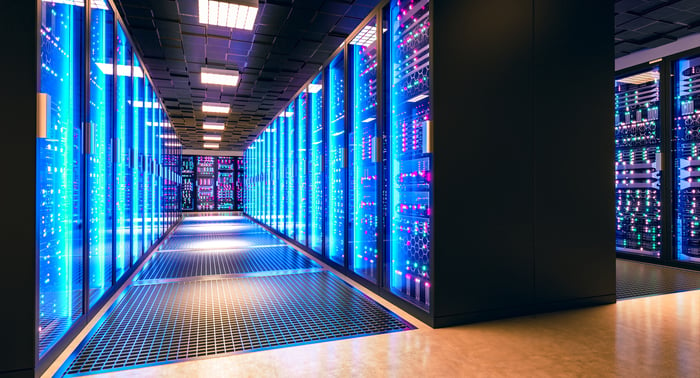
Image source: Getty Images.
If those forecasts are even partly true, AI capex will continue to drive economic growth and sustain the bull market for several years.
I wouldn't attempt to predict which of the four companies above will win this arms race to be the dominant provider of AI compute. But I am confident that the construction, maintenance, and ongoing scaling of these AI facilities will require substantial inputs. Namely, electricity, memory capacity, copper, and certain types of electronic components.
So, I've come up with a short list of companies providing those inputs, most of which are already seeing their revenue, profits, and share prices soar due to demand from data center spending. These should all be great stocks to buy and hold for at least the next five years.
Copper is indispensable, and demand is soaring
First, there's copper. A traditional data center requires between 5,000 and 15,000 tons of copper. AI data centers, in contrast, can need up to 50,000 tons of copper per facility, according to the Copper Development Association. As a result, the spot price of the red metal has increased from about $486 per pound one year ago to around $656 a pound today. That's a 35% increase.
A great way to play that is the Global X Copper Miners ETF (NYSEMKT: COPX), which tracks an index of global companies engaged in copper exploration, mining, and refining. It has more than doubled in price over the past year.
Next is power. Data centers are a huge new burden on the electric grid and are driving significant investment to bring more power online. The World Resources Institute estimates that global transmission and distribution infrastructure will need to double by 2050 to accommodate the world's power needs. GE Vernona (NYSE: GEV) is a leader in gas and steam turbines for power plants, wind turbines, and grid components. The stock is up 85% over the past year.
AI data center demand for memory is insatiable
The third major input is memory. Data centers have an insatiable need for it. Micron Technology (NASDAQ: MU) makes the dynamic random-access memory (DRAM) and NAND memory they need, and there's a global supply shortage, which has sent prices of DRAM and NAND chips soaring. As a result, the stock is up more than 900% over the past 52 weeks and recently entered the $1 trillion market-cap club.
Sandisk (NASDAQ: SNDK) makes the flash memory products that data centers also need in large volumes. Its products are generally solid-state drives that "hold" the memory so other chips, such as DRAM, can access it. The stock has soared more than 650% so far in 2026.
Certain other electronic components are also necessary for any data center. Taiyo Yuden (OTC: TYOYY), a Japanese company, manufacturers multilayer ceramic capacitors (MLCCs), which regulate power flow in electronic devices and are a critical component in data centers. A single Nvidia circuit board can require more than 6,000 MLCCs, and there is currently a global supply shortage of them. Goldman Sachs expects MLCC demand from AI servers to at least quadruple by 2030, while industry capacity is rising by about 10% per year. Taiyo Yuden's share price has soared more than 550% over the past year.
Finally, a bonus sixth pick for this AI-infrastructure inputs portfolio, and this one is rarely thought of as an AI-related company. I'm talking about Caterpillar (NYSE: CAT), maker of construction and farm equipment. Each data center construction project requires significant excavation, land clearing, and construction equipment, and CAT has the size and scale to handle the new level of demand. The stock is up 165% over the past year.
There you have it. A six-stock AI pick-and-shovel portfolio for the next five years.
Should you buy stock in Global X Funds - Global X Copper Miners ETF right now?
Before you buy stock in Global X Funds - Global X Copper Miners ETF, consider this:
The Motley Fool Stock Advisor analyst team just identified what they believe are the 10 best stocks for investors to buy now… and Global X Funds - Global X Copper Miners ETF wasn’t one of them. The 10 stocks that made the cut could produce monster returns in the coming years.
Consider when Netflix made this list on December 17, 2004... if you invested $1,000 at the time of our recommendation, you’d have $443,191!* Or when Nvidia made this list on April 15, 2005... if you invested $1,000 at the time of our recommendation, you’d have $1,258,838!*
Now, it’s worth noting Stock Advisor’s total average return is 941% — a market-crushing outperformance compared to 206% for the S&P 500. Don't miss the latest top 10 list, available with Stock Advisor, and join an investing community built by individual investors for individual investors.
See the 10 stocks »
*Stock Advisor returns as of June 7, 2026.
Matthew Benjamin has positions in Alphabet and Microsoft. The Motley Fool has positions in and recommends Alphabet, Amazon, Caterpillar, GE Vernova, Goldman Sachs Group, Meta Platforms, Micron Technology, Microsoft, and Nvidia. The Motley Fool has a disclosure policy.
Recommended Articles


