


Better Crypto Buy Right Now: XRP vs. Cardano
Key Points
Ripple is a private company and answers to its stakeholders, not XRP holders.
Cardano needs to attract stablecoin and tokenization partners to regain momentum.
Both cryptocurrencies have difficult waters to navigate.
- 10 stocks we like better than XRP ›
One of the fascinating parts of investing in an emerging technology like cryptocurrency is the different approaches taken by individual projects. The difference is deeper than their use cases; cryptos can have different underlying technologies, governance models, token issuance mechanisms, and ways to generate value. No two cryptocurrencies are the same when you look under the hood.
XRP (CRYPTO: XRP) and Cardano (CRYPTO: ADA) are good examples of this. Both are popular cryptocurrencies with the potential to disrupt traditional finance, but when you dig deeper, they are poles apart, revealing a major structural problem for XRP. This makes Cardano a better buy, even though XRP's price performance and other metrics suggest otherwise.
Will AI create the world's first trillionaire? Our team just released a report on the one little-known company, called an "Indispensable Monopoly" providing the critical technology Nvidia and Intel both need. Continue »

Image source: Getty Images.
How broader blockchain adoption affects XRP and Cardano
One of the ways I evaluate cryptocurrencies is by looking at their progress on stablecoins and tokenization. Tokenization is a way to record ownership on the blockchain, and it can apply to various assets, including equities, bonds, real estate, and more. Stablecoins are blockchain versions of traditional currencies that combine the speed and low transaction costs of the blockchain with the stability of, say, the U.S. dollar. If adoption continues, many financial transactions might move on-chain, changing the way money and investments work.
Cardano takes a research-first approach to development, which is both a strength and a weakness. It has the technology to compete with Ethereum (CRYPTO: ETH) in the stablecoin and tokenization space, but it lags behind other major blockchains. However, it could appeal to traditional financial institutions that value compliance and security.
Cardano is an ecosystem for developing a host of applications and products, but XRP had a different purpose. It is the native asset for the XRP Ledger and was initially intended as a cross-border payment bridge. It is closely connected to Ripple, a private company that set out to use blockchain technology to challenge traditional international money transfer and payment systems. Ripple (the company) has evolved and now offers businesses a host of blockchain services.
This brings me to XRP's fundamental flaw: Ripple and Cardano might benefit from the growth in stablecoins and tokenization. Cardano recently announced a regulation-focused tokenization engine. But XRP is a different story. Stablecoins offer a more effective way to move money across borders. This puts them in direct competition with XRP -- so much so that Ripple has launched its own dollar-pegged stablecoin, further undermining XRP's utility.
Moreover, XRP is becoming less and less important to Ripple as it develops other blockchain avenues, such as helping companies to integrate stablecoins or offering prime brokerage services. Ripple controls about 40% of XRP, much of which is in escrow, but it answers to its private stakeholders, not to XRP holders -- and it is those stakeholders who will benefit if Ripple grows its operations.
XRP's superior price performance and metrics
Like many cryptocurrencies, both Cardano and XRP have struggled price-wise this year. At the time of writing (June 1), Cardano is trading at $0.24 -- down 33% year to date. XRP is at $1.33, having fallen 30% since the start of the year. Over the past five years, Cardano's price has fallen by more than 85%, and XRP has gained almost 50%.
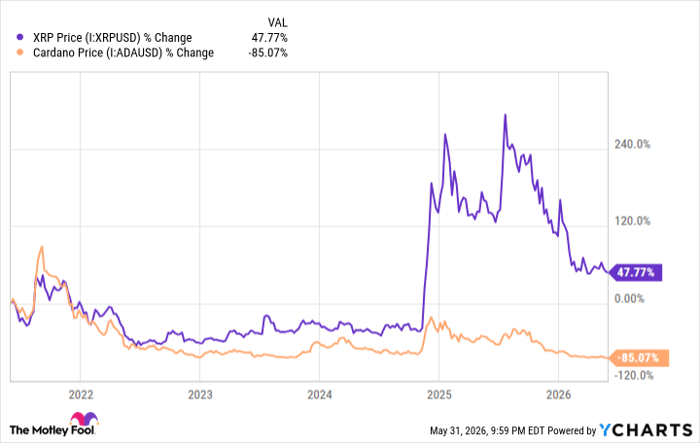
XRP Price data by YCharts.
XRP is the fifth-biggest cryptocurrency, with a market cap of $80.7 billion, while Cardano's is $8.6 billion, putting it in 17th place. Given that XRP and Cardano were pretty closely correlated until pre-U.S.-election speculation about the potential effect of a pro-crypto administration drove XRP to new highs, I find it hard to see how XRP will sustain its current price.
The XRP Ledger accounts for $660 million in stablecoins, considerably more than Cardano's $55 million. Ripple bought stablecoin company Rail last summer, which explains some of this difference. However, neither is winning the stablecoin race -- for context, there's $161 billion in stablecoins on Ethereum's ecosystem.
Cardano just hasn't built the same developer community or partnerships as, say, Ethereum or Solana (CRYPTO: SOL), and it will be hard for it to get its mojo back. But the tech is sound, and, as discussed earlier, mainstream blockchain adoption could be the spark Cardano needs. Decentralization is core to Cardano's model, which -- unlike XRP -- has pioneered on-chain governance. If its ecosystem does grow, Cardano investors will benefit.
Cardano and XRP both face challenges
This is a tale of two slightly problematic cryptocurrencies. Cardano put too much time into building the perfect engine and not enough into starting the race. XRP had a strong start, but it has since lost its way, and its investors have no control over its direction.
Ripple may well be a major crypto player for years to come, but that won't necessarily help XRP's price, since XRP transaction fees are negligible -- companies will pay Ripple directly for its services. That makes Cardano the stronger investment, no matter how much better XRP looks on paper.
Should you buy stock in XRP right now?
Before you buy stock in XRP, consider this:
The Motley Fool Stock Advisor analyst team just identified what they believe are the 10 best stocks for investors to buy now… and XRP wasn’t one of them. The 10 stocks that made the cut could produce monster returns in the coming years.
Consider when Netflix made this list on December 17, 2004... if you invested $1,000 at the time of our recommendation, you’d have $443,191!* Or when Nvidia made this list on April 15, 2005... if you invested $1,000 at the time of our recommendation, you’d have $1,258,838!*
Now, it’s worth noting Stock Advisor’s total average return is 941% — a market-crushing outperformance compared to 211% for the S&P 500. Don't miss the latest top 10 list, available with Stock Advisor, and join an investing community built by individual investors for individual investors.
See the 10 stocks »
*Stock Advisor returns as of June 7, 2026.
Emma Newbery has positions in Cardano, Ethereum, and Solana. The Motley Fool has positions in and recommends Ethereum, Solana, and XRP. The Motley Fool has a disclosure policy.
Recommended Articles


