


Meet the AI Company That Can Thrive Even if an AI Bubble Bursts
Key Points
Tesla's demand is less tied to the AI hype cycle, and its AI integration differentiates it from companies such as Oracle.
Tesla faces risks but may benefit in the long term after an AI bubble bursts.
- These 10 stocks could mint the next wave of millionaires ›
To see why Tesla (NASDAQ: TSLA) is an artificial intelligence (AI) company, it's necessary to appreciate what sets it apart from companies such as Oracle (NYSE: ORCL) and why it could be a longer-term winner if the AI bubble bursts.
An AI bubble?
History shows we might be in an AI bubble, but it also suggests that many people will call the top prematurely.
Will AI create the world's first trillionaire? Our team just released a report on the one little-known company, called an "Indispensable Monopoly" providing the critical technology Nvidia and Intel both need. Continue »
Let's put it this way: Two long-term investors can agree that the price of, say, oil is in a bubble when it's at $60. The price reaches $120, the bubble bursts, then falls to $80, only to rise inexorably afterward. The seller at $60 waxes lyrical about calling it a bubble and never gets to buy again at $80; the holder at $60 enjoys handsome returns even after getting burned in the bubble's collapse.
There is another approach: A third investor might find a company that, although it faces challenges when the bubble bursts, could actually benefit in the long run. Tesla could be in this position.
Why Tesla is well positioned
The rationale behind the argument is twofold. First, Tesla is a company that embeds AI into its solutions -- electric vehicles, robotaxis, and its Optimus humanoid robots -- rather than one that builds AI capabilities to sell to third parties. To be clear, Tesla, along with SpaceX, is an investor in chip manufacturing initiative Terafab.
SpaceX needs chips for its satellites and its AI business, xAI, while Tesla needs them for Optimus and eventually its EVs. So the Terafab project is meant to secure the supply chains for Tesla and SpaceX, not to sell chips to other companies.
The key point is that demand for Tesla's solutions comes from energy, EV, robotaxi, and Optimus customers, and that these solutions embed AI. Its massive $25 billion in capital investments in 2026 are intended to support the growth of these products and the supply chain that secures them. Its end demand isn't coming from AI computing.
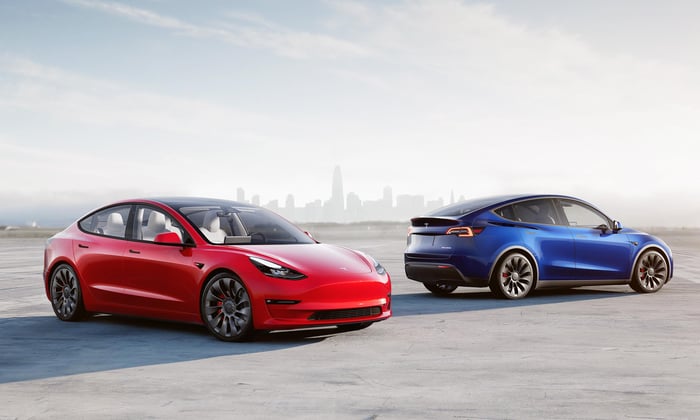
Image source: Tesla.
This situation sets Tesla apart from large companies like Oracle, which are spending heavily and taking on debt to build computing power they plan to sell to other companies, such as OpenAI.
If and when a bubble bursts and demand for AI computing moderates, companies like Oracle, with its $300 billion cloud computing agreement with OpenAI, could find themselves encumbered with massive debt, depreciating assets, and weakening revenue growth. The downside potential is significant.
Why Tesla can be a long-term winner from a bursting AI bubble
Again, Tesla and its stock will not be a net winner if an AI bubble bursts in the near term. When an inevitable correction occurs, the importance of AI in the global economy and the friction arising from misallocated investment mean that nearly all companies will suffer. That includes Tesla.
This brings us to the second point. After the initial shock of a burst bubble, if people still want energy, EVs, robotaxis, and Optimus, Tesla can keep growing in the long run because its main sources of demand are not directly linked to AI demand.
Image source: Getty Images.
In contrast, hyperscalers such as Oracle and AI companies such as OpenAI will need to adjust to a new long-term pricing reality as they model their revenue growth assumptions. Also, after a market correction, the technology, parts, and infrastructure that Tesla needs for production are likely to become more affordable.
What it means to Tesla investors
All of this is not to argue that Tesla is not a risky stock, because it continues to face execution risk around scaling and growing robotaxi and Optimus revenue. Moreover, a merger with SpaceX would definitely expose Tesla shareholders to the risk of a bursting AI bubble, given SpaceX's reliance on future revenue from orbital AI and the xAI business.
All told, there's every reason to believe Tesla would eventually emerge as a stronger company after an AI bubble bursts, and while it's impossible to know if we are months or years or even a decade from that moment, it does protect the long-term downside, with the stock maintaining the upside of productivity improvements from embedding AI in its solutions.
Don’t miss this second chance at a potentially lucrative opportunity
Ever feel like you missed the boat in buying the most successful stocks? Then you’ll want to hear this.
On rare occasions, our expert team of analysts issues a “Double Down” stock recommendation for companies that they think are about to pop. If you’re worried you’ve already missed your chance to invest, now is the best time to buy before it’s too late. And the numbers speak for themselves:
- Nvidia: if you invested $1,000 when we doubled down in 2009, you’d have $532,622!*
- Apple: if you invested $1,000 when we doubled down in 2008, you’d have $58,577!*
- Netflix: if you invested $1,000 when we doubled down in 2004, you’d have $443,191!*
Right now, we’re issuing “Double Down” alerts for three incredible companies, available when you join Stock Advisor, and there may not be another chance like this anytime soon.
See the 3 stocks »
*Stock Advisor returns as of June 6, 2026.
Lee Samaha has no position in any of the stocks mentioned. The Motley Fool has positions in and recommends Oracle and Tesla. The Motley Fool has a disclosure policy.
Recommended Articles


