


VTI vs. VOO: Which Vanguard ETF Will Buy More SpaceX Stock After Its IPO?
Key Points
S&P Dow Jones Indices just updated its policy on fast-tracking the addition of megacap stocks to the S&P 500.
SpaceX won't be added to the S&P 500 for at least a year.
The Vanguard S&P 500 ETF is more concentrated than the Vanguard Total Stock Market ETF.
- 10 stocks we like better than Vanguard S&P 500 ETF ›
The SpaceX initial public offering (IPO) is set to take place on June 12, with the company raising $75 billion at a valuation of $1.77 trillion. The sheer size of SpaceX has ripple effects through the investing world, from the major indexes to exchange-traded funds (ETFs).
Although SpaceX was initially expected to be fast-tracked for entry into the S&P 500 (SNPINDEX: ^GSPC), S&P Dow Jones Indices released a press release on June 4 rejecting its earlier proposal. Now, SpaceX and other megacap companies like Anthropic and OpenAI will have to wait at least 12 months after their IPOs to join the S&P 500.
Will AI create the world's first trillionaire? Our team just released a report on the one little-known company, called an "Indispensable Monopoly" providing the critical technology Nvidia and Intel both need. Continue »
Here's how the news impacts the two largest ETFs by net assets -- the Vanguard S&P 500 ETF (NYSEMKT: VOO) and the Vanguard Total Stock Market ETF (NYSEMKT: VTI) -- and which one will own more SpaceX after its IPO.

Image source: Getty Images.
Low-cost exposure to the broader market
The Vanguard S&P 500 ETF and the Vanguard Total Stock Market ETF have identical 0.03% expense ratios, which is the lowest of any index fund or ETF.
The Vanguard S&P 500 ETF uses the S&P 500 as a benchmark, while the Vanguard Total Stock Market ETF uses the CRSP U.S. Total Market Index. So while the Vanguard S&P 500 ETF has the same holdings as the S&P 500, the Vanguard Total Stock Market ETF has far more holdings -- 3,494 to be exact. However, both ETFs have similar long-term performance because the S&P 500 accounts for the vast majority of the U.S. stock market's value.
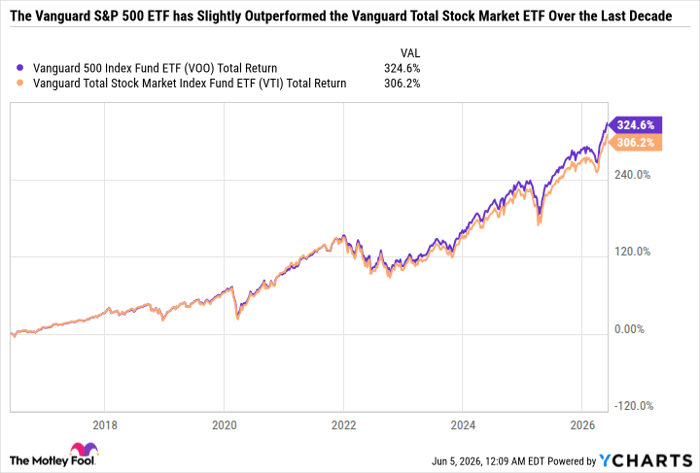
Data by YCharts.
In practice, both ETFs will have the same top 500 holdings, but the Vanguard Total Stock Market ETF will assign slightly lower weightings to each stock to make room for the 3,000 or so smaller companies.
The biggest differences are with the largest companies.
|
Company |
Market |
Vanguard S&P 500 |
Vanguard Total Stock Market |
|---|---|---|---|
|
Nvidia |
$5.3 trillion |
7.9% |
6.6% |
|
Alphabet |
$4.57 trillion |
6.5% |
5.8% |
|
Apple |
$4.51 trillion |
6.5% |
5.7% |
|
Microsoft |
$3.18 trillion |
4.9% |
4.4% |
|
Amazon |
$2.73 trillion |
4.2% |
3.7% |
|
Broadcom |
$1.98 trillion |
3.2% |
2.9% |
|
Meta Platforms |
$1.59 trillion |
2.2% |
1.9% |
|
Tesla |
$1.56 trillion |
1.7% |
1.6% |
|
Berkshire Hathaway |
$1.03 trillion |
1.4% |
1.2% |
|
JPMorgan Chase |
$833 billion |
1.3% |
1.1% |
Data sources: Vanguard, YCharts. Market capitalization figure is as of June 4, 2026. Index weightings are as of April 30, 2026.
Buy the Vanguard Total Stock Market ETF for SpaceX exposure
The SpaceX IPO, and likely Anthropic's and OpenAI's, throw a wrinkle in the composition of these funds. The Vanguard S&P 500 ETF won't buy a stock until it's part of the index, but the Vanguard Total Stock Market ETF will buy a stock shortly after its IPO, regardless of what index it is in. However, the Vanguard Total Stock Market ETF will likely base the weighting of that position on the total shares available for public trading, known as the float, rather than the market cap.
As insiders sell shares and more shares become available for public trading, SpaceX's weight in the Vanguard Total Stock Market ETF and other ETFs will increase. And if SpaceX is added to the S&P 500 shortly after its 12-month window expires -- in June 2027 -- then it will probably be based on market cap, assuming SpaceX's float is large enough.
In sum, SpaceX will start with a higher weighting in the Vanguard Total Stock Market ETF, but it will eventually be a higher weighting in the Vanguard S&P 500 ETF. Meaning that investors who want initial exposure to blockbuster IPOs would be better off buying the Vanguard Total Stock Market ETF since it isn't restricted by index rules.
Should you buy stock in Vanguard S&P 500 ETF right now?
Before you buy stock in Vanguard S&P 500 ETF, consider this:
The Motley Fool Stock Advisor analyst team just identified what they believe are the 10 best stocks for investors to buy now… and Vanguard S&P 500 ETF wasn’t one of them. The 10 stocks that made the cut could produce monster returns in the coming years.
Consider when Netflix made this list on December 17, 2004... if you invested $1,000 at the time of our recommendation, you’d have $443,191!* Or when Nvidia made this list on April 15, 2005... if you invested $1,000 at the time of our recommendation, you’d have $1,258,838!*
Now, it’s worth noting Stock Advisor’s total average return is 941% — a market-crushing outperformance compared to 211% for the S&P 500. Don't miss the latest top 10 list, available with Stock Advisor, and join an investing community built by individual investors for individual investors.
See the 10 stocks »
*Stock Advisor returns as of June 6, 2026.
JPMorgan Chase is an advertising partner of Motley Fool Money. Daniel Foelber has positions in Nvidia. The Motley Fool has positions in and recommends Alphabet, Amazon, Apple, Berkshire Hathaway, Broadcom, JPMorgan Chase, Meta Platforms, Microsoft, Nvidia, Tesla, and Vanguard S&P 500 ETF. The Motley Fool has a disclosure policy.
Recommended Articles


