


This Glorious Growth Stock Soared by 55% in May, but Here's Why It Probably Isn't a Buy in June
Key Points
Hackers are using artificial intelligence (AI) to launch powerful cyberattacks that traditional security tools simply can't handle.
Palo Alto is infusing AI into its entire portfolio of cybersecurity products to fight fire with fire, resulting in signficant demand.
The company's stock rocketed higher last month, but its sky-high valuation should give investors pause.
- 10 stocks we like better than Palo Alto Networks ›
The cybersecurity industry has a history of fragmentation. In the past, businesses could only achieve adequate protection by using several vendors, each of whom specialized in one or two products. But these products rarely worked well together, resulting in slow response times and gaping holes in corporate defenses.
This is no longer acceptable in the modern era, because hackers are using artificial intelligence (AI) to rapidly exploit such vulnerabilities. In fact, Palo Alto Networks (NASDAQ: PANW) CEO Nikesh Arora says a fragmented cybersecurity stack is the enemy.
Will AI create the world's first trillionaire? Our team just released a report on the one little-known company, called an "Indispensable Monopoly" providing the critical technology Nvidia and Intel both need. Continue »
The company now promotes a concept called "platformization," which involves enterprises using one single vendor for all of their needs. This unified approach plugs gaps and facilitates a machine-speed response to threats.
Platformization also means customers are spending more money with vendors like Palo Alto, and investors are taking notice. The company's stock soared by 55% in May alone. But here's why it might be wise to tread carefully from here on out.

Image source: Getty Images.
Fighting fire with fire
Earlier this year, Palo Alto's Unit 42 research division demonstrated how AI-powered cyberattacks can breach a corporate network and steal data within just 25 minutes. But here's the scary part: It still takes many companies several days to identify a successful breach, highlighting the woeful inadequacy of traditional cybersecurity tools.
Palo Alto has infused AI across its entire portfolio of cybersecurity platforms, which span cloud security, network security, and security operations. The company's AI models collect 17 petabytes (17 million gigabytes) of telemetry data from its customers' cybersecurity deployments every day, ensuring they continually learn and improve to thwart the latest threats.
Cortex XSIAM is one of Palo Alto's fastest-growing products. It's a security operations platform that uses AI to automate threat detection and incident response processes, and as a result, the company says most of its customers now identify attacks in under 10 minutes. During the fiscal 2026 third quarter (ended April 30), Palo Alto said XSIAM's revenue doubled year over year.
But Palo Alto is also trying to protect enterprises that are using AI. Every time they deploy an AI agent or feed their internal data into third-party models like those from OpenAI and Anthropic, they create new attack surfaces for hackers to exploit. The company's Prisma AIRS platform monitors every agent's actions in real time and continuously scans third-party models for vulnerabilities. It's another rapidly growing product, with its customer base tripling sequentially in the third quarter.
Revenue growth accelerated sharply in the recent quarter
Palo Alto generated $3 billion in revenue during the third quarter, topping management's guidance of $2.94 billion. It represented a 31% year-over-year increase, which marked a sharp acceleration from the 15% growth the company delivered three months earlier in the second quarter.
That suggests there is significant momentum in Palo Alto's business, but not all of the growth was organic; the company recognized $388 million in revenue from its newly acquired subsidiaries, CyberArk and Chronosphere, for the first time during the quarter, which boosted its results.
Palo Alto also reported a record $8.1 billion in annual recurring revenue (ARR) from its next-generation security (NGS) portfolio, which includes AI products like XSIAM. That was up by a whopping 60% compared to the year-ago period, but it would have grown by just 28% without the inclusion of $1.6 billion in NGS ARR from CyberArk and Chronosphere.
Companies grow through acquisitions all the time, so this isn't a bad thing, but investors shouldn't confuse this with organic growth, which is a far more valuable demand signal.
Palo Alto's valuation could limit further upside
Following its recent gains, Palo Alto stock is currently trading at a price-to-sales (P/S) ratio of 21.3. Not only is that an all-time high, but it's also more than twice its long-term average of 10.5, dating back to its initial public offering (IPO) in 2012.
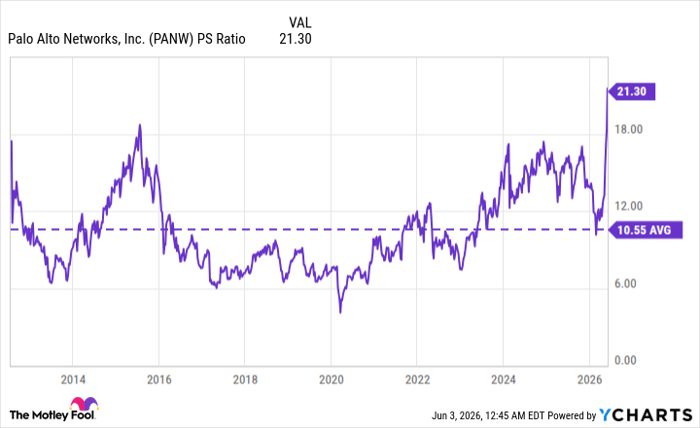
PANW PS Ratio data by YCharts
As a result, it's very difficult to make the case for buying Palo Alto stock at the current level. In fact, its valuation could lead to subdued returns for several years.
Palo Alto ended the third quarter with 2,280 customers that it considered "platformed," but it believes it can grow that number to over 4,000 by 2030. If successful, the company says these customers could contribute up to $20 billion in NGS ARR, more than double its current NGS ARR of $8.1 billion.
If we assume that scenario plays out exactly as forecast, Palo Alto stock would have a forward P/S ratio of 12, which would still be above its long-term average of 10.5. In other words, investors are pricing in significant future growth right now and assuming the company will execute flawlessly.
While cybersecurity will be an increasingly important industry in the AI era, I simply don't think the risk-reward equation for this stock makes sense right now. Investors might want to consider waiting for a pullback before adding it to their portfolio.
Should you buy stock in Palo Alto Networks right now?
Before you buy stock in Palo Alto Networks, consider this:
The Motley Fool Stock Advisor analyst team just identified what they believe are the 10 best stocks for investors to buy now… and Palo Alto Networks wasn’t one of them. The 10 stocks that made the cut could produce monster returns in the coming years.
Consider when Netflix made this list on December 17, 2004... if you invested $1,000 at the time of our recommendation, you’d have $439,632!* Or when Nvidia made this list on April 15, 2005... if you invested $1,000 at the time of our recommendation, you’d have $1,316,532!*
Now, it’s worth noting Stock Advisor’s total average return is 959% — a market-crushing outperformance compared to 210% for the S&P 500. Don't miss the latest top 10 list, available with Stock Advisor, and join an investing community built by individual investors for individual investors.
See the 10 stocks »
*Stock Advisor returns as of June 5, 2026.
Anthony Di Pizio has no position in any of the stocks mentioned. The Motley Fool recommends Palo Alto Networks. The Motley Fool has a disclosure policy.
Recommended Articles


