


Will Broadcom Stock Recover After Its Guidance Disappointment, Or Should You Cut Your Losses?
Key Points
The stock's decline wiped out just a week's worth of gains, a detail investors tend to miss.
Management is looking beyond 2027.
Valuation looks reasonable at 22 times forward earnings.
- 10 stocks we like better than Broadcom ›
Shares of Broadcom Inc. (NASDAQ:AVGO) tumbled more than 14% at one point today, wiping out nearly $300 billion in market value, following the company's fiscal second-quarter earnings report after the market closed yesterday.
The fallout reverberated across the semiconductor space, with chip stocks Advanced Micro Devices, Intel, and Micron Technology all falling as the market reevaluated its expectations for AI semiconductor growth.
Will AI create the world's first trillionaire? Our team just released a report on the one little-known company, called an "Indispensable Monopoly" providing the critical technology Nvidia and Intel both need. Continue »
A subtle detail investors tend to miss
Yet the scale of the sell-off obscures an important detail. Just over a week ago, Broadcom shares were trading at roughly the same level as they are at today’s close. In effect, the stock merely surrendered gains accumulated during a five-session rally (excluding today, of course).
So this raises the question: Was management simply tempering overly bullish expectations regarding Broadcom’s prospects in the run-up to the earnings announcement?

Image source: Getty Images. Broadcom reported a strong quarter.
Broadcom’s latest quarterly results were anything but weak. For the second quarter, revenue came in at $22.19 billion, up 48% year over year and slightly above consensus estimates of $22.13 billion.
Adjusted earnings-per-share (EPS), at $2.44, too, beat the $2.39 estimate. Importantly, revenue from AI semiconductors alone soared 143% to $10.8 billion, further establishing Broadcom as a key player in the build-out of AI infrastructure.
Furthermore, management guided fiscal Q3 revenue to approximately $29.4 billion, well above the $28.5 billion that analysts are anticipating.
Yet, the market seemed to focus on a narrower detail within Broadcom's AI outlook.
Was Wall Street expecting too much?
During the earnings call, management projected third-quarter AI chip revenue of roughly $16 billion. While this represents significant growth compared to prior periods, it seemed to have fallen short of the “whisper numbers” that many investors had expected. Specifically, the consensus forecast for AI chip revenue for the third quarter is about $17.2 billion.
Management also chose not to raise Broadcom’s longer-term AI revenue target of $100 billion by fiscal 2027. Instead, it reaffirmed the target.
The market seems to have grown accustomed to seeing strong upward revisions from top AI businesses every quarter. Investors effectively punished Broadcom not for missing expectations, but for failing to exceed increasingly unrealistic ones. Wall Street was indeed expecting too much.
Valuation still looks reasonable
Despite the stock gaining more than fivefold over the past three years, its forward 12-month PE ratio has traded in a fairly tight band of 12.5 and 35, with an average of 20.3. Right now, at 22.6, Broadcom’s forward PE stands a little over the average.
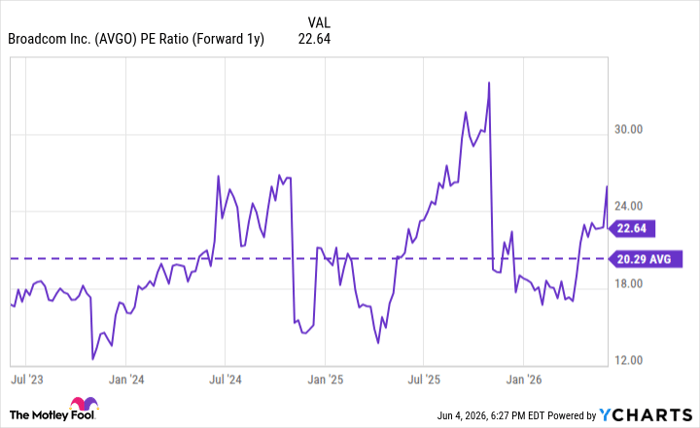
AVGO PE Ratio (Forward 1y) data by YCharts.
Management most likely wanted to temper runaway expectations and appear prudent rather than let the stock run further ahead, which would have hurt its price even more if unchecked. Broadcom has little reason to generate hype for its AI business if doing so creates expectations that are too high for the company to meet.
Management is looking beyond 2027
Management’s focus seems to be on Broadcom’s longer-term prospects in AI. CEO Hock Tan mentioned that supply commitments are largely secured through 2027, and that planning efforts are already underway for 2028 and 2029.
That implies that Broadcom will continue to see sustained demand from hyperscale customers.
By reiterating its long-term ambitions rather than raising near-term targets, management seems to have been intentionally conservative, potentially mitigating the risk of large-scale disappointments in the future.
Viewed through that lens, management’s decision to leave next year’s AI revenue target unchanged comes as no surprise.
Within the AI ecosystem, Broadcom’s importance can’t be understated. Broadcom's proficiency in AI networking and connectivity, facilitated by its specialized application-specific integrated circuit (ASIC) chips (which serve as substitutes for conventional processors), has enabled the company to cultivate robust ties with hyperscalers and establish a leading position in what may become a monumental period of technological investment.
Will the stock recover?
Ultimately, the key question for long-term investors is whether today’s decline in Broadcom’s stock price reflects deteriorating fundamentals or is simply a correction of previously unreasonable expectations. It appears less like a warning sign of fundamental weakness and more like a necessary cooling-off period after short-term expectations became unreasonable.
For investors willing to commit to a five-plus-year time frame, Broadcom’s superior free cash flow generation, expanding software business, and growing exposure to the burgeoning AI infrastructure build-out remain compelling advantages.
The underlying investment thesis remains largely intact.
Should you buy stock in Broadcom right now?
Before you buy stock in Broadcom, consider this:
The Motley Fool Stock Advisor analyst team just identified what they believe are the 10 best stocks for investors to buy now… and Broadcom wasn’t one of them. The 10 stocks that made the cut could produce monster returns in the coming years.
Consider when Netflix made this list on December 17, 2004... if you invested $1,000 at the time of our recommendation, you’d have $439,632!* Or when Nvidia made this list on April 15, 2005... if you invested $1,000 at the time of our recommendation, you’d have $1,316,532!*
Now, it’s worth noting Stock Advisor’s total average return is 959% — a market-crushing outperformance compared to 210% for the S&P 500. Don't miss the latest top 10 list, available with Stock Advisor, and join an investing community built by individual investors for individual investors.
See the 10 stocks »
*Stock Advisor returns as of June 4, 2026.
Isac Simon has no position in any of the stocks mentioned. The Motley Fool has positions in and recommends Advanced Micro Devices, Broadcom, Intel, and Micron Technology. The Motley Fool has a disclosure policy.
Recommended Articles


