


That Didn't Take Long: President Donald Trump Just Threw New Fed Chair Kevin Warsh Under the Bus
Key Points
Jerome Powell's final day as Fed chair was May 15, with Trump's handpicked successor, Kevin Warsh, officially being sworn in on May 22.
Although Trump spoke of central bank independence during Warsh's swearing-in ceremony, it took just hours for the president to change his tune on interest rates.
Two concurrent price shocks will make it difficult for the new Fed chair and the Federal Open Market Committee (FOMC) to lower interest rates.
- 10 stocks we like better than S&P 500 Index ›
Last month was a history-maker for Wall Street. The iconic Dow Jones Industrial Average (DJINDICES: ^DJI), benchmark S&P 500 (SNPINDEX: ^GSPC), and technology-driven Nasdaq Composite (NASDAQINDEX: ^IXIC) all catapulted to several record-closing highs. We also observed a change at the Federal Reserve's top position.
May 15 marked the end of Jerome Powell's tenure as head of the Fed and effectively passed the baton to President Donald Trump's nominee, Kevin Warsh, who was officially sworn in on May 22. Warsh, who brings five years of previous experience to the position, has promised to lead a reform-oriented Federal Reserve.
Will AI create the world's first trillionaire? Our team just released a report on the one little-known company, called an "Indispensable Monopoly" providing the critical technology Nvidia and Intel both need. Continue »

President Trump watching Fed Chair Kevin Warsh deliver remarks. Image source: Official White House Photo by Daniel Torok.
But just hours after the swearing-in ceremony at the White House, President Trump threw the new Fed chair under the bus concerning interest rates.
Donald Trump wasted no time outlining his expectations for Kevin Warsh
Long before Kevin Warsh was confirmed to his new post by the Senate Banking Committee and U.S. Senate, Trump was publicly chastising Powell and other members of the Federal Open Market Committee (FOMC) for their lack of action in cutting interest rates. The FOMC is the 12-person body, including the Fed chair, responsible for setting the nation's monetary policy.
Though the FOMC lowered the federal funds target rate six times from September 2024 to December 2025, the current rate of 3.5% to 3.75% is a far cry from the president's call for interest rates of 1% or lower.
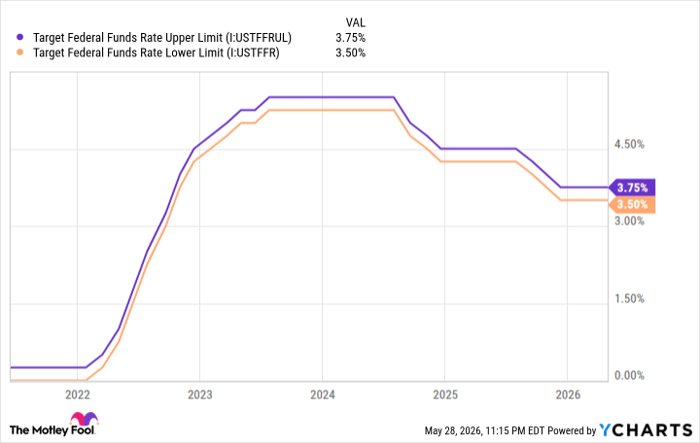
Target Federal Funds Rate Upper Limit data by YCharts.
Trump's impetus for lower interest rates is threefold:
- Lower lending rates can spur economic growth and increase hiring.
- A corresponding decline in Treasury yields should (indirectly) lead to lower mortgage rates, making housing more affordable.
- It would make servicing the nation's $39 trillion in debt more manageable.
During Warsh's swearing-in ceremony, Trump proclaimed:
Honestly, I really mean this. This is not said in any other way. I want Kevin to be totally independent... Just do your own thing and do a great job. OK?
But just hours later, while speaking to an audience at a local community college, Donald Trump declared:
We're going to get interest rates down quickly... everybody's gonna be happy.
It took the president virtually no time to outline his expectations for the new Fed chair. The problem is he's placed Warsh in a no-win scenario.

Image source: Getty Images.
Fed Chair Warsh is facing an impossible task of appeasing Trump and Wall Street
Warsh is taking the helm amid not one but two price shocks driven by President Trump.
The first, which Powell repeatedly referenced in FOMC meetings, is Trump's tariffs. Adding duties to imported unfinished goods (e.g., steel) has led to stickier prices in the goods sector.
However, the glaring issue is the inflationary effects of the Iran war. Iran's closing of the Strait of Hormuz to virtually all commercial vessels has created the largest energy supply disruption in modern history. Fuel prices are climbing at the fastest pace in over three decades, and the adverse effects of higher prices are just beginning to be felt beyond the energy arena.
"If Trump wants someone easy on inflation, he got the wrong guy in Kevin Warsh."@AnnaEconomist pic.twitter.com/FGMfeSqHpU
-- Daily Chartbook (@dailychartbook) January 31, 2026
The Cleveland Fed's May inflation forecast points to prices rising at the quickest pace in three years. Warsh, who has historically leaned hawkish (i.e., favored higher interest rates to suppress inflation), and the FOMC aren't in any position to consider lowering interest rates quickly, or at all.
Although President Trump and Wall Street would prefer lower interest rates, Warsh and the FOMC may have little choice but to raise rates in order to stabilize prices.
Should you buy stock in S&P 500 Index right now?
Before you buy stock in S&P 500 Index, consider this:
The Motley Fool Stock Advisor analyst team just identified what they believe are the 10 best stocks for investors to buy now… and S&P 500 Index wasn’t one of them. The 10 stocks that made the cut could produce monster returns in the coming years.
Consider when Netflix made this list on December 17, 2004... if you invested $1,000 at the time of our recommendation, you’d have $463,900!* Or when Nvidia made this list on April 15, 2005... if you invested $1,000 at the time of our recommendation, you’d have $1,294,401!*
Now, it’s worth noting Stock Advisor’s total average return is 978% — a market-crushing outperformance compared to 211% for the S&P 500. Don't miss the latest top 10 list, available with Stock Advisor, and join an investing community built by individual investors for individual investors.
See the 10 stocks »
*Stock Advisor returns as of June 2, 2026.
Sean Williams has no position in any of the stocks mentioned. The Motley Fool has no position in any of the stocks mentioned. The Motley Fool has a disclosure policy.
Recommended Articles


