


Why Oklo Is an Asymmetric AI Bet With a 'Nuclear Option'
Key Points
Oklo is a pre-revenue nuclear power company with a market cap of around $12 billion.
It plans to build and operate small modular reactors to supply reliable power to AI data centers.
Success depends on securing regulatory approval and avoiding costly construction delays.
- 10 stocks we like better than Oklo ›
The physical limits of the electrical grid have become a big problem for hyperscalers. Data centers are projected to consume a growing proportion of electricity in the U.S., and artificial intelligence (AI) training requires the kind of constant, reliable power that renewables cannot provide.
Will AI create the world's first trillionaire? Our team just released a report on the one little-known company, called an "Indispensable Monopoly" providing the critical technology Nvidia and Intel both need. Continue »
Oklo Inc. (NYSE: OKLO) believes it has a nuclear solution. The company is developing small-scale nuclear reactors to power data centers, but this massive market opportunity comes with significant risks and the potential for heavy dilution for shareholders.
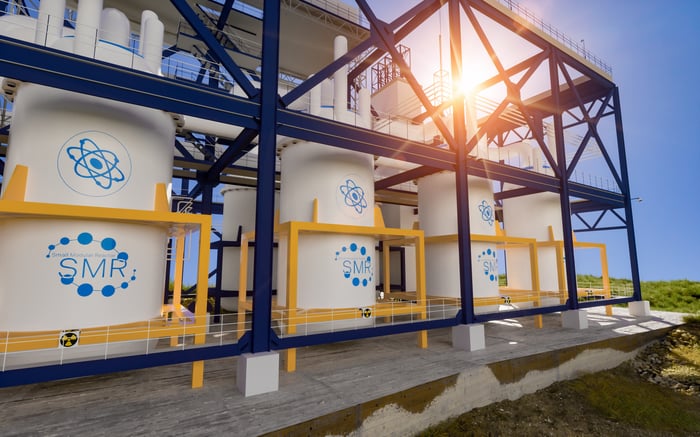
Image source: Getty Images.
A power play for the AI era
Oklo's solution is its Aurora powerhouse, a modular reactor designed to deliver 15-75 megawatts of carbon-free, baseload power. Unlike traditional nuclear companies that license technology, Oklo plans to build, own, and operate its systems, which would provide electricity directly to customers through long-term power purchase agreements.
Nuclear power has received a boost from the Trump administration, and hyperscalers continue to invest, including Microsoft's plans to reopen Three Mile Island. In fact, OpenAI's Sam Altman was an early investor in Oklo and was its board chairman until stepping down last year.
In late 2024, the company inked an important deal with data center operator Switch, which could reach 12 gigawatts over the next 20 years. In January, Oko reached an agreement with Meta (NASDAQ: META) to power a campus in Ohio, aiming to deliver around 1.2 gigawatts by 2030. These are not yet binding contracts, but show some of the promise if the company can secure licensing for its systems.
Oklo is also developing a fuel recycling business to convert spent nuclear fuel into a usable power source. This vertical integration is designed to lower long-term fuel costs and manage a critical supply chain risk.
The regulatory gauntlet
For any nuclear company, the major hurdle is regulatory approval. The U.S. Nuclear Regulatory Commission (NRC) process is long, expensive, and unpredictable. Oklo's first application was denied in 2022.
Today, the company is pursuing a faster Department of Energy (DOE) authorization pathway for its first plant at the Idaho National Laboratory. This allows construction to begin on a pilot version while the longer commercial NRC license proceeds in parallel.
Even with some regulatory progress, execution risk remains high as novel nuclear power projects are rarely completed on time or on budget. Oklo has a market capitalization of nearly $12 billion, but it has never generated revenue and doesn't expect to until at least 2028.
After issuing shares to raise over $1 billion in capital earlier this year, Oklo ended the first quarter with $2.5 billion in liquidity and no debt. This provides a runway to fund this year's projected capital expenditures of $350 million to $450 million and an operating cash flow of around $90 million at current burn rates.
For now, Oklo remains a speculative bet on AI with considerable regulatory and operational risks. Progress on the NRC's commercial licensing process and construction milestones at the Idaho site are the key events for investors to watch.
Should you buy stock in Oklo right now?
Before you buy stock in Oklo, consider this:
The Motley Fool Stock Advisor analyst team just identified what they believe are the 10 best stocks for investors to buy now… and Oklo wasn’t one of them. The 10 stocks that made the cut could produce monster returns in the coming years.
Consider when Netflix made this list on December 17, 2004... if you invested $1,000 at the time of our recommendation, you’d have $463,900!* Or when Nvidia made this list on April 15, 2005... if you invested $1,000 at the time of our recommendation, you’d have $1,294,401!*
Now, it’s worth noting Stock Advisor’s total average return is 978% — a market-crushing outperformance compared to 211% for the S&P 500. Don't miss the latest top 10 list, available with Stock Advisor, and join an investing community built by individual investors for individual investors.
See the 10 stocks »
*Stock Advisor returns as of June 1, 2026.
Bryan White has no position in any of the stocks mentioned. The Motley Fool has positions in and recommends Meta Platforms and Microsoft. The Motley Fool has a disclosure policy.
Recommended Articles


