


Will Bitcoin Fall Further? Strategy ‘Accumulation Signal’ Boosts Market Sentiment, But Outflows Remain a Major Pressure
TradingKey - Recently, Bitcoin ( BTCUSD) prices have continued to slide, once falling below the $60,000 psychological level last Friday (June 5). The primary reason for the decline is the persistent outflow of capital from the Bitcoin market, while Strategy's rare sale of Bitcoin has further intensified the downward pressure on prices.
MicroStrategy Chairman Michael Saylor’s remarks drive short-term buying expectations, yet remain insufficient to fully reverse liquidity pressures.
According to MicroStrategy ( MSTR) disclosures, MicroStrategy previously sold a rare 32 Bitcoins between May 26 and 31, cashing out approximately $2.5 million, which is expected to be used for preferred stock dividends. This is the company's first disclosed Bitcoin sale since 2022. While this amount is almost negligible relative to its massive holdings, the selling activity by a representative institution that typically only buys and never sells has weakened market confidence in the long-term absorption of Bitcoin into corporate treasuries.
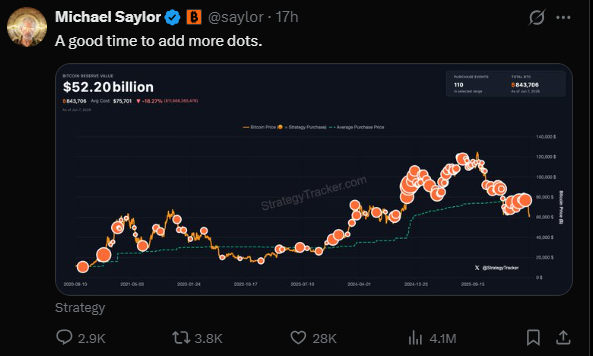
However, MicroStrategy Chairman Michael Saylor posted on the X platform on June 7, "A good time to add more dets," while noting that MicroStrategy still holds approximately 843,706 BTC with an average purchase price of about $75,701. Saylor's post prompted market speculation that MicroStrategy might resume its accumulation following the Bitcoin pullback. Upon the news, Bitcoin rose 4% that day, showing an improvement in short-term sentiment.
Over the past few years, MicroStrategy has continuously bought Bitcoin through the issuance of equity, convertible notes, and preferred stock, providing a steady source of demand for the market. For bulls, Saylor's public statements serve as a significant signal; as long as MicroStrategy continues to treat Bitcoin as its core reserve asset, the market is likely to believe that the institutional allocation logic remains intact. This expectation helps form psychological support during price drops, particularly during phases of sluggish retail sentiment, ETF outflows, or rising macro risks, where MicroStrategy's long-term buyer persona bolsters the confidence of some investors to hold.
Notably, the greater pressure for Bitcoin's decline still comes from ETF outflows. According to Coinglass data, as of June 3, U.S. spot Bitcoin ETFs saw net outflows for 13 consecutive trading days, with a cumulative outflow of approximately $4.37 billion; on June 5, spot Bitcoin ETFs recorded another net outflow of about $326 million. More importantly, when Bitcoin returned to the $60,000 level, ETF investors did not "buy the dip" as they did in February; instead, they opted for larger-scale redemptions, indicating that the institutional stance toward absorbing supply at low levels has clearly weakened.
Will Bitcoin fall further?
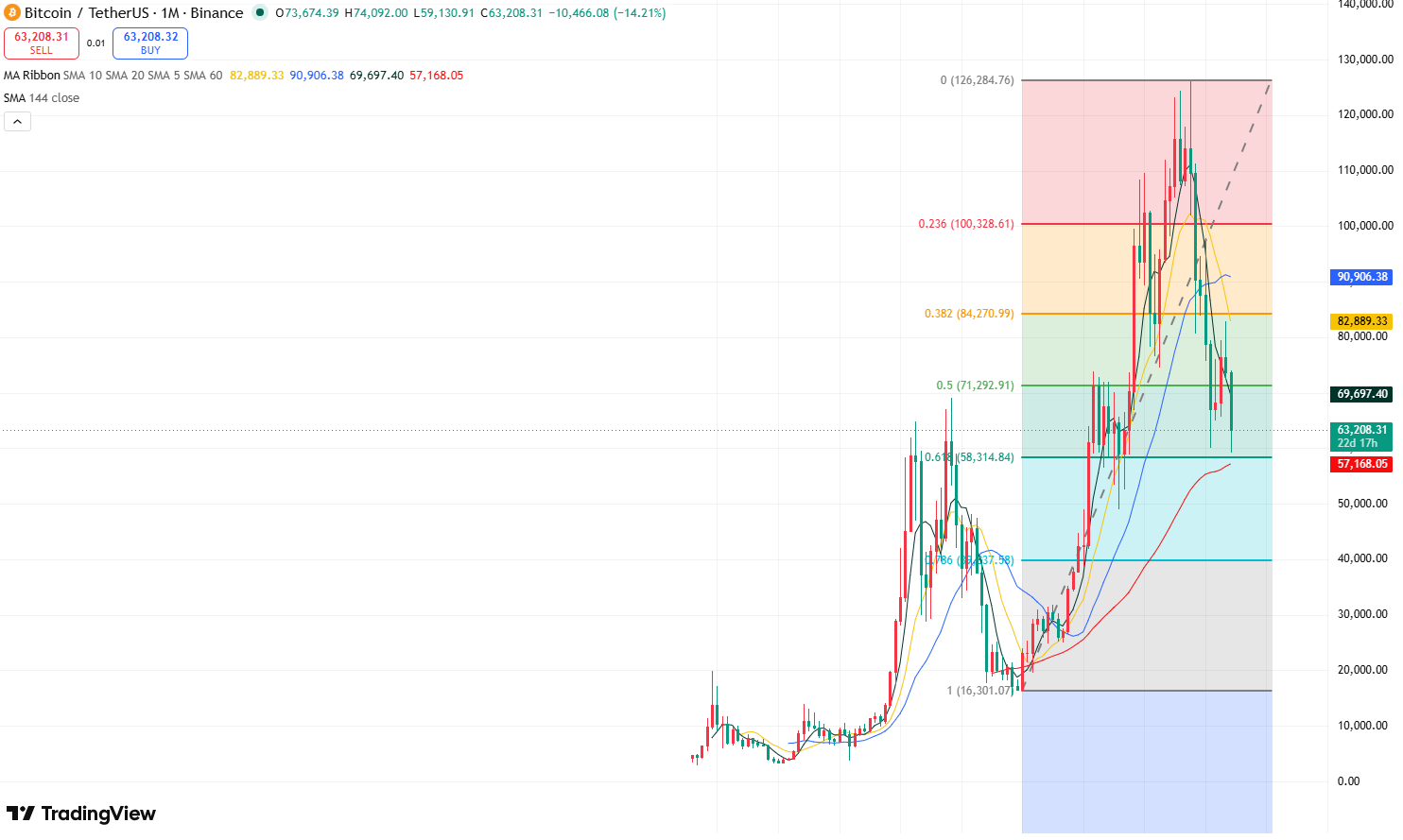
Bitcoin Price Weekly Chart, Source: TradingView
Looking at the Bitcoin weekly chart, the price briefly dipped below the $60,000 psychological mark last week, but the closing price remained firm above this level, indicating that support there remains strong. However, as the candlesticks crossed below the SMA144, the long-term bullish trend has been compromised, significantly increasing the likelihood of a short-term bearish reversal.
Currently, Bitcoin's key support lies in the $58,000–$60,000 range. If this level fails to hold, the price may further retreat toward the 0.786 Fibonacci retracement level at the $40,000 mark. Conversely, if signals of stabilization emerge at this level, a technical recovery rally may occur in the short term, with the potential to test the resistance zone between $70,000 and $71,000.
Recommended Articles


