


2026 Crypto Crash Causes: Why Bitcoin Prices Broke Through Key Levels? Future Trends and Key Support Level Predictions
Cryptocurrencies plunge across the board.
TradingKey - On June 4, cryptocurrencies continued to slump 4%, with total market capitalization hitting a low of $2.18 trillion, approaching the lows seen in February this year. Compared to last year's peak of $4.2 trillion, the crypto market has seen an outflow of approximately $2 trillion, a cumulative decline of 48%.
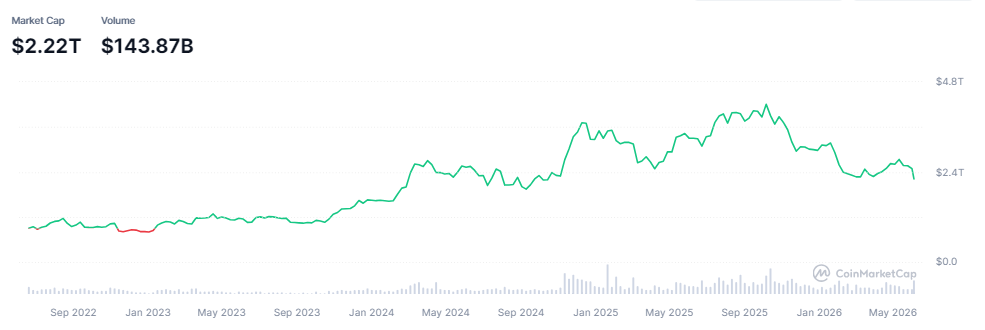
Changes in cryptocurrency market capitalization, Source: CoinMarketCap
Meanwhile, major coins generally fell by more than 4%. Among them, Bitcoin ( BTC) is approaching the $60,000 mark; Ethereum ( ETH) is nearing $1,700; Binance Coin ( BNB) briefly fell below the $600 level; Solana plunged 7%, losing the $70 mark.
Why is the crypto market falling?
Since the beginning of the year, the overall crypto market has generally maintained a downward trend, with Bitcoin retreating steadily, losing the $90,000, $80,000, and $70,000 levels in January and February alone to approach the $60,000 mark. In April, Bitcoin prices rebounded and briefly broke above $80,000 before falling continuously to approach the year's lows once again. Three main reasons are behind this: the U.S.-Iran conflict, the Federal Reserve, and Strategy. Although they occurred at different points in time, they are interconnected.
On February 28 this year, the U.S.-Iran war broke out; while negotiations provided some temporary relief, the conflict has yet to reach a definitive end. From the onset of the conflict until the eve of negotiations, Bitcoin prices did not drop significantly, indicating some immunity to the war. However, the conflict continuously pushed up crude oil prices, and rising oil prices directly increased corporate transportation and production costs, thereby fueling overall inflationary pressure and undermining the Federal Reserve's rate-cut plans. Some Fed officials even stated they would not rule out interest rate hikes, causing a shock to Bitcoin, all other cryptocurrencies (excluding stablecoins), and the stock market.
On June 1, market rumors suggested that Strategy had sold Bitcoin for the first time in years, adding fuel to the fire for the already fragile crypto market, further exacerbating capital outflows from U.S. spot Bitcoin ETFs while triggering follow-on selling by whales and retail investors. According to Coinglass data, since May 20, spot Bitcoin ETFs have seen net outflows of over 40,000 BTC—totaling approximately $3 billion—for ten consecutive trading days. Furthermore, whales holding between 10 and 10,000 BTC sold nearly 25,000 BTC in just the past week.
Will Bitcoin drop below $60,000 again?
This morning, Bitcoin's price dropped as low as $61,351, drawing exceptionally close to the $60,000 psychological level set on February 6. The market is concerned that prices will continue to trend lower and break below this support level. However, will such a dire scenario actually materialize?
Currently, several indicators—including mining rig shutdown prices, market sentiment, and the RSI—suggest that Bitcoin is in an oversold state and is flashing bullish signals. While a further breakdown is unlikely, a retest of the $60,000 mark cannot be ruled out. According to Antpool data, daily net profits for miners such as Antminer, Whatsminer, and Avalon have turned negative, approaching shutdown levels; this implies a washout of small-scale miners and signals that the price has touched Bitcoin's production cost.
From a support perspective, $60,000 is not only a psychological threshold but also provides structural technical support. Regarding selling pressure, the burden has significantly diminished, as evidenced by the Sentiment Index (20) and RSI (18), which have fallen into "extreme fear" and "oversold" territory, respectively, suggesting an imminent return to normalcy.
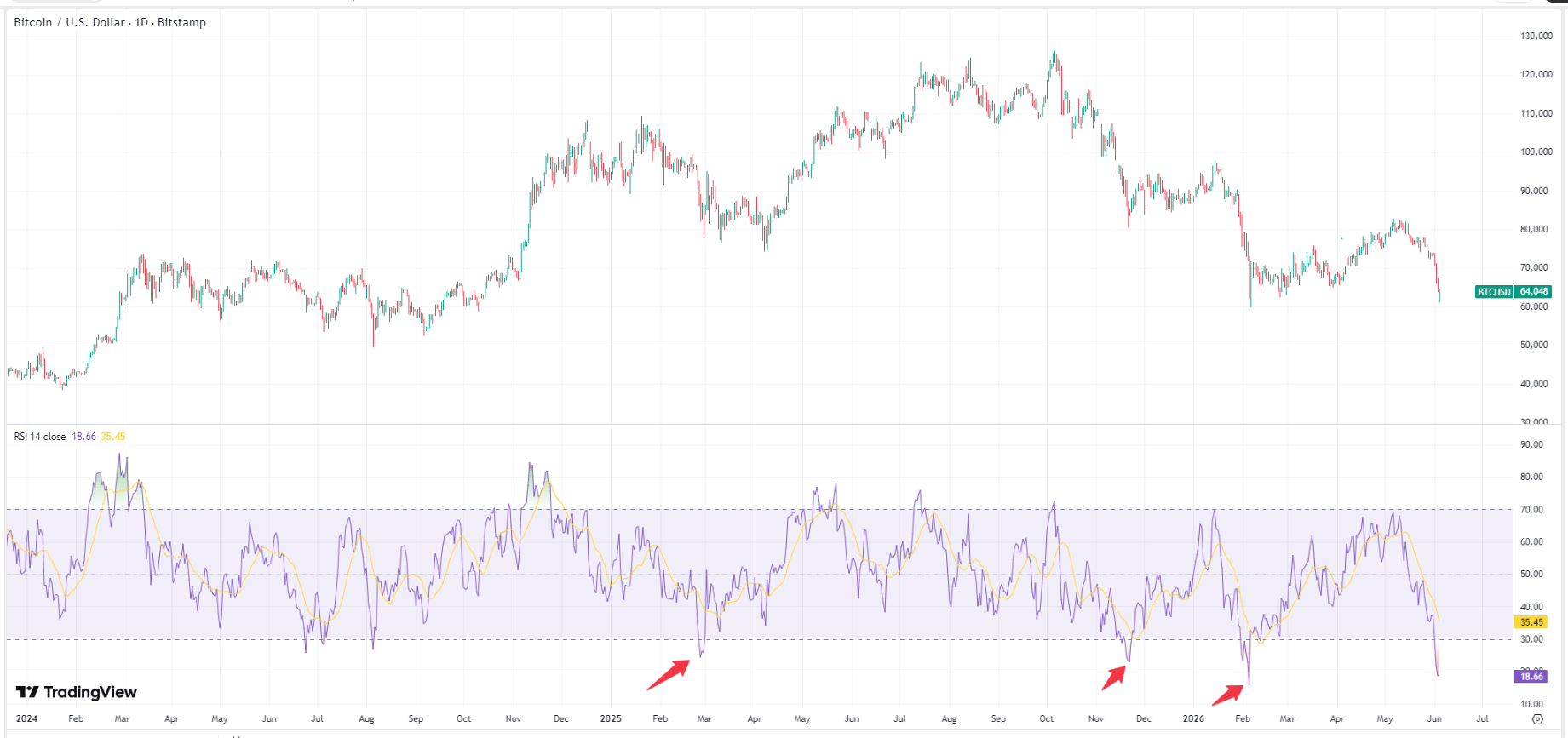
Bitcoin price chart, source: TradingView
Recommended Articles


