


MSTR Slumps 6% Pre-Market. Strategy Sells Bitcoin, Faith Collapse or Emergency Relief
TradingKey - Strategy was forced to sell Bitcoin, causing declines in both to widen as market panic spreads.
During pre-market hours on June 1, Eastern Time, the Bitcoin proxy stock Strategy ( MSTR) briefly fell over 6%, dipping below $150 and hitting a low of $149.75. The catalyst for this decline was the company's unprecedented sale of Bitcoin ( BTC ), breaking its long-standing "buy only, never sell" myth and triggering market panic.
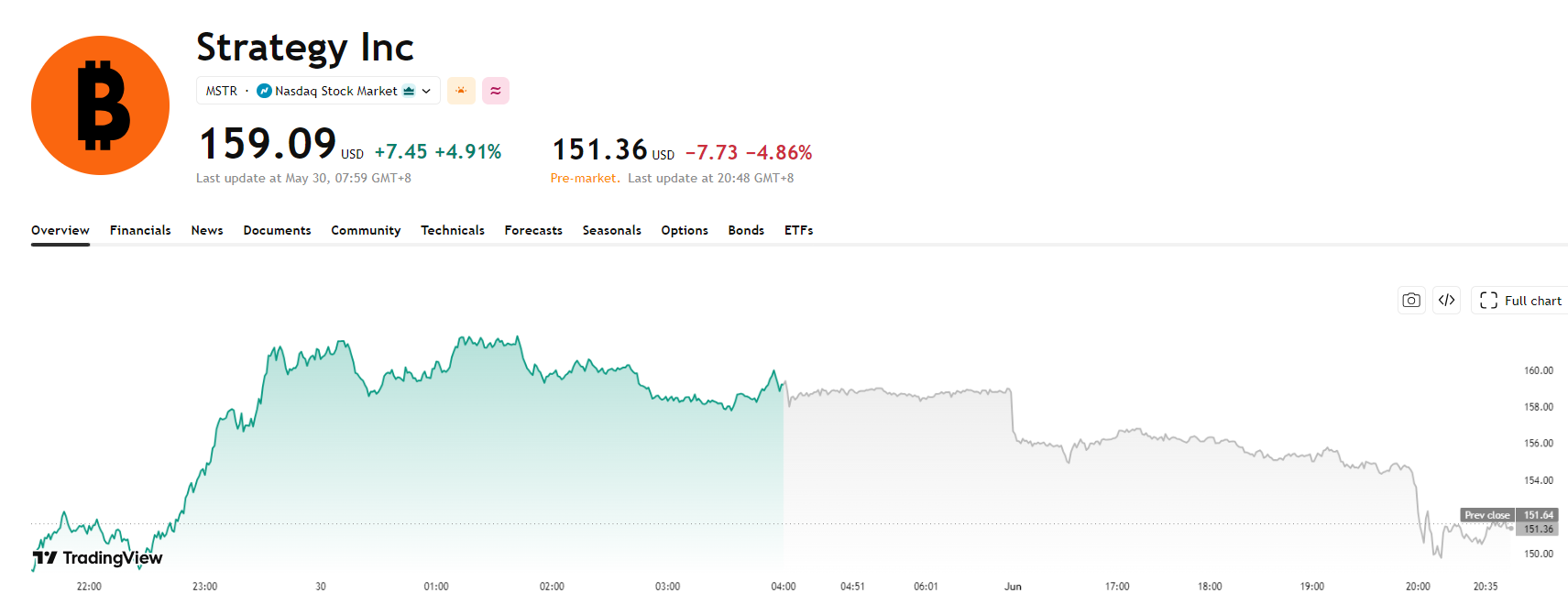 Strategy stock price chart, source: TradingView
According to the latest 8-K filing submitted by Strategy to the U.S. Securities and Exchange Commission (SEC), the company sold 32 Bitcoins last week at an average price of approximately $77,000, realizing a total of $2.5 million. Why did Strategy break its long-held "buy only, never sell" strategy? According to the filing, the sale was made to fulfill cash dividend obligations for the company's issued "preferred shares."
As of press time, Strategy holds a total of 840,000 Bitcoins, meaning the 32 Bitcoins sold represent only 0.0038% of its massive treasury holdings. While this amount is negligible, market panic remains for two reasons: first, it broke the market expectation of unwavering holding, suggesting potential future sales; second, Bitcoin's price falling below $72,000 has added fuel to the panic.
Over the past two years, Strategy has issued a large number of high-yield preferred shares in the U.S. stock market, such as STRC, STRF, STRE, STRD, and STRK. Although these have no maturity date for principal repayment, dividends must be paid at specific times, mostly in cash, which requires the company to have sufficient liquidity. Strategy's forced sale of Bitcoin indicates that its cash reserves are currently insufficient to meet interest payment demands.
Looking ahead, there is a risk of a mutually reinforcing downward price spiral between Bitcoin and Strategy. The trajectory is roughly as follows: Bitcoin's price drops, Strategy is forced to sell more Bitcoin to pay dividends, the selling pressure triggers market panic and follow-on selling, Bitcoin's decline widens, and Strategy sells even more Bitcoin to cover the next round of dividends, creating a continuous loop. Of course, if Strategy finds alternative ways to address its dividend obligations, Bitcoin's price may stabilize; otherwise, this could trigger a black swan event.
Recommended Articles


