


US Dollar Index slips from its 18-month high
- DXY drops back under 102.00 and below Monday's low.
- Lower bond yields ease French borrowing costs, and the Euro rebounds off a low.
Brent fell below $98 a barrel as Gulf exports picked up, and bond yields in Europe and the US fell with it. France got the most relief, as the extra yield investors want for holding its 10-year debt over Germany's narrowed to about 1.3 percentage points from more than 1.5 on Friday.
The Euro, more than half the Dollar Index, has rebounded from Monday's low, its weakest since May 2025. Every other currency in the index has gained on the Dollar except the Yen and the Swiss Franc, the two that investors buy when they're nervous.
Investors are buying risk, and the S&P 500 has hit a record. The record is narrow. Nvidia (NVDA), Apple (AAPL) and Microsoft (MSFT) now make up more than 21% of the S&P 500, and the Russell 2000 of smaller companies is barely higher.
Part of Brent Crude Oil's fall is a Group of Seven (G7) release of 100 million barrels of emergency stocks over four months. That's about five days of what went through the Strait of Hormuz before the war.
On the charts
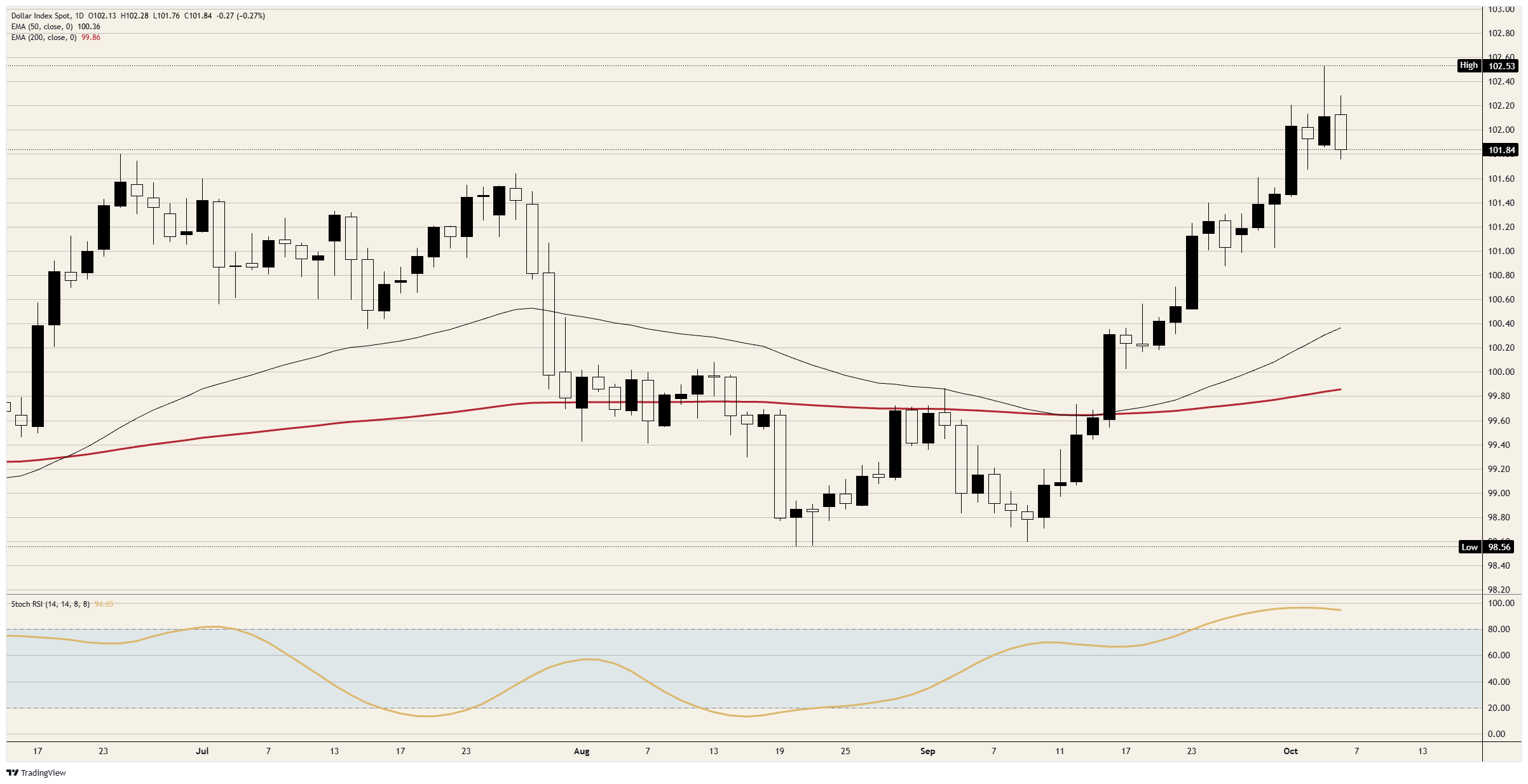
Monday's bar topped out just above 102.50, the highest since April 2025, and left a long upper wick. Tuesday's bar has gone back under 102.00 and below Monday's low.
The drop reached the 101.75 area, less than a fifth of the rally from the September 9 low near 98.60, and the index is trading near 101.85. Momentum indicators have broadly turned down since late September. The index is still well above its 50-day Exponential Moving Average (EMA) near 100.35.
DXY, daily chart
US Dollar FAQs
The US Dollar (USD) is the official currency of the United States of America, and the ‘de facto’ currency of a significant number of other countries where it is found in circulation alongside local notes. It is the most heavily traded currency in the world, accounting for over 88% of all global foreign exchange turnover, or an average of $6.6 trillion in transactions per day, according to data from 2022. Following the second world war, the USD took over from the British Pound as the world’s reserve currency. For most of its history, the US Dollar was backed by Gold, until the Bretton Woods Agreement in 1971 when the Gold Standard went away.
The most important single factor impacting on the value of the US Dollar is monetary policy, which is shaped by the Federal Reserve (Fed). The Fed has two mandates: to achieve price stability (control inflation) and foster full employment. Its primary tool to achieve these two goals is by adjusting interest rates. When prices are rising too quickly and inflation is above the Fed’s 2% target, the Fed will raise rates, which helps the USD value. When inflation falls below 2% or the Unemployment Rate is too high, the Fed may lower interest rates, which weighs on the Greenback.
In extreme situations, the Federal Reserve can also print more Dollars and enact quantitative easing (QE). QE is the process by which the Fed substantially increases the flow of credit in a stuck financial system. It is a non-standard policy measure used when credit has dried up because banks will not lend to each other (out of the fear of counterparty default). It is a last resort when simply lowering interest rates is unlikely to achieve the necessary result. It was the Fed’s weapon of choice to combat the credit crunch that occurred during the Great Financial Crisis in 2008. It involves the Fed printing more Dollars and using them to buy US government bonds predominantly from financial institutions. QE usually leads to a weaker US Dollar.
Quantitative tightening (QT) is the reverse process whereby the Federal Reserve stops buying bonds from financial institutions and does not reinvest the principal from the bonds it holds maturing in new purchases. It is usually positive for the US Dollar.
Artigos Recomendados


