


Gold hits new yearly high as US yields drop on mixed US manufacturing data
- Gold price catapults to $2,088.33, marking a significant rally in response to US economic reports and bond yield dynamics.
- Mixed manufacturing PMI reports fuel Gold's ascent with ISM data indicating contraction in US manufacturing sector.
- Declining US Treasury yields bolster Gold's attractiveness, pushing XAU/USD to new year-to-date peak.
Gold price soars to a new year-to-date high of $2,088.33 in Friday’s North American session, following the release of mixed economic data, as S&P Global revealed the economy in the United States is expanding. On the other hand, the Institute for Supply Management (ISM) reported that manufacturing activity is contracting, overshadowing the first report. The XAU/USD exchanges hands at $2,084.89, up more than 2.3%.
On Friday, S&P Global revealed that manufacturing conditions improved at the fastest pace since July 2022. The Manufacturing PMI for February was 52.2, up from 50.7. Chris Williamson, Chief Business Economist at S&P Global, said, “Manufacturing is showing encouraging signs of pulling out of the malaise that has dogged the goods-producing sector over much of the past two years.”
Later, the ISM February Manufacturing PMI came to 47.8, down from 49.1. Timothy Fiore, Chair of the Institute for Supply Management, noted, “The U.S. manufacturing sector continued to contract (and at a faster rate compared to January), with demand slowing, output easing and inputs remaining accommodative.”
The data sponsored a leg up in Gold prices after US Treasury bond yields plunged on expectations that rate cuts could arrive sooner than expected.
That said, XAU/USD prices embarked on an aggressive rally, hitting a new YTD high of $2,087.45 as US Treasury bond yields tumbled. The US 10-year Treasury bond yield dropped five and a half basis points (bps) to 4.197%, while real yields measured by 10-year Treasury Inflation-Protected Securities (TIPS) yield, falling from 1.934% to 1.878%. All of this weighed on the US Dollar (USD).
Daily digest market movers: Gold price surges as US economy gives mixed signals
- Following the data, interest rate probabilities measured by the CME FedWatch Tool suggest traders are expecting the first cut in June, with odds increasing to 53.2% at the time of writing.
- A slew of Federal Reserve speakers have crossed the wires.
- Atlanta Fed President Raphael Bostic said the Fed will need to hold rates higher for longer.
- Federal Reserve Governor Chris Waller and Dallas Fed President Lorie Logan talked about the Fed’s balance sheet.
- Chicago Fed President Austan Goolsbee said that he’s perplexed by the housing services inflation rate and added he remains uncertain where interest rates would settle. On Thursday he said that policy is restrictive, and the question is, “How long do we want to remain restrictive.”
- Richmond Fed President Thomas Barkin delivered hawkish remarks, saying, "We’ll see if there are rate cuts this year.” Barkin added that if numbers remain inconsistent, they should take that into consideration, emphasizing that he is in no rush to ease policy.
- San Francisco Fed President Mary Daly said the Fed’s policy is in a good place, and the bank is ready to cut rates when the data demands it.
- Atlanta Fed President Raphael Bostic commented that economic data should guide the Fed on when to start rate cuts, which, according to him, could happen in the summer. Bostic acknowledged that inflation is slowing down, but they have to stay “vigilant and attentive.”
- On Wednesday, New York Federal Reserve President John Williams said the rate-cut decision will depend on incoming data and stated the central bank has come a long way to bring down inflation to the 2% target, but there is more work to do.
- Boston Fed Bank President Susan Collins sees the Fed’s path to 2% as bumpy due to tight labor market conditions and higher inflation readings in January. Collins expects that the Fed will start reducing interest rates later this year.
- On Tuesday, Federal Reserve Governor Michelle Bowman said she’s in no rush to cut rates, given upside risks to inflation that could stall progress or cause a resurgence in price pressure. She added that inflation would decline “slowly,” and she will remain “cautious in my approach to considering future changes in the stance of policy.”
- Previous data releases in the week:
- The US Bureau of Economic Analysis revealed the Core PCE report, with annual figures decelerating from December’s 2.9% to 2.8% YoY in January. Headline inflation edged lower from 2.6% to 2.4% YoY in January, aligned with the consensus.
- Initial Jobless Claims in the US for the week ending February 24 of 215K, exceeded estimates of 210K and the previous reading of 202K.
- Housing data from the US was revealed by the National Association of Realtors, Pending Home Sales dropped from 5.7% MoM in January to -4.9%.
- Chicago PMI in February came at 44.0, below the consensus of 48.0 and the previous reading of 46.
- The Gross Domestic Product (GDP) for the final quarter of 2023 was reported at 3.2% YoY, slightly below the preliminary estimate of 3.3%.
- US Retail Sales Inventories rose 0.3% MoM in January, below 0.4% in the previous month's data, while Wholesale Inventories declined -0.1% MoM, missing estimates of 0.1%.
- US Durable Goods Orders dropped -6.1% MoM, more than the -4.5% contraction expected and the -0.3% dip observed in December.
- The S&P/Case Shiller Home Price Index for December rose 6.1% YoY, outpacing estimates of 6% and November’s 5.4% reading.
- US New Home Sales rose by 1.5% from 0.651M to 0.661M, less than the 0.68M expected.
- The US Dollar Index (DXY), which gauges the Greenback’s value against six major currencies, slumped 0.29%, down at 103.85.
Technical analysis: Gold soars as buyers eye $2,100
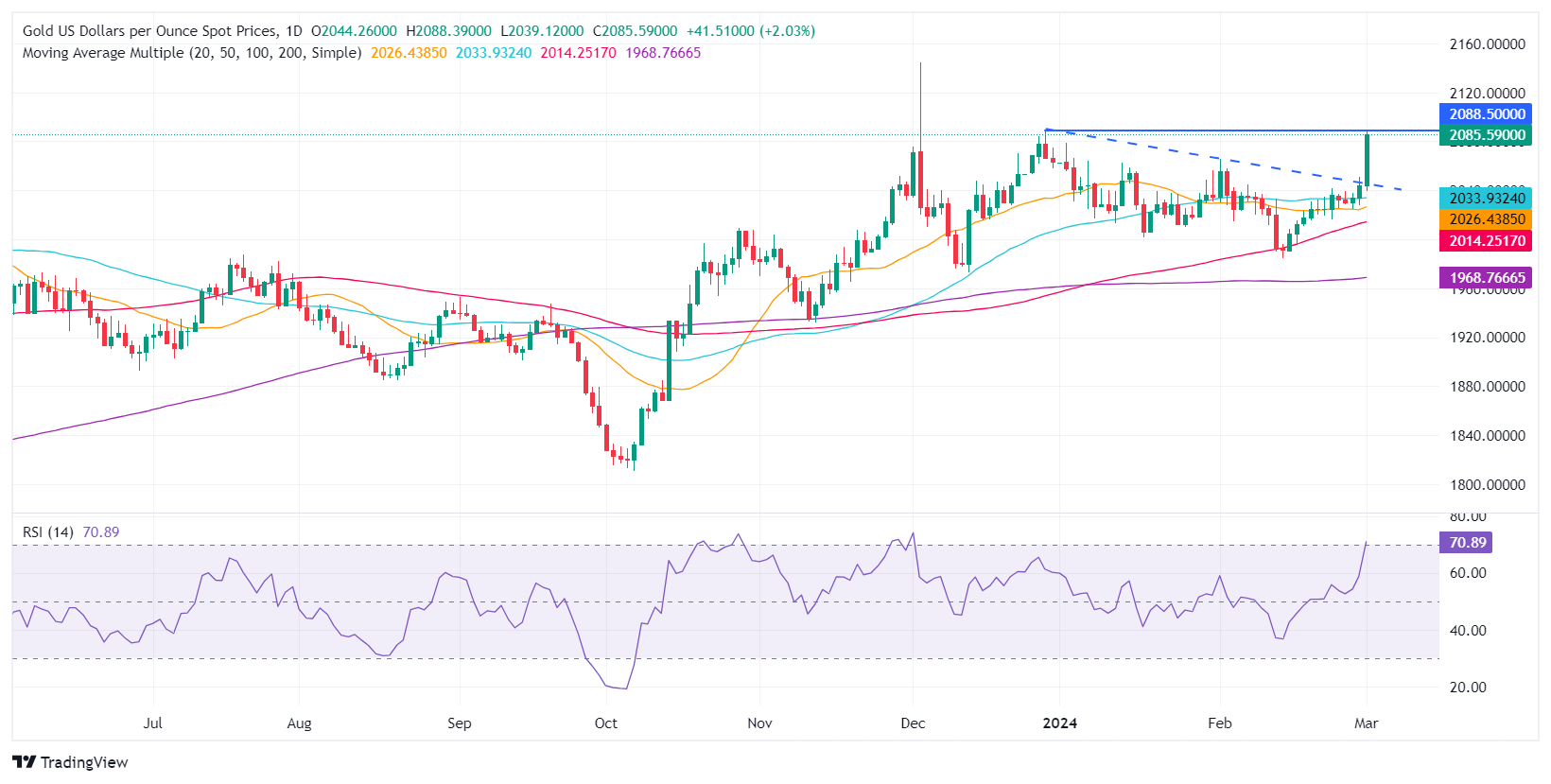
Gold is rallying sharply on its way toward the $2,100.00 figure. It cleared several key resistance levels, like the $2,050 psychological level and the February 1 high at $2,065.60. Nevertheless, it meanders within the $2,065-$2,090 area as buyers take a breather ahead of testing the all-time high of $2,146.79.
On the flip side, XAU/USD’s first support is $2,065.60, followed by the $2,050 mark. Once cleared, Gold’s next floor would be the February 16 swing low of $2,016.15 and the October 27 daily high-turned-support at $2,009.42. Once cleared, that will expose key technical support levels like the 100-day SMA at $2,009.42, followed by the 200-day SMA at $1,968.00.
Gold FAQs
Why do people invest in Gold?
Gold has played a key role in human’s history as it has been widely used as a store of value and medium of exchange. Currently, apart from its shine and usage for jewelry, the precious metal is widely seen as a safe-haven asset, meaning that it is considered a good investment during turbulent times. Gold is also widely seen as a hedge against inflation and against depreciating currencies as it doesn’t rely on any specific issuer or government.
Who buys the most Gold?
Central banks are the biggest Gold holders. In their aim to support their currencies in turbulent times, central banks tend to diversify their reserves and buy Gold to improve the perceived strength of the economy and the currency. High Gold reserves can be a source of trust for a country’s solvency. Central banks added 1,136 tonnes of Gold worth around $70 billion to their reserves in 2022, according to data from the World Gold Council. This is the highest yearly purchase since records began. Central banks from emerging economies such as China, India and Turkey are quickly increasing their Gold reserves.
How is Gold correlated with other assets?
Gold has an inverse correlation with the US Dollar and US Treasuries, which are both major reserve and safe-haven assets. When the Dollar depreciates, Gold tends to rise, enabling investors and central banks to diversify their assets in turbulent times. Gold is also inversely correlated with risk assets. A rally in the stock market tends to weaken Gold price, while sell-offs in riskier markets tend to favor the precious metal.
What does the price of Gold depend on?
The price can move due to a wide range of factors. Geopolitical instability or fears of a deep recession can quickly make Gold price escalate due to its safe-haven status. As a yield-less asset, Gold tends to rise with lower interest rates, while higher cost of money usually weighs down on the yellow metal. Still, most moves depend on how the US Dollar (USD) behaves as the asset is priced in dollars (XAU/USD). A strong Dollar tends to keep the price of Gold controlled, whereas a weaker Dollar is likely to push Gold prices up.
Artigos Recomendados


