


Gold remains vulnerable as US-Iran war, Fed rate outlook weigh on sentiment
- Gold pares some of the earlier losses as the US Dollar and Treasury yields ease from recent highs.
- Oil prices surge amid the US-Iran war, raising global inflation concerns, with investors quickly dialing back bets on Fed rate cuts.
- Technically, XAU/USD remains range-bound between $5,000 and $5,200.
Gold (XAU/USD) trims some intraday losses on Monday after coming under heavy selling pressure at the start of the week. The mild recovery comes as the US Dollar (USD) and Treasury yields ease somewhat from recent highs as markets digest shifting macro and geopolitical drivers.
At the time of writing, XAU/USD is trading around $5,100, rebounding from a daily low near $5,014. However, the move lacks follow-through buying, with the metal still down about 1.0% on the day.
Surging Oil prices deepen inflation concerns amid the US-Iran conflict
The precious metal has remained highly volatile since the US-Iran conflict began. Escalating geopolitical tensions continue to underpin safe-haven demand, helping limit deeper losses. However, at the same time, the war is disrupting Oil flows through the Strait of Hormuz, sending crude prices sharply higher and fuelling global inflation concerns.
West Texas Intermediate (WTI) crude Oil surged to around $113, its highest level since June 2022, before trimming gains after reports that G7 countries are discussing a coordinated release of Oil reserves through the International Energy Agency (IEA) to ease supply concerns. At the time of writing, WTI is trading near $100 per barrel, still up nearly 13% on the day.
While Gold is often viewed as a hedge against inflation, an Oil-driven inflation shock tends to lift Treasury yields and support the US Dollar, while also reducing expectations for near-term interest rate cuts from major central banks. These factors act as a headwind for the non-yielding metal and continue to cap upside attempts.
Markets have quickly reacted to the surge in energy prices by scaling back expectations for Federal Reserve (Fed) rate cuts. According to the CME FedWatch Tool, the probability of a 25 basis-point (bps) rate cut in June has fallen to around 30%, down from roughly 50% a month ago. Meanwhile, the odds of a July cut stand near 40%.
Soft NFP raises stagflation concerns ahead of US inflation data
Last week’s downside surprise in US Nonfarm Payrolls (NFP) complicates the outlook, highlighting rising stagflation risks and leaving the Fed with a policy dilemma as it tries to balance sticky inflation against deteriorating labour market conditions.
The US economy shed 92K jobs in February, missing expectations for a 59K increase, after adding 126K payrolls in January. The Unemployment Rate rose to 4.4% from 4.3% in the previous month.
Looking ahead, US inflation data due this week could influence interest-rate expectations. Economists expect the Consumer Price Index (CPI) to remain at 2.4% YoY in February, unchanged from January. Meanwhile, the Core Personal Consumption Expenditures (PCE) Price Index (data for January) is expected to hold at 3.0% YoY.
Technical analysis: XAU/USD struggles for direction within $5,000-$5,200 range
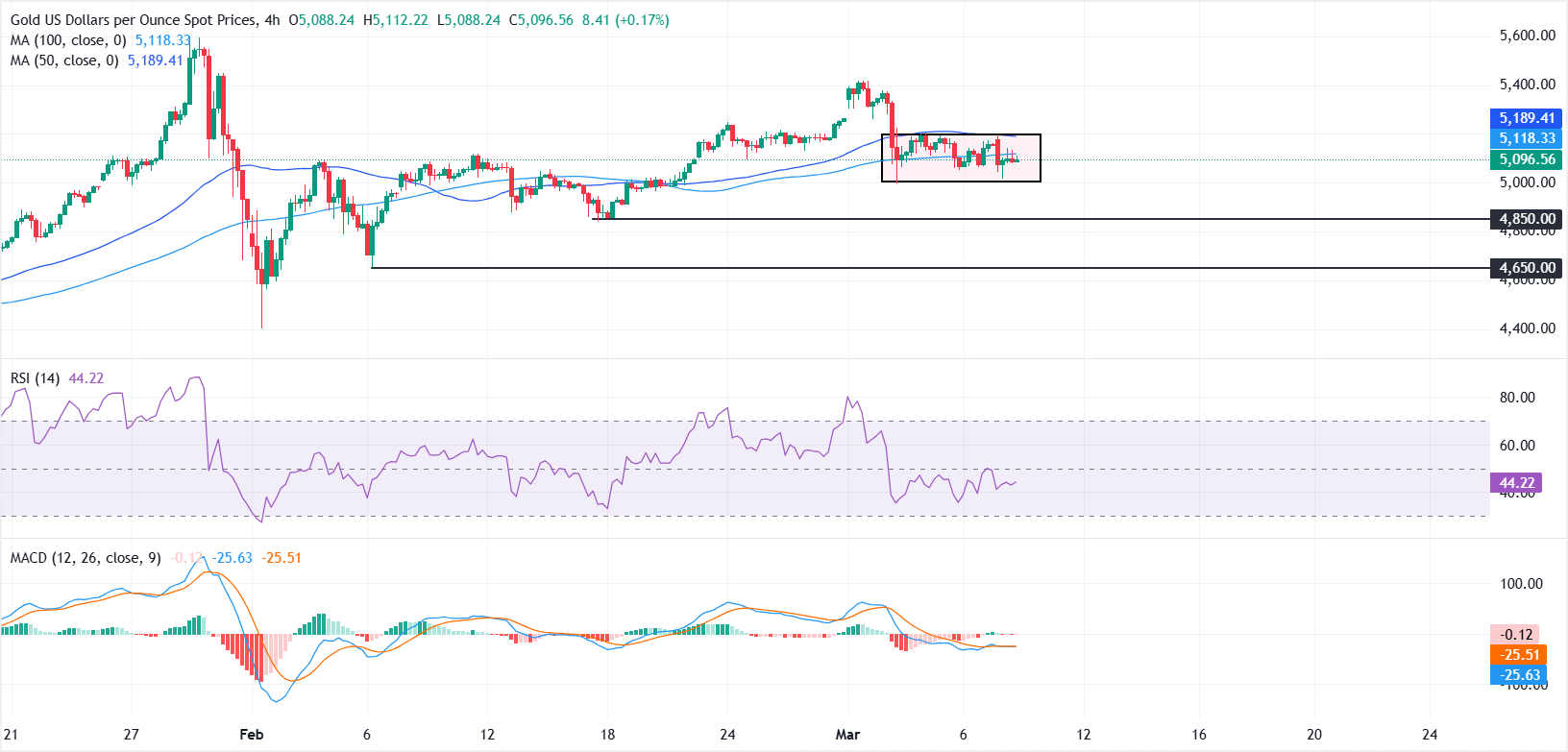
From a technical perspective, the near-term bias remains cautiously neutral, with price action fluctuating between $5,000 and $5,200.
XAU/USD is trading marginally below the 100-period Simple Moving Average (SMA) near $5,118, while the 50-period SMA around $5,189 continues to cap upside attempts, indicating fading bullish momentum and a lack of strong directional conviction.
On the downside, a decisive break below the 100-period SMA could open the door for a retest of the $5,000 psychological level. A sustained move below this support may expose deeper downside targets near $4,850, around the February 18 low, followed by $4,650, near the February 6 low.
On the upside, a break above the $5,200 resistance zone could revive bullish momentum and pave the way toward the $5,400-$5,500 region.
Momentum indicators reinforce the consolidative outlook. The Relative Strength Index (RSI) hovers around 43, staying below the neutral 50 level and suggesting modest bearish pressure without entering oversold territory.
Meanwhile, the Moving Average Convergence Divergence (MACD) remains slightly below the zero line with a flattened profile, signaling limited directional conviction in the short term.
Gold FAQs
Gold has played a key role in human’s history as it has been widely used as a store of value and medium of exchange. Currently, apart from its shine and usage for jewelry, the precious metal is widely seen as a safe-haven asset, meaning that it is considered a good investment during turbulent times. Gold is also widely seen as a hedge against inflation and against depreciating currencies as it doesn’t rely on any specific issuer or government.
Central banks are the biggest Gold holders. In their aim to support their currencies in turbulent times, central banks tend to diversify their reserves and buy Gold to improve the perceived strength of the economy and the currency. High Gold reserves can be a source of trust for a country’s solvency. Central banks added 1,136 tonnes of Gold worth around $70 billion to their reserves in 2022, according to data from the World Gold Council. This is the highest yearly purchase since records began. Central banks from emerging economies such as China, India and Turkey are quickly increasing their Gold reserves.
Gold has an inverse correlation with the US Dollar and US Treasuries, which are both major reserve and safe-haven assets. When the Dollar depreciates, Gold tends to rise, enabling investors and central banks to diversify their assets in turbulent times. Gold is also inversely correlated with risk assets. A rally in the stock market tends to weaken Gold price, while sell-offs in riskier markets tend to favor the precious metal.
The price can move due to a wide range of factors. Geopolitical instability or fears of a deep recession can quickly make Gold price escalate due to its safe-haven status. As a yield-less asset, Gold tends to rise with lower interest rates, while higher cost of money usually weighs down on the yellow metal. Still, most moves depend on how the US Dollar (USD) behaves as the asset is priced in dollars (XAU/USD). A strong Dollar tends to keep the price of Gold controlled, whereas a weaker Dollar is likely to push Gold prices up.
Artigos Recomendados


