


Gold holds below $4,000 as US Dollar strength curbs momentum
- Gold consolidates below $4,000 as investors weigh Fed guidance and Dollar strength.
- China’s VAT change cools retail demand, adding near-term pressure to bullion
- Technically, XAU/USD shows neutral momentum as the RSI hovers around 47, signaling consolidation.
Gold (XAU/USD) holds its ground within familiar ranges on Tuesday, recovering modestly from earlier declines after finding support near the $3,970 zone. At the time of writing, XAU/USD is trading around $3,995, as traders remain reluctant to take fresh positions amid a stronger US Dollar (USD) and a cautious tone from the Federal Reserve (Fed).
Gold appears to be in a healthy consolidation phase following its correction from the record high of $4,381 reached on October 20. A pullback in global equities is helping to limit losses in Bullion, as the softening risk appetite offers some support to the metal. However, the upside remains limited amid reduced safe-haven flows and fading expectations of another Fed interest rate cut this year.
Nevertheless, the broader uptrend remains intact as persistent geopolitical and economic uncertainties continue to keep investors cautious. At the same time, the prolonged United States (US) government shutdown remains a drag on market sentiment.
Market movers: Traders reassess December rate cut odds after Fed remarks
- China’s new gold VAT rules prompted several state banks to halt physical gold redemptions and new retail account openings, as authorities moved to cool speculative demand in the domestic bullion market. The revised policy, which cuts the VAT exemption on certain gold transactions from 13% to 6%, is expected to temporarily curb retail buying and is likely to weigh on short-term demand from one of the biggest global buyers of physical Gold.
- Fed officials offered mixed signals on Monday, with some emphasizing inflation risks while others highlighted a gradual cooling in the labor market. Fed Governor Lisa Cook said inflation remains above the 2% target and could stay elevated through next year due to tariff effects. However, she stressed the need for policy to remain “appropriately focused” to restore price stability. She added that the recent 25-basis-point rate cut was suitable given rising downside risks to employment, but reiterated readiness to act forcefully if inflation proves more persistent.
- Chicago Fed President Austan Goolsbee said he remains uneasy with front-loading rate cuts and views inflation as still “worrisome,” while Fed Governor Stephen Miran warned it is “a mistake to make conclusions about monetary policy from financial conditions alone.” Goolsbee noted the threshold for further easing is now higher than at the past two meetings, and Miran said the Fed could “get to neutral in a series of 50-basis-point cuts but does not need 75-basis-point cuts,” adding that policy has “passively tightened despite Fed cuts.”
- Based on the latest Fed remarks, traders reassessed the outlook for a December rate cut as policymakers offered mixed signals. According to the CME FedWatch Tool, markets now assign roughly a 70% probability of a 25 bps cut at the next meeting, down from 94% a week ago but slightly higher than 65% on Monday.
- UBS said the recent pullback in gold is likely temporary and maintained its forecast of $4,200 per ounce, with an upside scenario toward $4,700 if geopolitical or market risks intensify. The bank noted that “the much-anticipated correction has taken a breather,” adding that while fading price momentum triggered a second leg down in futures open interest, “underlying demand remains strong” and there is “no fundamental reason for the sell-off.”
Technical analysis: XAU/USD lacks momentum, consolidation persists below $4,000
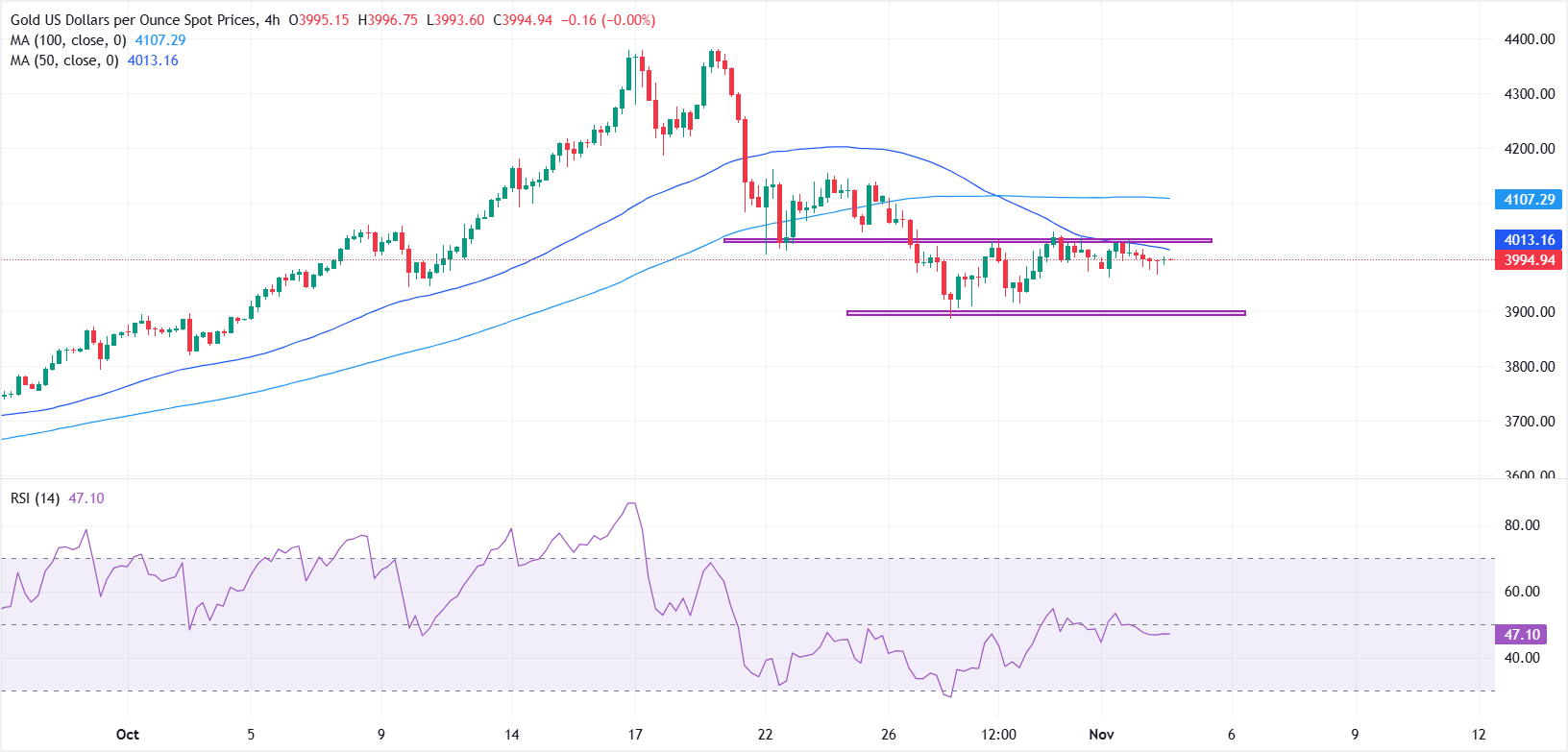
Gold (XAU/USD) lacks clear directional momentum, trading within a narrow range just below the $4,000 mark. On the 4-hour chart, the metal faces immediate resistance at the 50-period SMA, which aligns closely with the $4,020–$4,050 zone — a former support-turned-resistance area.
A sustained move above this region could pave the way toward the 100-period SMA near $4,107, with follow-through buying potentially extending gains toward the $4,150 area.
On the downside, initial support lies at the intraday low of $3,966, followed by the $3,900 psychological level. The Relative Strength Index (RSI) on the 4-hour chart stands near 47, indicating a neutral bias and reinforcing the view of consolidation within the current range.
Fed FAQs
Monetary policy in the US is shaped by the Federal Reserve (Fed). The Fed has two mandates: to achieve price stability and foster full employment. Its primary tool to achieve these goals is by adjusting interest rates. When prices are rising too quickly and inflation is above the Fed’s 2% target, it raises interest rates, increasing borrowing costs throughout the economy. This results in a stronger US Dollar (USD) as it makes the US a more attractive place for international investors to park their money. When inflation falls below 2% or the Unemployment Rate is too high, the Fed may lower interest rates to encourage borrowing, which weighs on the Greenback.
The Federal Reserve (Fed) holds eight policy meetings a year, where the Federal Open Market Committee (FOMC) assesses economic conditions and makes monetary policy decisions. The FOMC is attended by twelve Fed officials – the seven members of the Board of Governors, the president of the Federal Reserve Bank of New York, and four of the remaining eleven regional Reserve Bank presidents, who serve one-year terms on a rotating basis.
In extreme situations, the Federal Reserve may resort to a policy named Quantitative Easing (QE). QE is the process by which the Fed substantially increases the flow of credit in a stuck financial system. It is a non-standard policy measure used during crises or when inflation is extremely low. It was the Fed’s weapon of choice during the Great Financial Crisis in 2008. It involves the Fed printing more Dollars and using them to buy high grade bonds from financial institutions. QE usually weakens the US Dollar.
Quantitative tightening (QT) is the reverse process of QE, whereby the Federal Reserve stops buying bonds from financial institutions and does not reinvest the principal from the bonds it holds maturing, to purchase new bonds. It is usually positive for the value of the US Dollar.
Artigos Recomendados


