


Canadian Dollar finds fresh highs amid general sentiment improvement
- The Canadian Dollar rose around 0.3% on Thursday.
- General market sentiment has improved, pushing down the Greenback.
- Canadian data remains light, but a softer USD is propping up the Loonie.
The Canadian Dollar (CAD) caught a fresh bid on Thursday on the back of a weakening US Dollar (USD). Market flows are drifting away from the safe haven Greenback, providing support for the otherwise unremarkable Loonie and pushing the USD/CAD pair back down toward the 1.4200 handle.
Canada remains overwhelmingly underrepresented on the economic data docket this week, but a spat of US inflation figures is giving investors plenty to chew on. US Producer Price Index (PPI) figures came in above expectations, but a sharp upside revision to previous figures means inflation pressures are still coming down, at least in theory.
Daily digest market movers: Canadian Dollar drifts higher as traders await latest Trump tariffs
- The Canadian Dollar drifted around one-third of one percent higher against the Greenback on Thursday.
- US PPI inflation came in above forecasts, but steep revisions to older data means inflation isn’t as big of a problem as markets feared on Wednesday when US Consumer Price Index (CPI) inflation lurched back into the high side.
- Market bets of a Federal Reserve (Fed) rate cut have been walked forward to July or September, from the early week’s initial bets of no moves until December.
- US Retail Sales still loom ahead on Friday.
- US President Donald Trump is expected to unveil his latest “reciprocal tariff” proposals later on Thursday, but the implementation date is already getting pushed further down the road, with a soft date set for April.
- Repeated kicks of the Trump administration’s own can on tariffs has investors largely ignoring continued trade war gesticulations from President Trump.
Canadian Dollar price forecast
A steady grind higher for the Canadian Dollar as market sentiment continues to improve across the board means the US Dollar is taking a back seat, sending the USD/CAD down into fresh multi-week lows. Price action is grinding its way back to the 1.4200 handle after the Loonie tumbled to multi-decade lows recently, and a technical congestion pattern is beginning to break down as volatility kicks the walls down on USD/CAD.
The pair has drifted back into the low side of the 50-day Exponential Moving Average (EMA) near 1.4290 for the first time since October, but momentum is set to remain constrained as the 200-day EMA lies in wait just south of the 1.4000 handle.
USD/CAD daily chart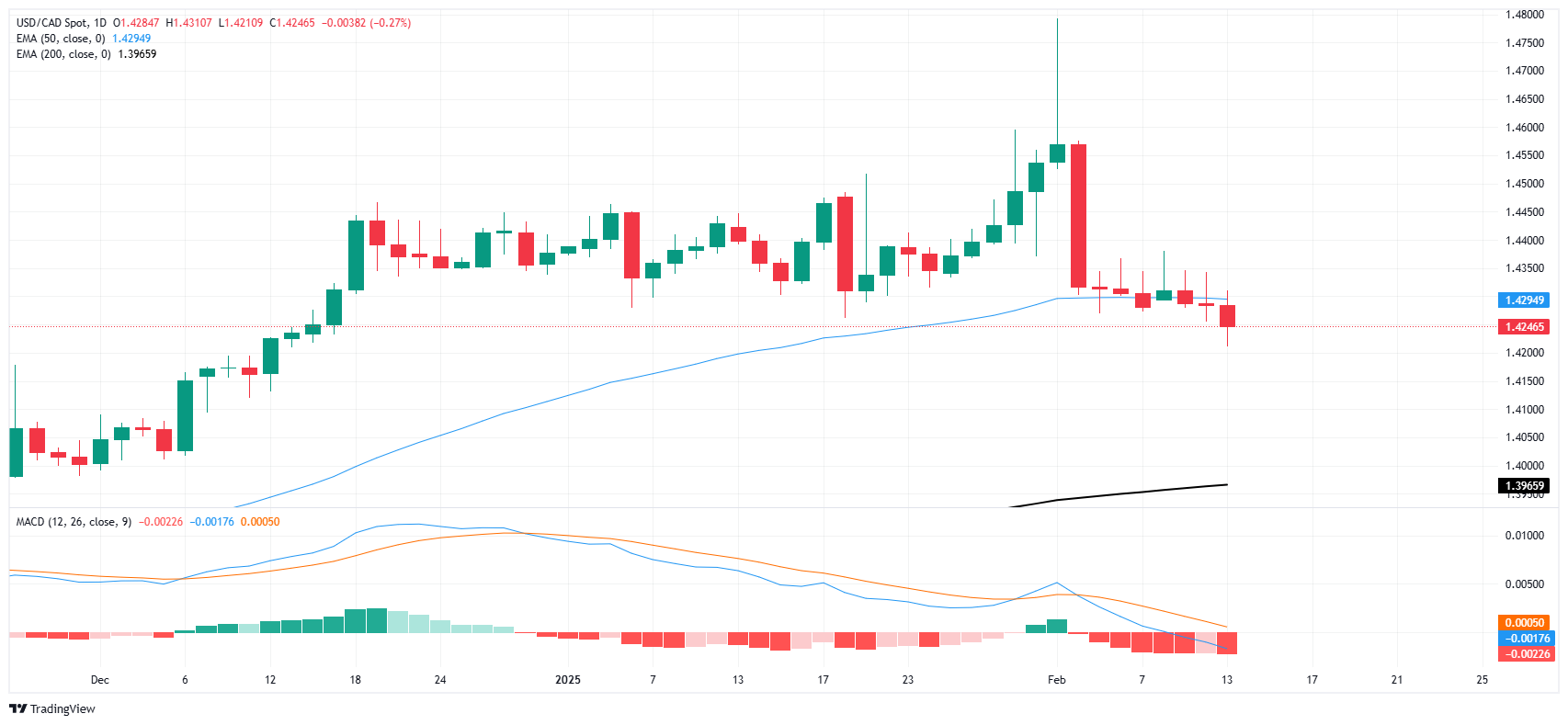
Canadian Dollar FAQs
The key factors driving the Canadian Dollar (CAD) are the level of interest rates set by the Bank of Canada (BoC), the price of Oil, Canada’s largest export, the health of its economy, inflation and the Trade Balance, which is the difference between the value of Canada’s exports versus its imports. Other factors include market sentiment – whether investors are taking on more risky assets (risk-on) or seeking safe-havens (risk-off) – with risk-on being CAD-positive. As its largest trading partner, the health of the US economy is also a key factor influencing the Canadian Dollar.
The Bank of Canada (BoC) has a significant influence on the Canadian Dollar by setting the level of interest rates that banks can lend to one another. This influences the level of interest rates for everyone. The main goal of the BoC is to maintain inflation at 1-3% by adjusting interest rates up or down. Relatively higher interest rates tend to be positive for the CAD. The Bank of Canada can also use quantitative easing and tightening to influence credit conditions, with the former CAD-negative and the latter CAD-positive.
The price of Oil is a key factor impacting the value of the Canadian Dollar. Petroleum is Canada’s biggest export, so Oil price tends to have an immediate impact on the CAD value. Generally, if Oil price rises CAD also goes up, as aggregate demand for the currency increases. The opposite is the case if the price of Oil falls. Higher Oil prices also tend to result in a greater likelihood of a positive Trade Balance, which is also supportive of the CAD.
While inflation had always traditionally been thought of as a negative factor for a currency since it lowers the value of money, the opposite has actually been the case in modern times with the relaxation of cross-border capital controls. Higher inflation tends to lead central banks to put up interest rates which attracts more capital inflows from global investors seeking a lucrative place to keep their money. This increases demand for the local currency, which in Canada’s case is the Canadian Dollar.
Macroeconomic data releases gauge the health of the economy and can have an impact on the Canadian Dollar. Indicators such as GDP, Manufacturing and Services PMIs, employment, and consumer sentiment surveys can all influence the direction of the CAD. A strong economy is good for the Canadian Dollar. Not only does it attract more foreign investment but it may encourage the Bank of Canada to put up interest rates, leading to a stronger currency. If economic data is weak, however, the CAD is likely to fall.
Artigos Recomendados


