


Australian Dollar sinks as US jobs report brushes away recession fears
- AUD/USD falls following robust US Nonfarm Payrolls data, reducing the likelihood of aggressive Fed rate cuts.
- Fed Chair Powell signals slower pace of easing, with markets now pricing in a 25 bps cut for November.
- Australian data shows mixed results with strong Retail Sales and trade surplus but ongoing manufacturing contraction and slowing business activity.
The Australian Dollar dropped during the North American session after September’s jobs report in the United States (US), suggesting that the Federal Reserve (Fed) would not cut rates by 50 basis points (bps) at the November meeting. The AUD/USD trades at 0.6796, down over 0.60%.
The AUD/USD extended its losses following September’s monster Nonfarm Payrolls report in the US, which lowered the Unemployment Rate. Average Hourly Earnings were mixed, though overall the data relieved the Fed from lowering rates aggressively.
In September, the Fed cut rates by 50 bps. The swaps markets showed that investors had earlier been eyeing another one of the same size in the November or December meeting. However, Fed Chair Jerome Powell pushed against this stance on Monday, saying that officials foresaw 50 bps of easing in total at the end of 2024 and that the US central bank is in no rush to cut rates.
According to CME FedWatch Tool data, the markets had priced in a 25 bps cut at the November meeting regarding Fed interest rate probabilities.
Aside from this, Australia’s data witnessed a solid Retail Sales report, and the Balance of Trade in August printed a surplus. Although those conditions could prevent the Reserve Bank of Australia (RBA) from cutting rates, business activity in the manufacturing sector, via the Judo Bank Manufacturing PMI, contracted for eight straight months.
On the other hand, the Judo Bank Services PMI slowed sharply, while Building Permits plummeted, hinting at an ongoing economic slowdown.
Next week, Australia’s economic docket will feature Business and Consumer Confidence data, RBA speakers, and the RBA’s latest meeting minutes. On the US front, the schedule will feature the release of inflation data, jobless claims, and University of Michigan Consumer Sentiment.
Daily digest market movers: Australian Dollar depreciates on US data, geopolitical risks
- The Australian Dollar will likely remain pressured due to several factors. Geopolitical risks, such as over-the-weekend developments in the Middle East, could hurt risk appetite for the AUD.
- The Aussie’s economic docket will feature the NAB Business Confidence and the Westpac Consumer Confidence for September and October, respectively. Following that, traders eye RBA’s Hauser, Kent and Hunter speeches.
- US Nonfarm Payrolls increased by 254K in September, significantly surpassing the estimated 140K and the upwardly revised August figure of 159K. The Unemployment Rate fell from 4.2% to 4.1%, lower than expected.
- Average Hourly Earnings in September rose by 0.4% MoM, down from 0.5% in the previous month but exceeding forecasts of 0.3%.
- On a YoY basis, earnings per hour increased by 4% in the 12 months to September, surpassing estimates and improving on August’s figures of 3.8% and 3.9%.
- Market participants have ruled out a 50 bps cut from the Fed. The odds of a 25 bps cut stand at 95%, with only a 5% chance of rates being held unchanged, according to the CME FedWatch Tool data.
Technical analysis: Australian Dollar extends its losses below 0.6800
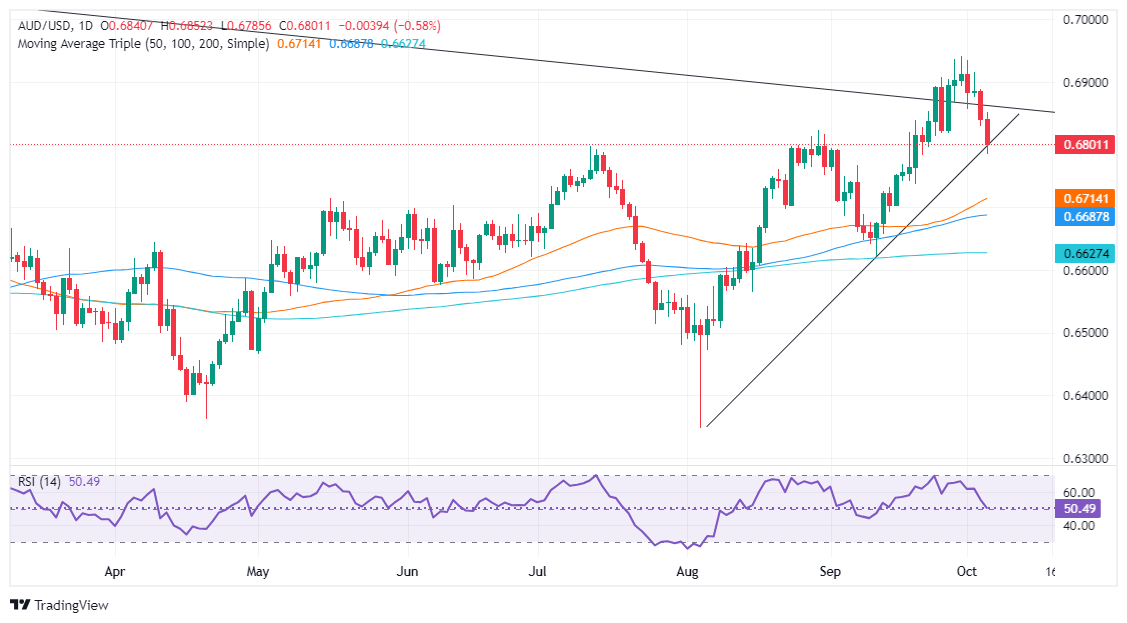
Despite retreacing below the 0.6800 figure, the AUD/USD remains upwardly biased. Momentum is mixed with the Relative Strength Index (RSI) remaining bullish but hinting at dropping into bearish territory.
The AUD/USD could accelerate its losses if it clears the September 6 peak at 0.6767. Once surrendered, the next demand area will be the 50-day Simple Moving Average (SMA) at 0.6712.
On the other hand, if buyers lift the AUD/USD above 0.6800, the first supply zone will be the October 1, 2024 low of 0.6856. A breach of the latter will expose 0.6900 before retesting the year-to-date high of 0.6934.
Australian Dollar FAQs
One of the most significant factors for the Australian Dollar (AUD) is the level of interest rates set by the Reserve Bank of Australia (RBA). Because Australia is a resource-rich country another key driver is the price of its biggest export, Iron Ore. The health of the Chinese economy, its largest trading partner, is a factor, as well as inflation in Australia, its growth rate and Trade Balance. Market sentiment – whether investors are taking on more risky assets (risk-on) or seeking safe-havens (risk-off) – is also a factor, with risk-on positive for AUD.
The Reserve Bank of Australia (RBA) influences the Australian Dollar (AUD) by setting the level of interest rates that Australian banks can lend to each other. This influences the level of interest rates in the economy as a whole. The main goal of the RBA is to maintain a stable inflation rate of 2-3% by adjusting interest rates up or down. Relatively high interest rates compared to other major central banks support the AUD, and the opposite for relatively low. The RBA can also use quantitative easing and tightening to influence credit conditions, with the former AUD-negative and the latter AUD-positive.
China is Australia’s largest trading partner so the health of the Chinese economy is a major influence on the value of the Australian Dollar (AUD). When the Chinese economy is doing well it purchases more raw materials, goods and services from Australia, lifting demand for the AUD, and pushing up its value. The opposite is the case when the Chinese economy is not growing as fast as expected. Positive or negative surprises in Chinese growth data, therefore, often have a direct impact on the Australian Dollar and its pairs.
Iron Ore is Australia’s largest export, accounting for $118 billion a year according to data from 2021, with China as its primary destination. The price of Iron Ore, therefore, can be a driver of the Australian Dollar. Generally, if the price of Iron Ore rises, AUD also goes up, as aggregate demand for the currency increases. The opposite is the case if the price of Iron Ore falls. Higher Iron Ore prices also tend to result in a greater likelihood of a positive Trade Balance for Australia, which is also positive of the AUD.
The Trade Balance, which is the difference between what a country earns from its exports versus what it pays for its imports, is another factor that can influence the value of the Australian Dollar. If Australia produces highly sought after exports, then its currency will gain in value purely from the surplus demand created from foreign buyers seeking to purchase its exports versus what it spends to purchase imports. Therefore, a positive net Trade Balance strengthens the AUD, with the opposite effect if the Trade Balance is negative.
Artigos Recomendados


