


Canadian Dollar backslides on NFP Friday
- The Canadian Dollar (CAD) eased lower after better-than-expected US NFP numbers.
- Canada saw an upswing in Ivey PMIs, but was passed over by market watchers.
- A firm jump in US NFP jobs additions toppled rate cut hopes to wrap up the trading week.
The Canadian Dollar (CAD) slipped further on Friday, driven lower by a broad-market extension of recent Greenback bidding that sent the US Dollar higher across the board after US Nonfarm Payrolls (NFP) figures widely outran expectations.
Canada’s Ivey Purchasing Manager’s Index (PMI) recovered in September, but the Canadian datapoint was swept aside by investors fully focused on US payrolls data. US NFP net job additions came in well above expectations in September, with upside revisions to several month’s of jobs figures. The rapid shift in the market’s outlook of the US labor market has widely shifted rate market bets of November’s Federal Reserve (Fed) rate cut.
Daily digest market movers
- The Canadian Dollar lost a scant one-fifth of one percent against the Greenback on Friday.
- Canada’s Ivey PMI for September recovered ground, climbing back into 54.9 after dipping to 50.3 the month prior.
- US NFP jobs data came in wildly above expectations, adding 254K net new job additions in September compared to the forecast 140K. August’s NFP print was also revised upwards to 159K.
- The US Unemployment Rate also ticked down to 4.1% from the previous 4.2%, further burying market hopes for a follow-up double rate cut from the Fed in November.
- According to the CME’s FedWatch Tool, rate traders now see an overwhelming 95% chance of a single 25 bps cut from the Fed on November 7, with a particularly beleaguered 5% expecting no movement at all.
- Hopes for a second 50 bps rate cut in November have entirely evaporated.
Canadian Dollar price forecast
The USD/CAD pair has been grinding higher over the past few sessions, with the pair finding itself at a critical juncture near the 50-day (1.3584) and 200-day (1.3602) Exponential Moving Averages (EMA). After a sustained downtrend from mid-August to early September, the pair has shown signs of stabilization, rebounding off the 1.3450 level.
This recent price action signals that USD/CAD could be testing the upper boundaries of its consolidation range, with potential resistance near the 1.3600 handle. While the pair remains below both the 50-day and 200-day EMAs, the proximity of these moving averages suggests a zone of significant technical resistance. A break above these levels could open the door for further gains, targeting the 1.3700 level.
On the downside, the pair appears to have found support around 1.3450, a key level that has acted as a floor in recent trading. A failure to hold above this level may lead to renewed selling pressure, potentially driving the pair back to the 1.3350 region.
USD/CAD daily chart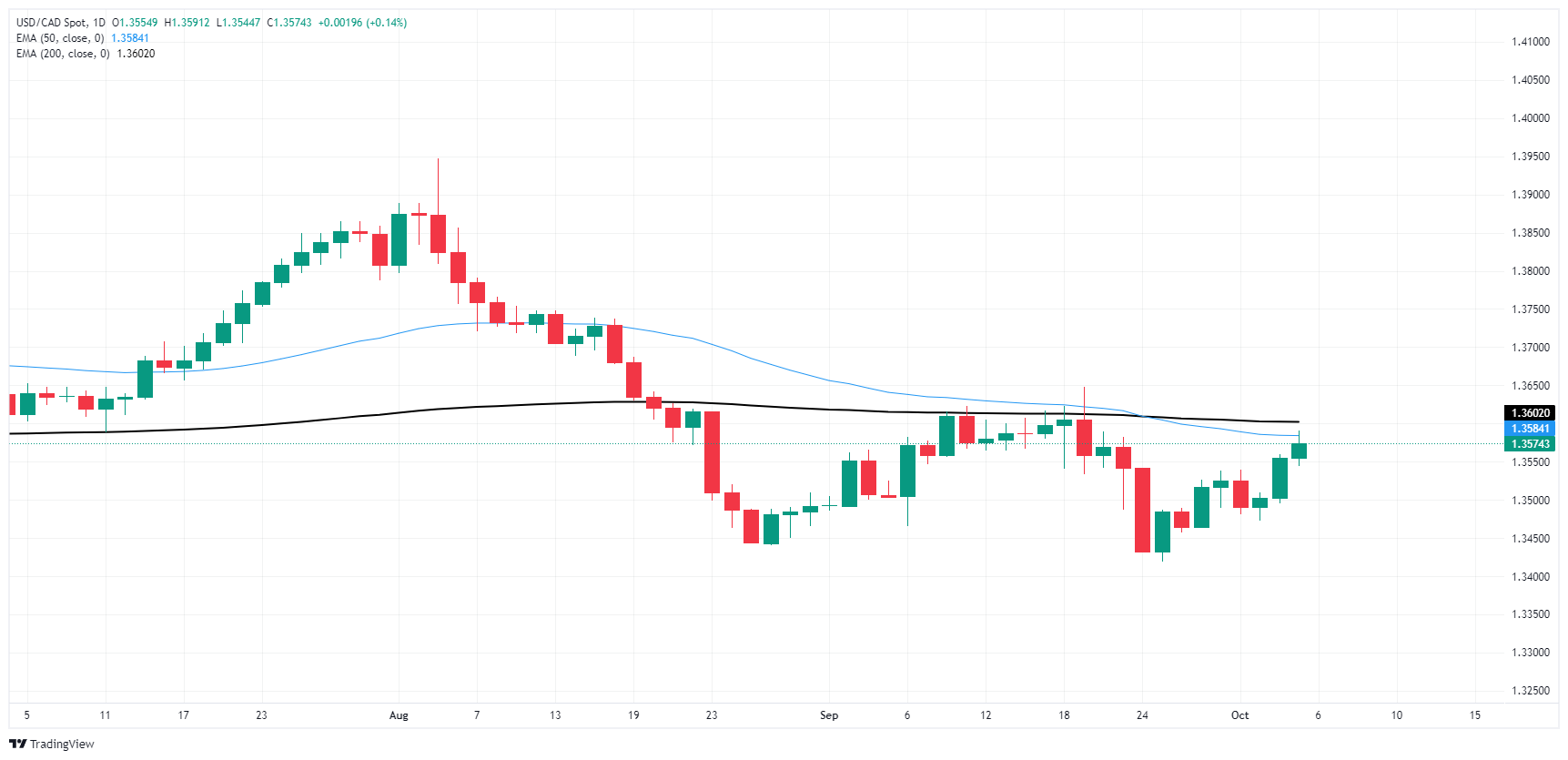
Canadian Dollar FAQs
The key factors driving the Canadian Dollar (CAD) are the level of interest rates set by the Bank of Canada (BoC), the price of Oil, Canada’s largest export, the health of its economy, inflation and the Trade Balance, which is the difference between the value of Canada’s exports versus its imports. Other factors include market sentiment – whether investors are taking on more risky assets (risk-on) or seeking safe-havens (risk-off) – with risk-on being CAD-positive. As its largest trading partner, the health of the US economy is also a key factor influencing the Canadian Dollar.
The Bank of Canada (BoC) has a significant influence on the Canadian Dollar by setting the level of interest rates that banks can lend to one another. This influences the level of interest rates for everyone. The main goal of the BoC is to maintain inflation at 1-3% by adjusting interest rates up or down. Relatively higher interest rates tend to be positive for the CAD. The Bank of Canada can also use quantitative easing and tightening to influence credit conditions, with the former CAD-negative and the latter CAD-positive.
The price of Oil is a key factor impacting the value of the Canadian Dollar. Petroleum is Canada’s biggest export, so Oil price tends to have an immediate impact on the CAD value. Generally, if Oil price rises CAD also goes up, as aggregate demand for the currency increases. The opposite is the case if the price of Oil falls. Higher Oil prices also tend to result in a greater likelihood of a positive Trade Balance, which is also supportive of the CAD.
While inflation had always traditionally been thought of as a negative factor for a currency since it lowers the value of money, the opposite has actually been the case in modern times with the relaxation of cross-border capital controls. Higher inflation tends to lead central banks to put up interest rates which attracts more capital inflows from global investors seeking a lucrative place to keep their money. This increases demand for the local currency, which in Canada’s case is the Canadian Dollar.
Macroeconomic data releases gauge the health of the economy and can have an impact on the Canadian Dollar. Indicators such as GDP, Manufacturing and Services PMIs, employment, and consumer sentiment surveys can all influence the direction of the CAD. A strong economy is good for the Canadian Dollar. Not only does it attract more foreign investment but it may encourage the Bank of Canada to put up interest rates, leading to a stronger currency. If economic data is weak, however, the CAD is likely to fall.
Artigos Recomendados


