


Mexican Peso slips on geopolitical risks and US Dollar strength
- Mexican Peso snaps two days of gains and falls on Israel/Iran hostilities.
- Banxico’s September poll revised USD/MXN exchange rate expectations upward, while inflation projections were lowered.
- Traders await September’s Nonfarm Payrolls data, with strong results likely boosting the Greenback and further impacting the Peso.
The Mexican Peso registers losses in early trading against the Greenback on Thursday amid increasing geopolitical risks as President Joe Biden is discussing with Israel how to attack Iranian oil facilities. Data from Mexico witnessed an increase in Foreign Exchange Reserves, according to the Bank of Mexico (Banxico). The USD/MXN trades at 19.53, gaining over 0.60%.
Market sentiment has slightly deteriorated by the conflict in the Middle East. The clashes between Israel and Hezbollah continue in southern Lebanon on Thursday. Meanwhile, Israel struck central Beirut and is expected to launch a separate attack on Iranian assets in the near future.
This has impacted the risk-sensitive Mexican Peso, due to its status of an emerging market currency. The US Dollar Index (DXY), which reflects the buck’s performance against a basket of six currencies, has soared 0.43% on the safe-haven flows, regaining the 102.00 figure for the first time since August 20.
Meanwhile, Banxico’s September poll of 40 private groups of analysts and economists revealed that the USD/MXN exchange rate was revised up and would end higher, compared to August poll. The same survey showed that expectations on headline and underlying inflation were lowered, while the main reference rate set by the Mexican central bank is projected to end at around 10%.
President Claudia Sheinbaum has proposed an increase of 12% to wages in 2025, according to newswires.
In the US, the Department of Labor revealed that the number of Americans filing for unemployment benefits jumped, exceeding forecasts and the previous reading. S&P Global and the Institute for Supply Management (ISM) showed that Services PMI readings were mixed. The former missed estimates, while the latter crushed estimates, expanding at its highest level since February 2023.
On Friday, USD/MXN traders will eye the release of September’s Nonfarm Payrolls figures. If data surpasses estimates, this would be positive for the Greenback and could sponsor a leg-up in the pair. Conversely if data comes as expected, and risk appetite has improved, it would be positive for the Mexican Peso.
Daily digest market movers: Mexican Peso tumbles on risk aversion to Middle East conflict
- Mexico’s Foreign Exchange Reserves in August grew from $227 billion to $231 billion.
- Banxico’s poll showed economists expect the USD/MXN exchange rate to end at 19.69 in 2024. Inflation expectations were revised down from 4.69% to 4.48%, and core is expected to drop to 3.84% from 3.94%.
- Mexico’s economy is foreseen growing 1.45% in 2024, lower than August’s 1.57%. Economists estimate Banxico to lower rates to 10%, down from 10.25% on the previous survey.
- On Tuesday, Banxico Deputy Governor Jonathan Heath said that interest rates should remain higher for “more time” while acknowledging that core inflation is coming toward the target. He added that the US central bank’s rate cut wouldn’t directly impact Banxico’s policy path and does not believe Mexico is close to a recession.
- Mexican data shows the economy might slow down sharply. Business Confidence continued to deteriorate, while business activity, measured by the S&P Global Manufacturing PMI, contracted sharply.
- US Initial Jobless Claims for the week ending September 28 jumped from 219K to 225K, exceeding estimates of 220K.
- The ISM Services PMI in September expanded from 51.5 to 54.9; Factory Orders for August shrank, missing estimates of 0% to arrive at -0.2%, down from the previous 4.9%.
- Market participants have put the odds of a 25 bps cut at 66.7%. According to the CME FedWatch Tool, the chances for a larger 50 bps cut diminished to 33.3%.
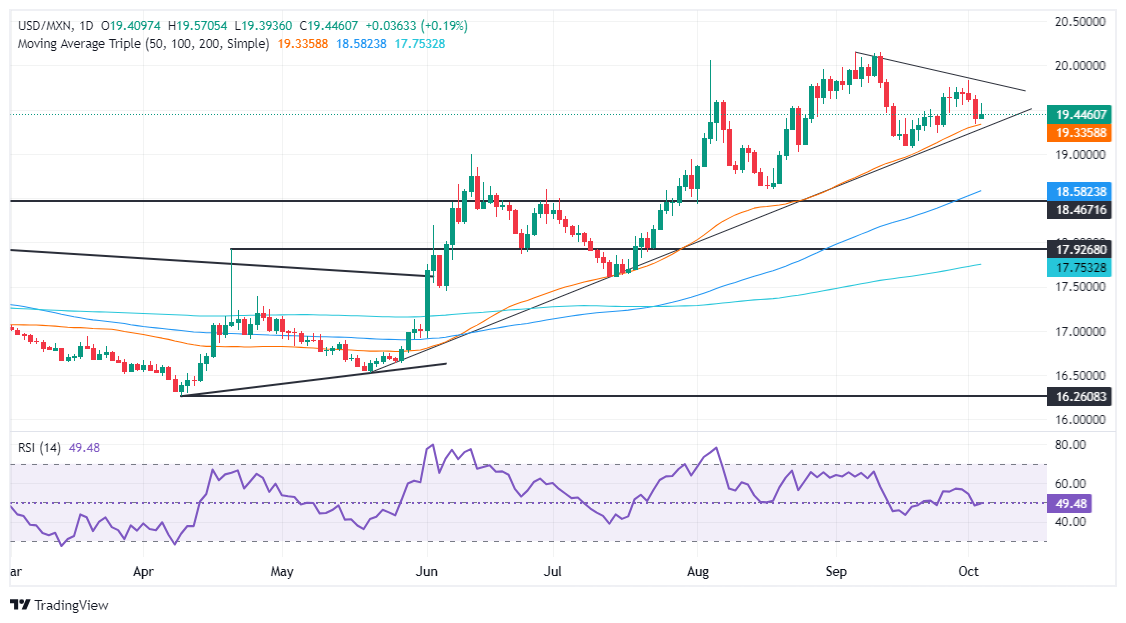
Technical analysis: Mexican Peso falls as USD/MXN climbs above 19.40
The USD/MXN uptrend remains intact, but buyers have lost steam as shown by the Relative Strength Index (RSI). The RSI slipped below its neutral line, an indication that sellers have the upper hand. Hence, the path of least resistance is skewed to the downside.
If USD/MXN clears the 50-day Simple Moving Average (SMA) at 19.32, the next support would be the September 24 swing low of 19.23 before the pair moves toward the September 18 daily low of 19.06. Once those levels are surpassed, the 19.00 figure emerges as the following line of defense.
Conversely, for a bullish resumption, the USD/MXN needs to surpass the October 1 daily high of 19.82. On further strength, the next resistance will be the psychological 20.00 figure, followed by the YTD peak of 20.22.
Mexican Peso FAQs
The Mexican Peso (MXN) is the most traded currency among its Latin American peers. Its value is broadly determined by the performance of the Mexican economy, the country’s central bank’s policy, the amount of foreign investment in the country and even the levels of remittances sent by Mexicans who live abroad, particularly in the United States. Geopolitical trends can also move MXN: for example, the process of nearshoring – or the decision by some firms to relocate manufacturing capacity and supply chains closer to their home countries – is also seen as a catalyst for the Mexican currency as the country is considered a key manufacturing hub in the American continent. Another catalyst for MXN is Oil prices as Mexico is a key exporter of the commodity.
The main objective of Mexico’s central bank, also known as Banxico, is to maintain inflation at low and stable levels (at or close to its target of 3%, the midpoint in a tolerance band of between 2% and 4%). To this end, the bank sets an appropriate level of interest rates. When inflation is too high, Banxico will attempt to tame it by raising interest rates, making it more expensive for households and businesses to borrow money, thus cooling demand and the overall economy. Higher interest rates are generally positive for the Mexican Peso (MXN) as they lead to higher yields, making the country a more attractive place for investors. On the contrary, lower interest rates tend to weaken MXN.
Macroeconomic data releases are key to assess the state of the economy and can have an impact on the Mexican Peso (MXN) valuation. A strong Mexican economy, based on high economic growth, low unemployment and high confidence is good for MXN. Not only does it attract more foreign investment but it may encourage the Bank of Mexico (Banxico) to increase interest rates, particularly if this strength comes together with elevated inflation. However, if economic data is weak, MXN is likely to depreciate.
As an emerging-market currency, the Mexican Peso (MXN) tends to strive during risk-on periods, or when investors perceive that broader market risks are low and thus are eager to engage with investments that carry a higher risk. Conversely, MXN tends to weaken at times of market turbulence or economic uncertainty as investors tend to sell higher-risk assets and flee to the more-stable safe havens.
Artigos Recomendados


