


New Zealand Dollar extends recovery to near 0.5650 amid hawkish RBNZ outlook
- NZD/USD recovers further to near 0.5650 due to hawkish RBNZ expectations.
- OCBC said that RBNZ’s decision to hold rates on Wednesday was a temporary pause.
- The US Dollar trades lower ahead of US mid-term elections.
The New Zealand Dollar (NZD) extends its Thursday’s recovery move to near 0.5650 against the US Dollar (USD) in the European trade on Friday. The Kiwi pair gains as financial markets anticipate that the Reserve Bank of New Zealand’s (RBNZ) will remain on the monetary tightening path after leaving the Official Cash Rate (OCR) steady at 2.75% on Wednesday.
The RBNZ was expected to hike its OCR by 25 basis points (bps) to 3%; however, its decision to maintain the status-quo weighed heavily on the antipodean.
Kiwi steadies as RBNZ pause seen as temporary, with NZD downside capped near 0.5600
Analysts at OCBC note that the Reserve Bank of New Zealand’s decision to hold the OCR was not unanimous, with “Governor Anna Breman” siding with the majority to keep rates unchanged, while “Chief Economist Paul Conway backed a hike.” They highlight that the majority on the committee “preferred to give the July and September rate increases more time to work through the economy, particularly with domestic demand still subdued.”
OCBC stresses that the move should be viewed “more of a pause than a dovish pivot.” In their words, “the RBNZ said tighter monetary policy is likely to be required, although the timing remains data-dependent,” and “attention now shifts to December.” The bank reiterates its policy outlook, stating, “we continue to expect two further hikes, in December and 1Q27, which should limit further NZD downside.” On the currency, OCBC adds that “for NZD/USD, 0.5600 remains the key near-term level to watch after being tested around the decision.”
Meanwhile, the US Dollar is under pressure while entering into the weekend. Going forward, headlines related to mid-term elections scheduled on Tuesday will have a significant impact.
Analysts at ING note that “fresh pressure on tech stocks has triggered some safe-haven buying in US Treasuries and weighed on the Dollar as the front end followed lower.” While they stress that “moves are contained in both equities and FX,” the episode serves as “a reminder that the greenback still faces downside risks from oscillating AI sentiment.”
At the same time, ING points out that “whenever tech stocks don’t dominate headlines, the Dollar has had no trouble attracting buyers,” adding that they “don’t think Wednesday’s FOMC changed that.” The bank highlights that “yesterday’s US data was hawkish-leaning, with 3Q growth slightly above consensus at 3.4% and core PCE at 0.3% month-on-month in September – enough to keep the Federal Reserve on high alert.”
Looking ahead, ING argues that “the main risk for the Dollar today is some precautionary unwinding of net-long positions ahead of Tuesday’s US midterm elections.” They note that “a Democratic sweep is trading around 68% in prediction markets, and that could be seen as slightly negative for the US Dollar from a few angles, from higher risk of government shutdown and gridlock on debt ceiling negotiations to potential damage to already shaky AI-related sentiment.” Against this backdrop, ING concludes: “We’d be cautious in chasing the USD upside in the next few days.”
NZD/USD Technical Analysis
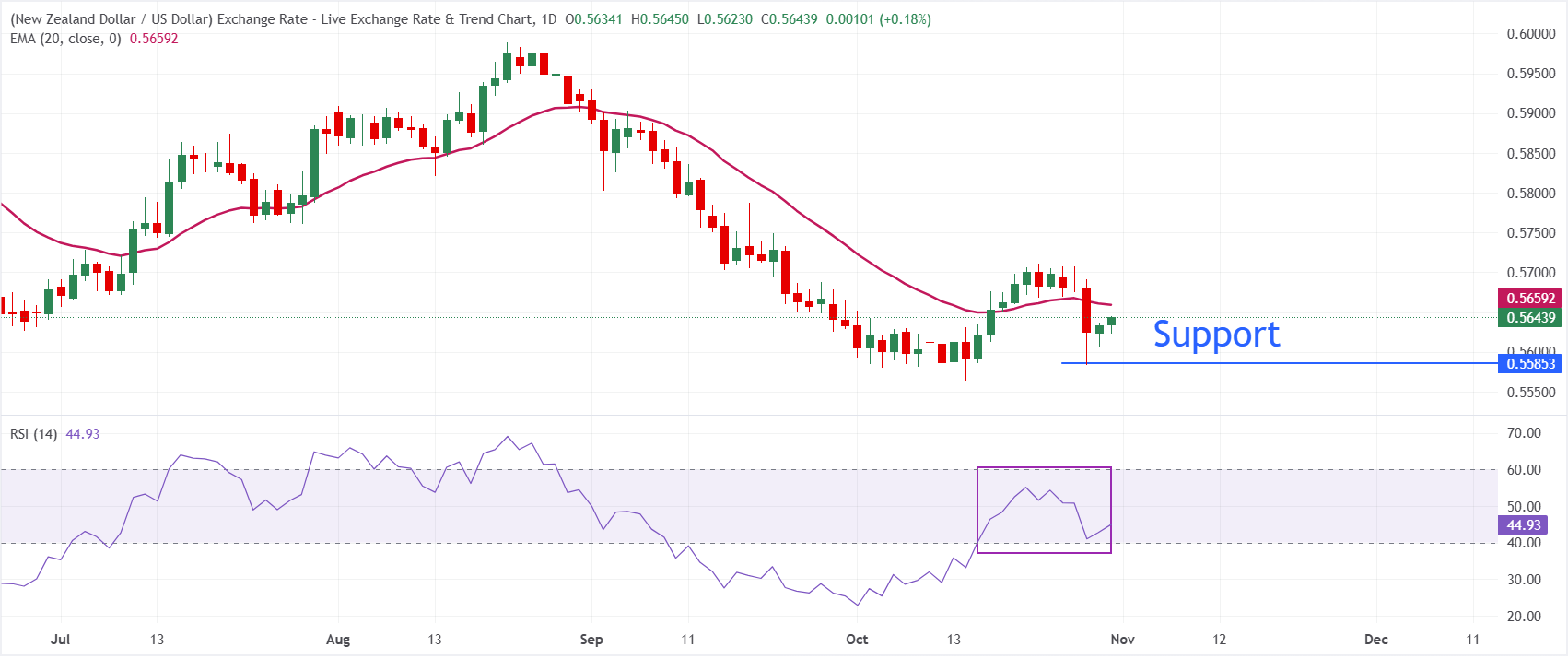
In the daily chart, NZD/USD trades at 0.5644, keeping a bearish near-term bias as spot remains capped beneath the 20-day exponential moving average (EMA) at 0.5659. The pair has struggled to sustain the recent rebound, with price still below this short-term trend filter, while the Relative Strength Index (RSI) around 45 suggests only moderate, non-committal momentum that does little to offset the prevailing downside tone.
On the topside, immediate resistance is located at the 20-day EMA at 0.5659, which acts as the first barrier that bulls would need to reclaim to ease bearish pressure and open the way for a more sustained recovery. As long as NZD/USD trades below this level, the risk favors further consolidation or downside extension, with intraday rallies likely to be challenged by selling interest around the moving average.
(The technical analysis of this story was written with the help of an AI tool. Know more.)
RBNZ FAQs
The Reserve Bank of New Zealand (RBNZ) is the country’s central bank. Its economic objectives are achieving and maintaining price stability – achieved when inflation, measured by the Consumer Price Index (CPI), falls within the band of between 1% and 3% – and supporting maximum sustainable employment.
The Reserve Bank of New Zealand’s (RBNZ) Monetary Policy Committee (MPC) decides the appropriate level of the Official Cash Rate (OCR) according to its objectives. When inflation is above target, the bank will attempt to tame it by raising its key OCR, making it more expensive for households and businesses to borrow money and thus cooling the economy. Higher interest rates are generally positive for the New Zealand Dollar (NZD) as they lead to higher yields, making the country a more attractive place for investors. On the contrary, lower interest rates tend to weaken NZD.
Employment is important for the Reserve Bank of New Zealand (RBNZ) because a tight labor market can fuel inflation. The RBNZ’s goal of “maximum sustainable employment” is defined as the highest use of labor resources that can be sustained over time without creating an acceleration in inflation. “When employment is at its maximum sustainable level, there will be low and stable inflation. However, if employment is above the maximum sustainable level for too long, it will eventually cause prices to rise more and more quickly, requiring the MPC to raise interest rates to keep inflation under control,” the bank says.
In extreme situations, the Reserve Bank of New Zealand (RBNZ) can enact a monetary policy tool called Quantitative Easing. QE is the process by which the RBNZ prints local currency and uses it to buy assets – usually government or corporate bonds – from banks and other financial institutions with the aim to increase the domestic money supply and spur economic activity. QE usually results in a weaker New Zealand Dollar (NZD). QE is a last resort when simply lowering interest rates is unlikely to achieve the objectives of the central bank. The RBNZ used it during the Covid-19 pandemic.
Artigos Recomendados


