


Pound Sterling's six-month high has no British test this week
- GBP/USD trades at its highest since February on a 33-pip session range.
- UK inflation back to 2.9% in July, up from 2.6% in June.
- Core PCE, Jackson Hole and a Fed Chair keynote inside four days.
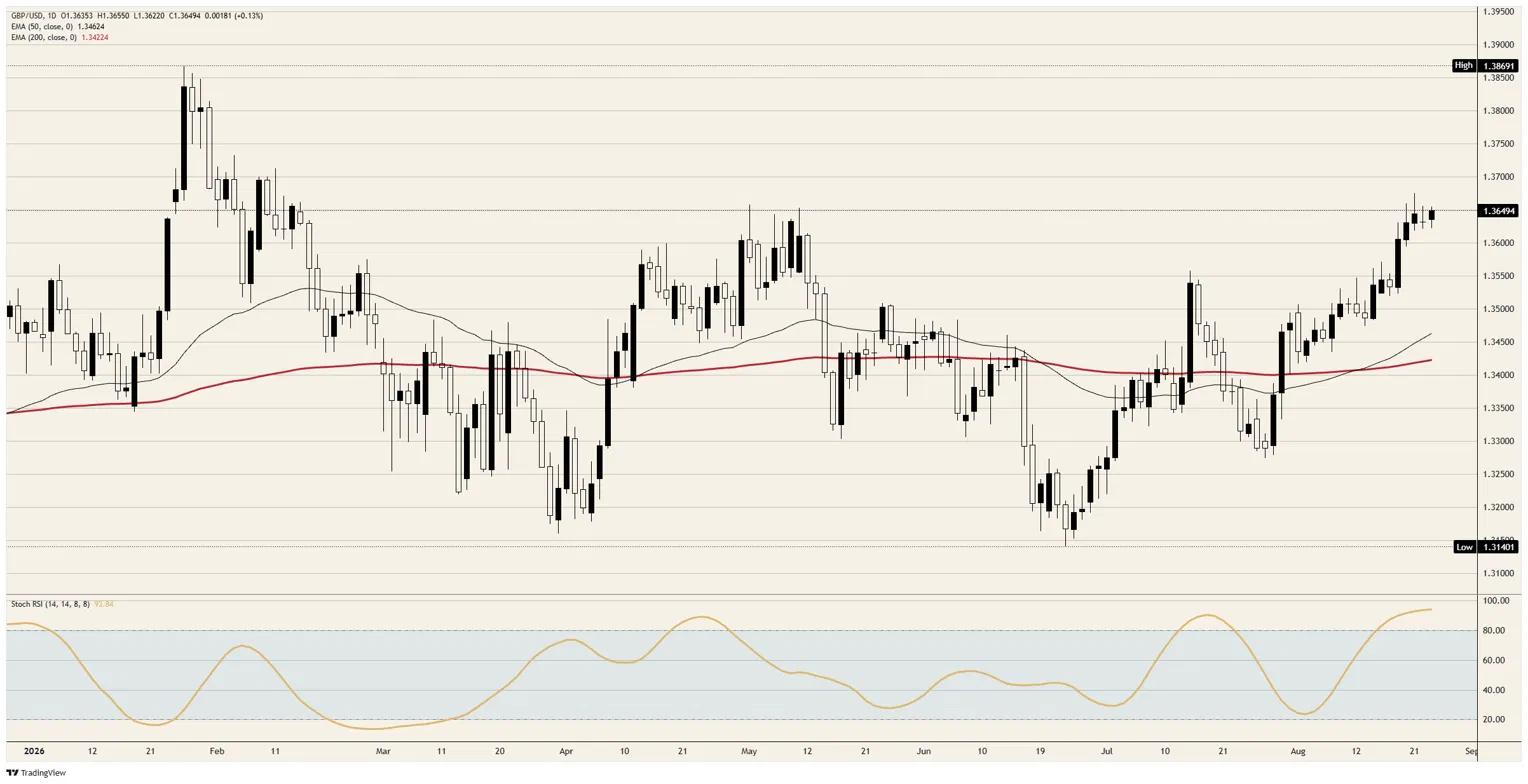
GBP/USD trades near 1.3650 late on Tuesday, August 25, up around a tenth of a percent on a session that has covered barely 33 pips between a floor just above 1.3600 and a ceiling a shade over 1.3650. That is the highest the pair has traded since February and roughly a cent and a half above where it sat in the second week of the month. The move that produced it was written almost entirely on the other side of the Atlantic.
The rally has an American author
Sterling's advance out of the 1.3500 area began on August 19, when the US Treasury announced it would at least double its purchases of longer-dated government debt. The Dollar fell broadly on the news and every major currency took its share, which is a different thing from a currency being bought on its own account. The Pound was a passenger on a repricing of American debt management.
The mechanism is worth naming, because it decides how durable the move is. Long-dated Treasury yields have spent months delivering the tightening the Fed declined to deliver, and a buyback facility aimed at capping those yields removes part of the yield support the Dollar had been drawing on. It also invites the objection markets raised within a day, which is that rearranging the maturity of existing debt does nothing to the quantity of it.
Positioning makes the same point from the other end. The last published read on large speculators still had them net short more than 54K Pound contracts, and that figure only refreshes on Friday at 19:30 GMT with data already three sessions old on arrival. A six-month high reached with the speculative base still short is a squeeze as much as a trend, and squeezes give ground faster than they take it.
The British case improved and cannot be expressed
Consumer Price Index (CPI) inflation returned to 2.9% in the year to July, published August 19, from 2.6% in June, with housing and household services the largest single upward contribution. Food inflation fell to 1.3%, its softest in two years, so the re-acceleration is not a grocery story. It is a housing and services story, which is the harder kind to write off as an energy passthrough.
Three Monetary Policy Committee (MPC) members already voted for 4.00% at the July 30 meeting against six for a hold, a dissenting bloc that grew from two at the previous decision. An inflation rate that has turned back up hands that bloc its argument, and the next opportunity to use it falls on September 17. No Monetary Policy Report (MPR) is attached to that meeting, so the vote arrives without a fresh forecast round behind it.
The awkward part is what sits immediately before it. August CPI publishes September 16, a day ahead of the decision and on the same date the Federal Open Market Committee (FOMC) announces. Between now and then the calendar offers Sterling nothing, and the only line on this week's slate carrying the currency's name is Friday's positioning figure.
Everything that can move it this week is American
Wednesday, August 26 stacks the week's data into a single 12:30 GMT release. Core Personal Consumption Expenditures (PCE) prices are forecast at 0.2% MoM for July against a 0.1% prior, with the annual rate steady at 3.3% and headline PCE at 0.1% MoM from -0.1%. The second reading of second-quarter Gross Domestic Product (GDP) is expected unchanged at 1.5% annualised, the GDP price index holds at 6.3%, and durable goods orders run at 0.7% from 0.5%.
Thursday brings initial jobless claims at 208K against 206K and the opening of the Jackson Hole symposium. Friday, August 28 carries the Chicago Purchasing Managers Index (PMI) at 57 from 57.6, Michigan sentiment at 51 unchanged with one-year inflation expectations running from a 4.3% prior, and the preliminary nonfarm payrolls benchmark revision.
The Jackson Hole keynote is the largest single risk to the level Sterling now holds. The Fed Chair speaks at 14:00 GMT on Friday, his first address in the job and 19 days before the September 16 decision, at a moment when futures price roughly one in three odds of an increase against about two-thirds in the days after July's hold. A chair who has told markets he will not take his cue from their prices arrives with one podium and no statement to hide behind.
Levels
Resistance: The 1.3700 handle is the first line above the session ceiling, with 1.3750 behind it and the February peak near 1.3850 the extension objective if the Dollar keeps leaking.
Support: The 1.3600 area has held through the session and is the first floor, with 1.3550 the shelf the rally used through the middle of the month and 1.3500 the base of the current leg.
Bias: Bullish while 1.3550 holds, objectives 1.3700 then 1.3750. A daily Stochastic Relative Strength Index (Stoch RSI) above 93 argues for a pause rather than a turn, and the Pound has no domestic catalyst to force one in either direction before September. Invalidation is a daily close beneath 1.3500, which puts the pair back inside the mid-August range and hands the rest of the week to the Dollar.
GBP/USD daily chart
Pound Sterling FAQs
The Pound Sterling (GBP) is the oldest currency in the world (886 AD) and the official currency of the United Kingdom. It is the fourth most traded unit for foreign exchange (FX) in the world, accounting for 12% of all transactions, averaging $630 billion a day, according to 2022 data. Its key trading pairs are GBP/USD, also known as ‘Cable’, which accounts for 11% of FX, GBP/JPY, or the ‘Dragon’ as it is known by traders (3%), and EUR/GBP (2%). The Pound Sterling is issued by the Bank of England (BoE).
The single most important factor influencing the value of the Pound Sterling is monetary policy decided by the Bank of England. The BoE bases its decisions on whether it has achieved its primary goal of “price stability” – a steady inflation rate of around 2%. Its primary tool for achieving this is the adjustment of interest rates. When inflation is too high, the BoE will try to rein it in by raising interest rates, making it more expensive for people and businesses to access credit. This is generally positive for GBP, as higher interest rates make the UK a more attractive place for global investors to park their money. When inflation falls too low it is a sign economic growth is slowing. In this scenario, the BoE will consider lowering interest rates to cheapen credit so businesses will borrow more to invest in growth-generating projects.
Data releases gauge the health of the economy and can impact the value of the Pound Sterling. Indicators such as GDP, Manufacturing and Services PMIs, and employment can all influence the direction of the GBP. A strong economy is good for Sterling. Not only does it attract more foreign investment but it may encourage the BoE to put up interest rates, which will directly strengthen GBP. Otherwise, if economic data is weak, the Pound Sterling is likely to fall.
Another significant data release for the Pound Sterling is the Trade Balance. This indicator measures the difference between what a country earns from its exports and what it spends on imports over a given period. If a country produces highly sought-after exports, its currency will benefit purely from the extra demand created from foreign buyers seeking to purchase these goods. Therefore, a positive net Trade Balance strengthens a currency and vice versa for a negative balance.
Artigos Recomendados


