


Australian Dollar advances following RBA Meeting Minutes
- Australian Dollar appreciates after the release of the Reserve Bank of Australia's Minutes of its December meeting.
- RBA Meeting Minutes showed growing doubt that policy remains restrictive as inflation pressures appear more persistent.
- The US Dollar faced headwinds as expectations grew that the Fed would continue easing policy.
The Australian Dollar (AUD) gains ground against the US Dollar (USD) on Tuesday, following the release of the Reserve Bank of Australia (RBA) Minutes of its December monetary policy meeting. Additionally, the AUD/USD pair appreciated as the US Dollar (USD) faced challenges as expectations grew that the Federal Reserve (Fed) would continue to ease monetary policy.
The RBA Meeting Minutes showed that board members signalled growing less confident that monetary policy remains restrictive, as evidence mounts that inflation pressures may prove more persistent than previously expected.
Policymakers also indicated that they would assess policy at future meetings, noting that G4 inflation data had been released ahead of the February meeting. They discussed whether a rate increase might be needed at some point in 2026 and felt that it would take a little longer to assess the persistence of inflation.
The ASX 30-Day Interbank Cash Rate Futures February 2026 contract was trading at 96.34 as of December 18, implying a 27% probability of a rate increase to 3.85% at the next RBA Board meeting.
US Dollar declines as precious metals rally amid rising geopolitical tensions
- The US Dollar Index (DXY), which measures the value of the US Dollar against six major currencies, is losing ground and trading around 98.20 at the time of writing. Traders await the US Gross Domestic Product Annualized for the third quarter due on Tuesday. The US economy is estimated to have expanded at an annual rate of 3.2% in Q3. It would be a slowdown from the 3.8% growth in Q2.
- The Greenback faces challenges as precious metals rally, supported by safe-haven demand amid rising geopolitical tensions between the US and Venezuela. US President Donald Trump said on Monday that the US would keep and maybe sell the oil it had seized off the coast of Venezuela in recent weeks. Trump added that the US would also keep the seized ships.
- The CME FedWatch tool shows a 80.0% probability of rates being held at the Fed’s January meeting, up from 75.6% a week earlier. Meanwhile, the likelihood of a 25-basis-point rate cut has fallen to 20.0% from 24.4% a week ago.
- Federal Reserve Bank of Cleveland President Beth Hammack said on Sunday that monetary policy is in a good position to pause and assess the effects of the 75-basis-point (bps) rate cuts on the economy during the first quarter, according to Bloomberg. Meanwhile, Governor Miran reiterated last week that further easing is warranted, citing signs that inflation has cooled.
- The University of Michigan reported on Friday that the Consumer Sentiment Index was revised down to 52.9 in December from the previous reading of 53.3. Consumer Expectations Index fell to 54.6 from 55.0. Meanwhile, One-year Inflation Expectations were revised up to 4.2% from 4.1% in both the initial estimate and the prior month.
- The People’s Bank of China (PBOC), China's central bank, announced on Monday to leave its Loan Prime Rates (LPRs) unchanged. The one- and five-year LPRs were at 3.00% and 3.50%, respectively.
- Australia’s Consumer Inflation Expectations, which rose to 4.7% in December from November’s three-month low of 4.5%, support the Reserve Bank of Australia’s (RBA) hawkish stance.
Australian Dollar eyes three-month highs near 0.6700
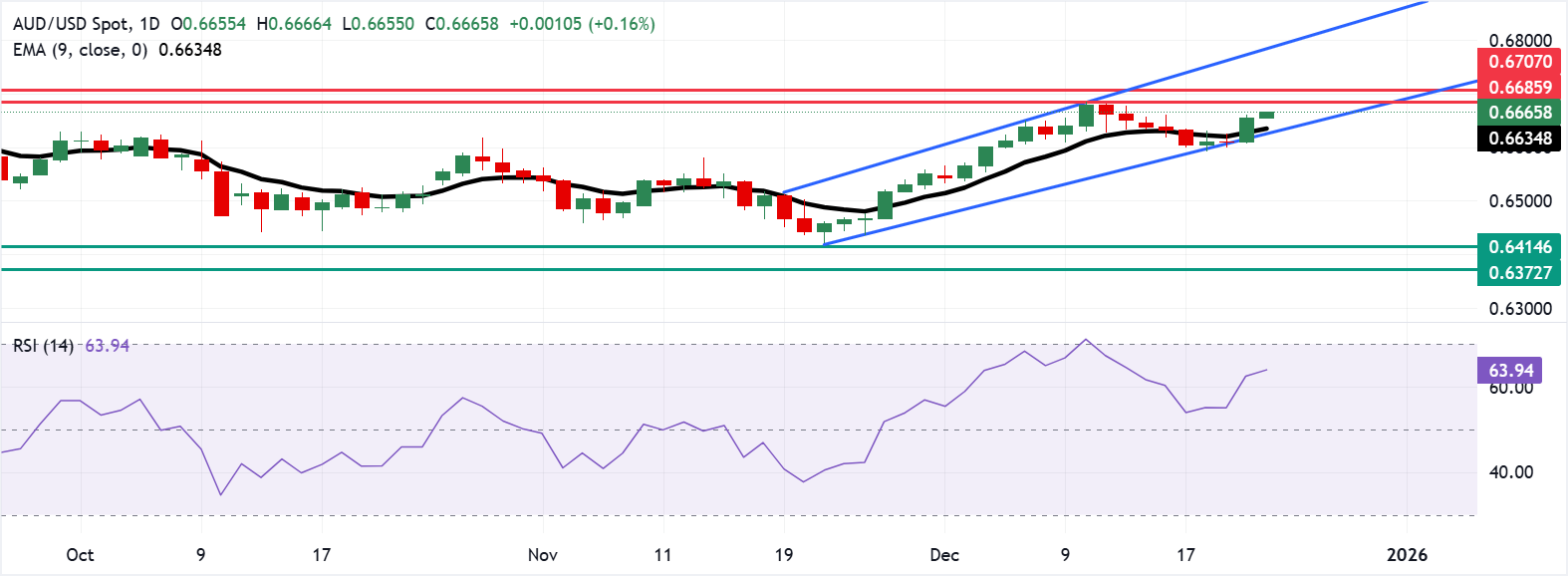
The AUD/USD pair is trading below 0.6660 on Tuesday. The technical analysis of the daily chart shows the pair is rising above the lower ascending channel boundary, indicating the strengthening of a bullish bias. The 14-day Relative Strength Index (RSI) stands at 63.34, reflecting bullish conditions and building momentum.
A successful break above the nine-day Exponential Moving Average (EMA) has improved the short-term price momentum and lead the AUD/USD pair to target the three-month high at 0.6685 and then 0.6707, the highest since October 2024.
On the downside, the immediate support lies at 0.6633, aligned with the lower ascending channel boundary around 0.6630. A break below the channel would expose the six-month low near 0.6414, marked on August 21.
Australian Dollar Price Today
The table below shows the percentage change of Australian Dollar (AUD) against listed major currencies today. Australian Dollar was the strongest against the US Dollar.
| USD | EUR | GBP | JPY | CAD | AUD | NZD | CHF | |
|---|---|---|---|---|---|---|---|---|
| USD | -0.16% | -0.18% | -0.34% | -0.09% | -0.14% | -0.26% | -0.19% | |
| EUR | 0.16% | -0.03% | -0.18% | 0.07% | 0.01% | -0.10% | -0.04% | |
| GBP | 0.18% | 0.03% | -0.17% | 0.10% | 0.04% | -0.08% | -0.01% | |
| JPY | 0.34% | 0.18% | 0.17% | 0.26% | 0.22% | 0.06% | 0.16% | |
| CAD | 0.09% | -0.07% | -0.10% | -0.26% | -0.03% | -0.17% | -0.09% | |
| AUD | 0.14% | -0.01% | -0.04% | -0.22% | 0.03% | -0.12% | -0.05% | |
| NZD | 0.26% | 0.10% | 0.08% | -0.06% | 0.17% | 0.12% | 0.07% | |
| CHF | 0.19% | 0.04% | 0.00% | -0.16% | 0.09% | 0.05% | -0.07% |
The heat map shows percentage changes of major currencies against each other. The base currency is picked from the left column, while the quote currency is picked from the top row. For example, if you pick the Australian Dollar from the left column and move along the horizontal line to the US Dollar, the percentage change displayed in the box will represent AUD (base)/USD (quote).
Australian Dollar FAQs
One of the most significant factors for the Australian Dollar (AUD) is the level of interest rates set by the Reserve Bank of Australia (RBA). Because Australia is a resource-rich country another key driver is the price of its biggest export, Iron Ore. The health of the Chinese economy, its largest trading partner, is a factor, as well as inflation in Australia, its growth rate and Trade Balance. Market sentiment – whether investors are taking on more risky assets (risk-on) or seeking safe-havens (risk-off) – is also a factor, with risk-on positive for AUD.
The Reserve Bank of Australia (RBA) influences the Australian Dollar (AUD) by setting the level of interest rates that Australian banks can lend to each other. This influences the level of interest rates in the economy as a whole. The main goal of the RBA is to maintain a stable inflation rate of 2-3% by adjusting interest rates up or down. Relatively high interest rates compared to other major central banks support the AUD, and the opposite for relatively low. The RBA can also use quantitative easing and tightening to influence credit conditions, with the former AUD-negative and the latter AUD-positive.
China is Australia’s largest trading partner so the health of the Chinese economy is a major influence on the value of the Australian Dollar (AUD). When the Chinese economy is doing well it purchases more raw materials, goods and services from Australia, lifting demand for the AUD, and pushing up its value. The opposite is the case when the Chinese economy is not growing as fast as expected. Positive or negative surprises in Chinese growth data, therefore, often have a direct impact on the Australian Dollar and its pairs.
Iron Ore is Australia’s largest export, accounting for $118 billion a year according to data from 2021, with China as its primary destination. The price of Iron Ore, therefore, can be a driver of the Australian Dollar. Generally, if the price of Iron Ore rises, AUD also goes up, as aggregate demand for the currency increases. The opposite is the case if the price of Iron Ore falls. Higher Iron Ore prices also tend to result in a greater likelihood of a positive Trade Balance for Australia, which is also positive of the AUD.
The Trade Balance, which is the difference between what a country earns from its exports versus what it pays for its imports, is another factor that can influence the value of the Australian Dollar. If Australia produces highly sought after exports, then its currency will gain in value purely from the surplus demand created from foreign buyers seeking to purchase its exports versus what it spends to purchase imports. Therefore, a positive net Trade Balance strengthens the AUD, with the opposite effect if the Trade Balance is negative.
Artigos Recomendados


