


SpaceX Rises Over 2% Pre-Market: Stifel Maintains Buy Rating, $190 Target on AI Data Center Push as 15th Starship Test Flight Nears
TradingKey - On November 9, ET, SpaceX (SPCX) rose more than 2% in premarket trading. Investment bank Stifel reiterated its "Buy" rating on SpaceX and maintained a $190 price target, about 41.5% above its November 6 closing price of $134.27.
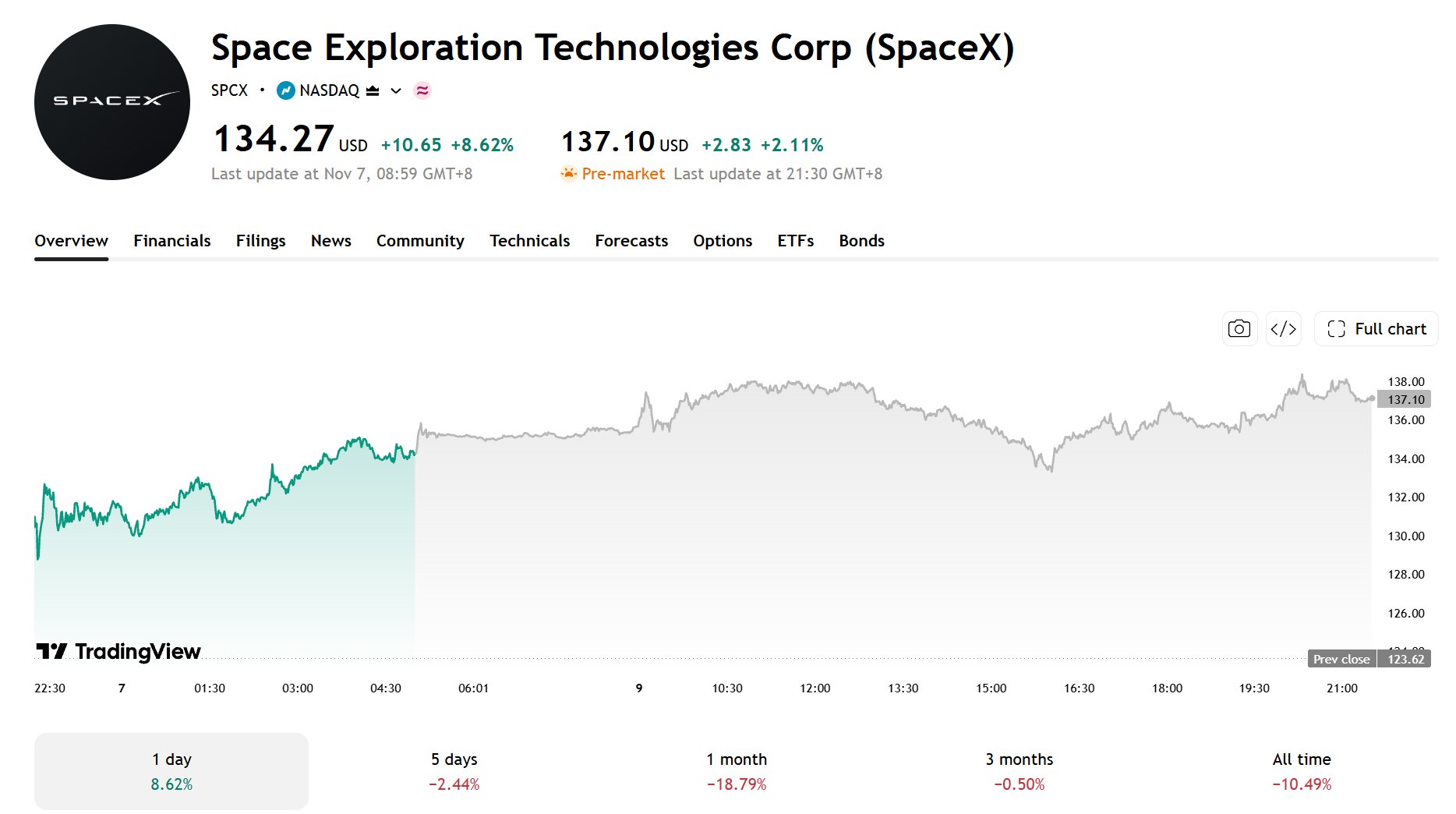
[Source: TradingView]
Stifel analysts believe that following the U.S. midterm elections, some data center projects may be delayed due to stricter approval processes. Leveraging its financing capabilities and GPU procurement arrangements, SpaceX has an opportunity to acquire data center projects that are already connected to power but have stalled in development, thereby expanding its AI computing business.
Stifel Bullish on Data Center Acquisition Opportunities
Following the Texas gubernatorial election, data center approval policies have become a key market focus. Democratic Governor-elect Gina Hinojosa pledged to pause approvals for new data center projects until the state legislature passes relevant protective measures, while requiring companies to bear power infrastructure costs to avoid driving up residential electricity bills.
Stifel analyst Jonathan Siegmann believes that policy tightening could delay some data center projects, especially those that have not yet broken ground and are scheduled to come online in 2028.
For projects that already have power access but have stalled due to permitting or financing issues, SpaceX could shorten construction timelines and accelerate AI computing power deployment through acquisitions.
On the financing front, SpaceX announced on October 26 that it had secured a binding commitment for an approximately $40 billion lease financing facility for GPUs and related equipment, provided by entities managed by Apollo Global Management and involving Nvidia's next-generation Vera Rubin chips.
This is not a $40 billion cash loan, but rather an arrangement where the financiers purchase the GPUs and supporting equipment and lease them to SpaceX. The transaction is expected to close by the end of 2026, with equipment deliveries scheduled to begin in the first half of 2027.
Stifel believes that SpaceX's financing capability and GPU procurement arrangements will help expand its AI computing business, while also creating conditions to acquire stalled data center projects.
However, the company has not yet announced specific acquisition plans, and whether any transactions proceed will still depend on project valuations, power access, and regulatory approvals.
Starship Nears 15th Test Flight, Targets First Two-Stage Recovery
SpaceX plans to launch its 15th-generation Starship from Starbase, Texas, as early as November 13, with a 75-minute launch window opening at 16:45 Central Time, pending regulatory approval.
A major highlight of this test flight is the first attempt to simultaneously catch both the Starship upper stage and the Super Heavy booster using the launch tower's mechanical arms.
Previously, SpaceX had successfully caught three Super Heavy boosters, but has yet to achieve a tower recovery of the Starship upper stage. This will also mark the first tower catch attempt for the V3 Super Heavy booster.
Musk confirmed on X on November 6 that the company will attempt a dual-stage recovery during this flight. If successful, Starship will achieve the first complete return of both stages of an orbital launch system. However, whether the upper stage can return to the launch site still depends on its in-orbit operations and pre-reentry status checks.
The 14th test flight was completed on September 28, during which Starship successfully entered Earth orbit for the first time and deployed 26 Starlink V3 satellites. The 15th test flight is scheduled to deploy 26 satellites again, while focusing on validating the Starship upper stage's orbital operations, atmospheric reentry, and launch-site return capabilities.
If the dual-stage recovery succeeds, it will propel Starship toward full and rapid reusability, which is expected to reduce future launch costs and boost Starlink satellite deployment efficiency, supporting NASA's lunar missions and SpaceX's subsequent space infrastructure plans.
What Should SpaceX Investors Watch Next?
In the near term, investors should watch two developments: first, whether SpaceX can leverage an approximately $40 billion GPU lease-financing arrangement to expand its terrestrial AI computing business and acquire stalled data center projects with power access; second, whether Starship's 15th test flight can obtain FAA approval and achieve its first successful two-stage recovery.
Stifel maintained its Buy rating and $190 price target on SpaceX, noting that the company still possesses growth potential in data center infrastructure, satellite communications, and Starship reusability technology.
However, the data center acquisitions remain at the potential opportunity stage, and Starship's two-stage recovery has yet to be validated through actual flight testing. Subsequent stock performance will depend on the commercialization progress of the AI computing business, returns on infrastructure investments, and whether Starship's technological breakthroughs can translate into tangible commercial value.
Recommended Articles


