


Not AMD. Not Intel. This Is the Artificial Intelligence (AI) Chip Stock Nvidia Should Fear Most.
Key Points
Nvidia dominates the artificial intelligence (AI) data center industry thanks to its roster of GPUs.
AMD and Intel design their own AI GPUs and CPUs that compete with Nvidia's chip architectures.
AI hyperscalers are increasingly investing in custom silicon, a market currently dominated by Broadcom.
- Motley Fool Issues Rare "Total Conviction" Buy Alert ›
Nvidia (NASDAQ: NVDA) has dominated the semiconductor market throughout the artificial intelligence (AI) revolutions. Its graphics processing units (GPUs) are essential infrastructure for companies developing generative AI models.
Naturally, investors are focusing on competitors like Advanced Micro Devices (NASDAQ: AMD) and Intel (NASDAQ: INTC), both of which make their own GPU and CPU architectures. However, I think Nvidia's biggest competitive threat could come from an entirely different direction.
Missed Nvidia in 2009? This Rare Signal Is Flashing Again. In 2009, a "Double Down" signal flashed for a little-known chipmaker called Nvidia. For the first time in years, that same "Total Conviction" signal is flashing for a company 1/100th the size of Nvidia. Continue »
AI hyperscalers are developing their own processors, known as application-specific integrated circuits (ASICs), to reduce costs and optimize performance for particular workloads.
With major customers including Alphabet (NASDAQ: GOOGL) (NASDAQ: GOOG), Meta Platforms (NASDAQ: META), OpenAI, and Anthropic, Broadcom (NASDAQ: AVGO) is emerging as a formidable competitor for future AI infrastructure spending. Here's why smart investors should pay attention.
Image source: Getty Images.
Broadcom is helping Nvidia's biggest customers make their own chips
Nvidia's GPUs are useful because they can handle a wide variety of accelerated computing tasks. However, that flexibility isn't always necessary. Custom ASICs are designed for specific applications, potentially offering better performance per dollar of compute and lower energy consumption for certain workloads.
Broadcom is helping design these specialized processors while also supplying networking technology that connects clusters of chips inside data centers. Let's consider its expanding roster of AI chip customers.
Alphabet is working with Broadcom on its Tensor Processing Units (TPUs), including the seventh-generation Ironwood processor. These chips support Google Cloud and are being deployed for Anthropic. Broadcom expects Anthropic to deploy 5 gigawatts of eighth-generation TPU v8i capacity in 2027, followed by an additional 10 gigawatts in 2028.
Meanwhile, Meta is collaborating with Broadcom on its Meta Training and Inference Accelerator (MTIA) processors. Their partnership extends through 2029, with visibility into 3 gigawatts of deployments through 2028.
Last October, Broadcom and OpenAI announced plans to deploy 5 gigawatts of XPUs by the end of 2028. OpenAI's first processor, code-named Jalapeño, is expected to support 1.3 gigawatts of deployments in 2027.
These relationships show how Broadcom isn't simply competing for isolated semiconductor contracts. The company is becoming an important partner for world's largest AI developers.
Broadcom's AI revenue could become a problem for Nvidia
Broadcom's financial results suggest demand for custom silicon is accelerating. During the company's fiscal third quarter (period ended Aug. 2), AI semiconductor revenue more than tripled year over year to $16.7 billion. Custom chips accounted for roughly 73% of that total.
Management guided for AI semiconductor revenue to reach $21.7 billion in the fourth quarter. The longer-term projections are even more impressive. Broadcom expects AI semiconductor revenue to reach roughly $115 billion in fiscal 2027 and potentially double to $230 billion in fiscal 2028.
This is where it gets challenging for Nvidia. As AI adoption accelerates, developers are increasingly focused on inference, the process of using trained models to generate responses and perform tasks.
Specialized processors can be attractive for repetitive inference workloads because they are designed around specific requirements. As a result, custom silicon could become a growing market that competes with Nvidia's GPUs in data center budgets.
Semiconductor sell-off: Buy the dip in Broadcom stock
The investment thesis here becomes compelling once you consider Broadcom's valuation. As of this writing (Nov. 6), Broadcom stock trades around $294, representing a 39% decline from its all-time high. Broadcom stock now trades at a forward price-to-earnings (P/E) multiple of 15, its cheapest level since the AI revolution began.
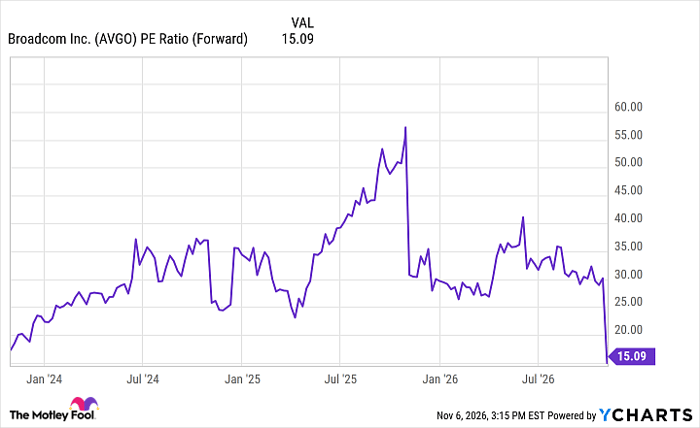
AVGO PE Ratio (Forward) data by YCharts
I think Broadcom's valuation profile looks reasonable given management's robust expectations for AI semiconductor growth in fiscal 2027 and 2028. Moreover, the company's business extends beyond custom processors. Broadcom also specializes in Ethernet switching, optical connectivity, and other networking technologies that are essential for connecting AI accelerators.
On a deeper level, this means Broadcom can actually benefit from expanding AI infrastructure even when customers continue purchasing Nvidia GPUs. This means Nvidia doesn't actually need to lose its dominance for Broadcom to become a winner in the AI chip market. Rather, Broadcom simply needs more hyperscalers to decide that designing their own silicon makes economic sense.
Based on its customer relationships and revenue outlook, that transition appears to be gathering momentum. For long-term investors looking for alternatives to Nvidia, Broadcom deserves serious consideration.
Should you buy stock in Broadcom right now?
Before you buy stock in Broadcom, consider this:
The Motley Fool Stock Advisor analyst team just identified what they believe are the 10 best stocks for investors to buy now… and Broadcom wasn’t one of them. The 10 stocks that made the cut could produce monster returns in the coming years.
Consider when Netflix made this list on December 17, 2004... if you invested $1,000 at the time of our recommendation, you’d have $341,966!* Or when Nvidia made this list on April 15, 2005... if you invested $1,000 at the time of our recommendation, you’d have $1,146,819!*
Now, it’s worth noting Stock Advisor’s total average return is 852% — a market-crushing outperformance compared to 203% for the S&P 500. Don't miss the latest top 10 list, available with Stock Advisor, and join an investing community built by individual investors for individual investors.
See the 10 stocks »
*Stock Advisor returns as of November 9, 2026.
Adam Spatacco has positions in Alphabet and Nvidia. The Motley Fool has positions in and recommends Advanced Micro Devices, Alphabet, Broadcom, Intel, Meta Platforms, and Nvidia. The Motley Fool has a disclosure policy.
Recommended Articles


