


Alphabet Plans Up to $3 Billion Asia Bond Sale as AI Funding Pressure Draws Focus, Shares Rise Over 1% Pre-Market
TradingKey - Google parent Alphabet (GOOGL) is considering further expanding its global financing channels. According to Bloomberg on November 9 citing people familiar with the matter, the company has recently approached banks and potential investors to evaluate the feasibility of issuing Hong Kong dollar- and Singapore dollar-denominated bonds, with transactions potentially launching as early as this month.
In U.S. premarket trading on Monday, Google rose over 1% to trade at $290.06.
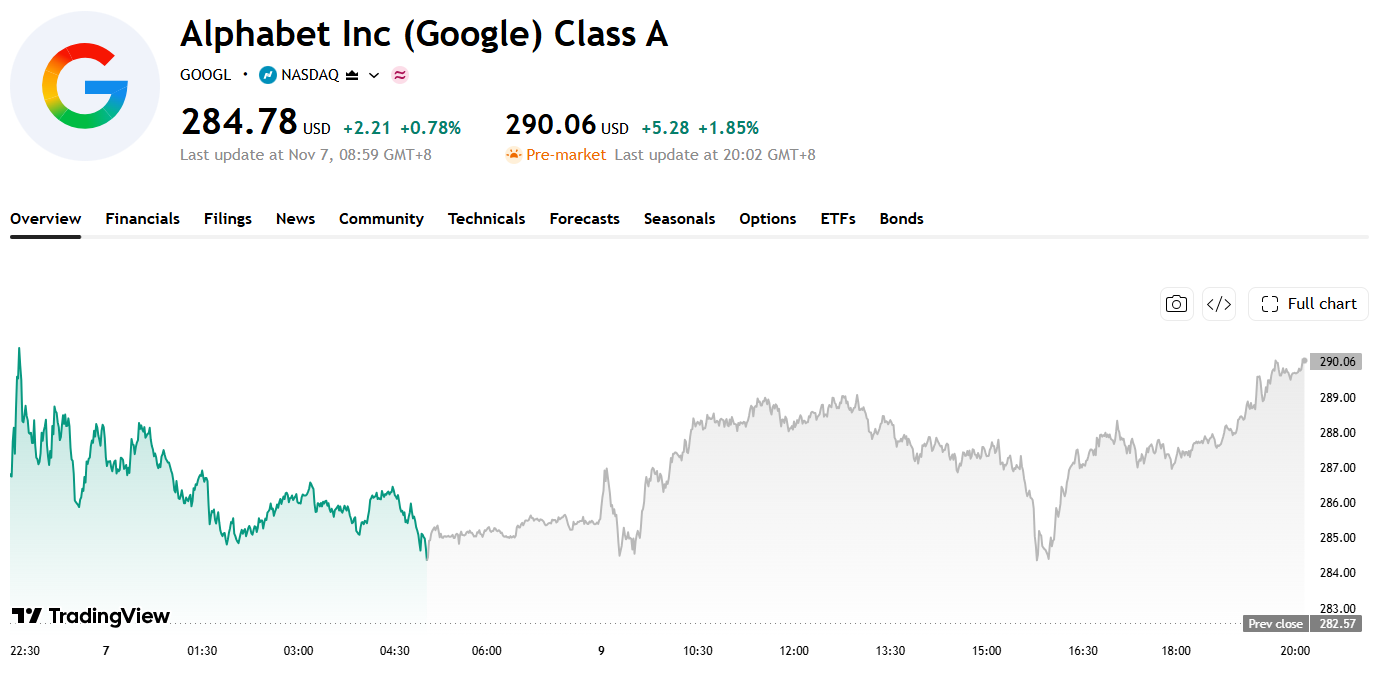
Source: TradingView
Under the plan currently under discussion, the Hong Kong dollar bond offering would raise about $1 billion to $1.5 billion, while the Singapore dollar bond is expected to raise around $1.5 billion, bringing the combined total of the two deals to between $2.5 billion and $3 billion. The proceeds are intended for general corporate purposes, but discussions are ongoing, and the final size, tenor, and timing could still be adjusted depending on market conditions.
If completed, the deals would mark Alphabet's debut in the Hong Kong dollar and Singapore dollar bond markets. So far this year, the company has successively tapped markets across euros, British pounds, Japanese yen, Canadian dollars, Australian dollars, and Swiss francs, steadily broadening its investor base and reducing reliance on any single-currency funding channel. Turning to Asia at this juncture also signals Alphabet's intention to test Asian institutions' appetite for mega AI investment projects as credit spreads for European and U.S. tech companies widen.
Last week, Alphabet completed a 6 billion euro (roughly $6.7 billion) bond offering spanning floating- and fixed-rate tranches with maturities ranging from 2 to 19 years. Order books exceeded 17 billion euros, indicating that market demand remains intact. However, the company's borrowing costs rose notably compared with May. Taking the bond maturing in 2045 as an example, its issue spread reached mid-swaps plus 185 basis points, widening by about 60 basis points compared with similar long-dated bonds in May, reflecting investors demanding higher risk premiums.
Alphabet's frequent taps of the bond market are closely tied to its rapidly escalating investments in AI infrastructure. In the third quarter, the company's capital expenditures reached $51.4 billion, while free cash flow dropped to negative $9.1 billion, and it maintained its full-year 2026 capex guidance of $195 billion to $205 billion. Management also anticipates that spending will increase significantly further in 2027. With spending on data centers, servers, networking equipment, and custom in-house chips continually expanding, the company's long-term debt had grown to $125.1 billion as of the end of September, compared with just $21.6 billion a year earlier.
Despite Alphabet's massive advertising and cloud computing businesses, cash flow pressures have begun weighing on market valuations. Following the release of its third-quarter earnings report, investors shifted their focus from top-line growth to capital expenditures and funding requirements, sending the stock down more than 12% the following day in its steepest single-day drop since going public. This also means that even with growth in its core businesses intact, the company must still prove that its massive AI investments can deliver returns down the road sufficient to cover buildout costs.
As Alphabet plans its Asian bond offerings, the financing environment across the tech sector is tightening. Amid recent concerted selloffs in AI-related stocks, risk aversion has gradually spilled over from equity markets to credit markets. Over the past month, credit default swap (CDS) spreads for Nvidia (NVDA), Broadcom (AVGO), and Amazon (AMZN) have all widened notably, while the cost of debt default protection for Oracle (ORCL) has also remained at elevated levels.
Recommended Articles


