


Tech Stock Sell-Off: This Could Be the Most Powerful Reason to Buy Bonds Right Now
Key Points
After a yearlong rise in bond yields, now could be a good occasion to buy bonds to protect some of your portfolio from the risk of a stock market crash.
During the recent tech stock sell-off in October, Treasury yields dropped -- showing that U.S. Treasury bonds are still serving as a “safe” alternative to stocks.
Bond prices fell in 2022 along with stocks, but that might not happen again in the next bear market.
- These 10 stocks could mint the next wave of millionaires ›
What a difference a few weeks make on Wall Street. Earlier this month, artificial intelligence (AI) stocks experienced a sudden sell-off. The tech-heavy Nasdaq-100 declined by about 6.5% between Oct. 6 and Oct. 16. Some of the biggest share price declines were among semiconductor stocks and other companies involved with supplying the build-out of AI data centers worldwide.
Tech stocks have recovered slightly over the past few days since Oct. 16, but many investors remain nervous about the AI trade. What if AI companies are borrowing too much money? Will major AI hyperscalers keep spending hundreds of billions of dollars on AI capital expenditures? And if they do, will those investments pay off at a high enough level to justify the cost?
Missed Nvidia in 2009? This Rare Signal Is Flashing Again. In 2009, a "Double Down" signal flashed for a little-known chipmaker called Nvidia. For the first time in years, that same "Total Conviction" signal is flashing for a company 1/100th the size of Nvidia. Continue »
If you're uneasy about the AI boom and want to diversify your investment portfolio, now could be a good time to buy bonds. Bond yields have risen in the past year to over 5% on the most-watched U.S. Treasury bonds. Higher bond yields are sometimes a sign of a looming slowdown in the stock market. But they can also be an opportunity to protect some of your money if bonds become a "safe haven" during the next stock market crash.
Let's look at why the recent tech stock sell-off gave investors a powerful reason to buy bonds.

Image source: Getty Images.
Bonds: Once again a "safe haven" from stocks?
One of the classic rules of thumb in investing is that bonds and stocks perform differently. This is called negative correlation. When stock prices go up, bond prices tend to go down (as bond yields go up).
Rising stock market prices are a sign of a fast-growing economy. Rising share prices make fixed-income bond investments less competitive, and bond issuers have to pay higher interest rates to investors to compensate.
But when the economy slows, or the stock market crashes, high-quality bonds (such as U.S. Treasury bonds) have traditionally offered a "safe haven" relative to stocks. A slowing economy or a shaky stock market signals to investors that stocks are riskier than usual and that companies are less likely to generate high enough earnings to justify those risks. Often, when stock prices go down, bond prices go up.
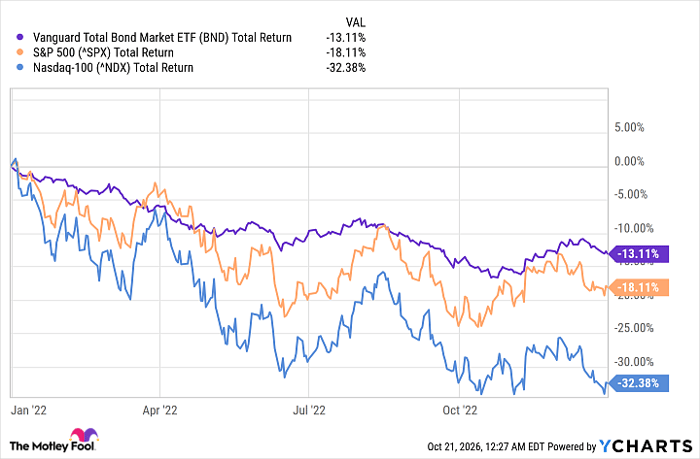
This doesn't always happen. It didn't work out that way in 2022, during the most recent bear market in stocks. The S&P 500 (SNPINDEX: ^GSPC), Nasdaq-100, and Vanguard Total Bond Market ETF (NASDAQ: BND) all delivered negative returns that year.
Data by YCharts.
2022 might have been a special case; that year, the Federal Reserve was hiking interest rates aggressively, which is bad for bond prices. But recent trends have made some bond investors question whether bonds are still "negatively correlated" with stocks.
If stocks and bonds rise and fall together, that could reduce the value of buying bonds as an easy way to diversify your investment portfolio. If so, there might be nowhere to hide during the next stock market crash.
Good news: Signs of bonds as a "safe haven"
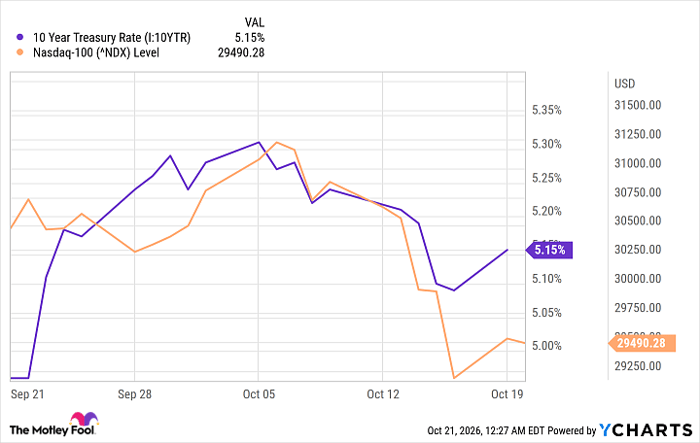
Fortunately, the recent tech sell-off might be sending a more hopeful message about the value of bonds as a safe haven from stocks. The chart shows how the Nasdaq-100 has performed over the past month compared with the 10-year Treasury bond yield. Look at what happened starting Oct. 5, when both levels peaked:
Data by YCharts
When the Nasdaq-100 started to decline, the U.S. 10-year Treasury bond yield declined, too -- meaning bond prices rose. This is a sign that U.S. Treasury bonds could serve as a meaningful "safe haven" in the event of a tech stock sell-off. There seems to be a "flight to safety" happening, with investors fleeing risky stocks and buying safer bonds. This didn't happen in 2022, when bond and stock prices both fell.
Why buy bonds?
This recent 6.5% sell-off in tech stocks is a good reminder of the concentration risks of a top-heavy, tech-heavy stock market. Now could be a great time to diversify your portfolio with bond ETFs. According to Bloomberg reporting from Oct. 15, a strategist from J.P. Morgan said, "Government bonds can both help to rebalance portfolios and offer a genuine way to diversify this concentration risk" in equities.
One of the best bond ETFs is the Vanguard Total Bond Market ETF. It lets you own a mix of 11,434 high-quality bonds, such as Treasury bonds and investment-grade corporate bonds, at an ultra-low expense ratio of 0.03%.
The past few years have been tough for bond investors, but the future might be a lot brighter. Based on what we've seen in October bond yields, if the stock market crashes, bonds might perform better than they did in 2022. Now that investors can buy bonds at yields of 5% or higher, there is more room for yields to fall (if the economy slows or goes into a recession) and for bond prices to rise.
Missed Nvidia in 2009? This Rare Signal Is Flashing Again
In 2009, a "Double Down" signal flashed for a little-known chipmaker called Nvidia. If you’d invested $5,000 then, you’d be sitting on $2,758,512 today.*
Now, for the first time in years, that same "Total Conviction" signal is flashing for a company 1/100th the size of Nvidia. It’s a key player in the $1.8 trillion space race, and with the stock recently sitting 20% off its highs, the window to get in early is closing fast.
Continue »
*Stock Advisor returns as of October 24, 2026.
Ben Gran has positions in Vanguard Total Bond Market ETF. The Motley Fool has positions in and recommends Vanguard Total Bond Market ETF. The Motley Fool has a disclosure policy.
Recommended Articles


